A while ago I discovered this artist, Thomas Deininger, who intrigued me. I am highly allergic to bee stings, but I like the little busy insects.
So my museful perambulations made me realize that there is a paradox in their behavior. While bees trust their hives completely, their lives are lonely and selfless, and create a tapestry of collective nurturing out of a solitary endeavor. Somewhere, once, I read about striking the balance between individual sacrifice and communal benefit.
When I was targeted by a single bee that caused me so much pain, I realized, somewhat with glee, that AHAH! the little monster had met its well-deserved demise. I felt the same when I removed gazillion bee stingers from my dogs’ floppy ears and snouts.
But then I wrote a little story on bees for my grandchildren, and came to the realization that those little bees had died away from their hive, leaving those barbed stingers in their victims or perceived enemies, but having their little abdomens torn in the process. From the buzzing life of their hive to the solitude of their lonely death, what an end nature’s harsh cycle bestows.
At the end of the day, isn’t that the crux of our lives?
And then I came across this little bee below. Many times, things are just not what they appear to be… first appearances can be deceiving. (Plato, right?).
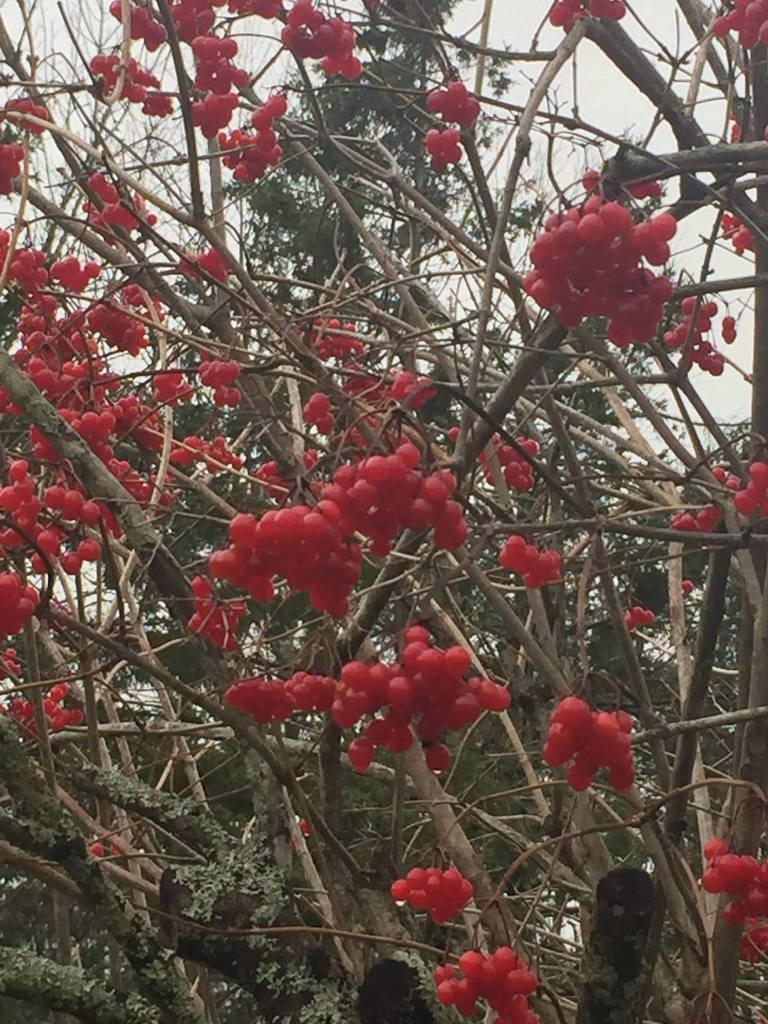
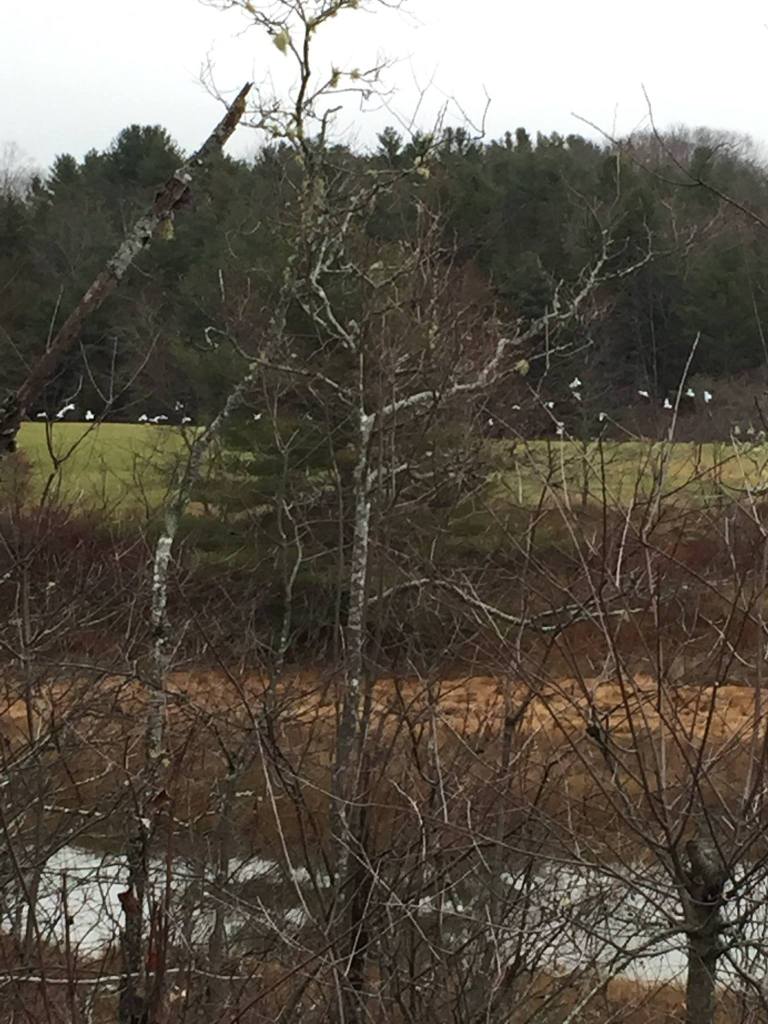
A lifetime ago, November 30, 2016, it was a bit gloomy in Maine. A few berries still sparkled, Millie was a pup having fun with the apples, and a bunch of snow geese were flocking around a little inlet. Millie is older, and other than the pine tree by the water that has grown taller and taller, not much has changed.
I watched a movie the other night about an old man and his daughter, and someone in it quoted this little poem by Edna St. Vincent Millay, which came back to mind as I saw the geese, Millie, and the dormition of the landscape, which lacked a lovely light:
My candle burns at both ends;
It will not last the night;
But ah, my foes, and oh, my friends
—It gives a lovely light!
I realized I had never studied Millay’s poems, and curiosity made me search. I came across one in particular that struck me as providential, and made me think of the magnificence of the rebirth of Notre-Dame de Paris by mere mortals.
Because while it had burnt like a candle, at both ends, I thought how sad it was to see it turn to rubble, or a lonely grave. But just a few years later we are witnessing its majestic “renascence”, a fitting word that the poet reflected on.
All my musings in an hour, all because of a few melancholy and unartistic photos. Go figure. And all because of a little poem!
Ever since I was a little girl I have been enthralled with etymology. Maybe it was studying Latin, which I had to learn in school in Argentina, when I was around 10…for 3 years! I was sick and tired of all the “hic haec hoc” and “amo amas amat” and all the declensions that we had to repeat by rote. It was bad enough to learn Spanish and English verbs. Life seemed complicated then.
All that effort paid off my Senior year of High School in the US. I happened to use the word “triturate” with one of my teachers, and he bet me a steak dinner that it did not exist. I knew I had him. He challenged me in front of many classmates, so I accepted the bet. He went to the dictionary and BINGO I had won. (He never had to deliver on the bet since I ended up leaving the school a few weeks later).
Fast forward to my attempts to communicate in Russian. When I was desperate, I would take a word with a Latin base and give it a Russian accent, and again, BINGO, most times the Russians would understand because there are many Latin-based words adopted into Russian. A few decades later, it was Cyrillic that helped me read menus and train station signs in Greece, so I could maneuver a little and not be a bumbling fool. It came in useful to find the entry and exit signs.
So, recently, I was reading some obscure article, that led me to a fascinating discovery. Well, for me. I know. My mind works in convoluted ways.
It turns out that metabolism, ballistic, emblem, hyperbole, embolism, parable, problem, all these words stem from the Greek word “diaballein”. Same with symbolic -which means to bring together- and diabolic, which comes from “diabolos”, or to tear apart. “Diabolos” is derivative of “diaballein”, which means to throw, scatter, rend asunder, hence the origin of the word “devil”, that derives from “diabolos”.
I am contemplating either getting a Greek/English dictionary just for fun, or spending some time learning Greek. After all, I’m at that stage in my life where they do recommend that you exercise your brain to keep it from atrophying. I certainly can identify with Mr. Portokalos!
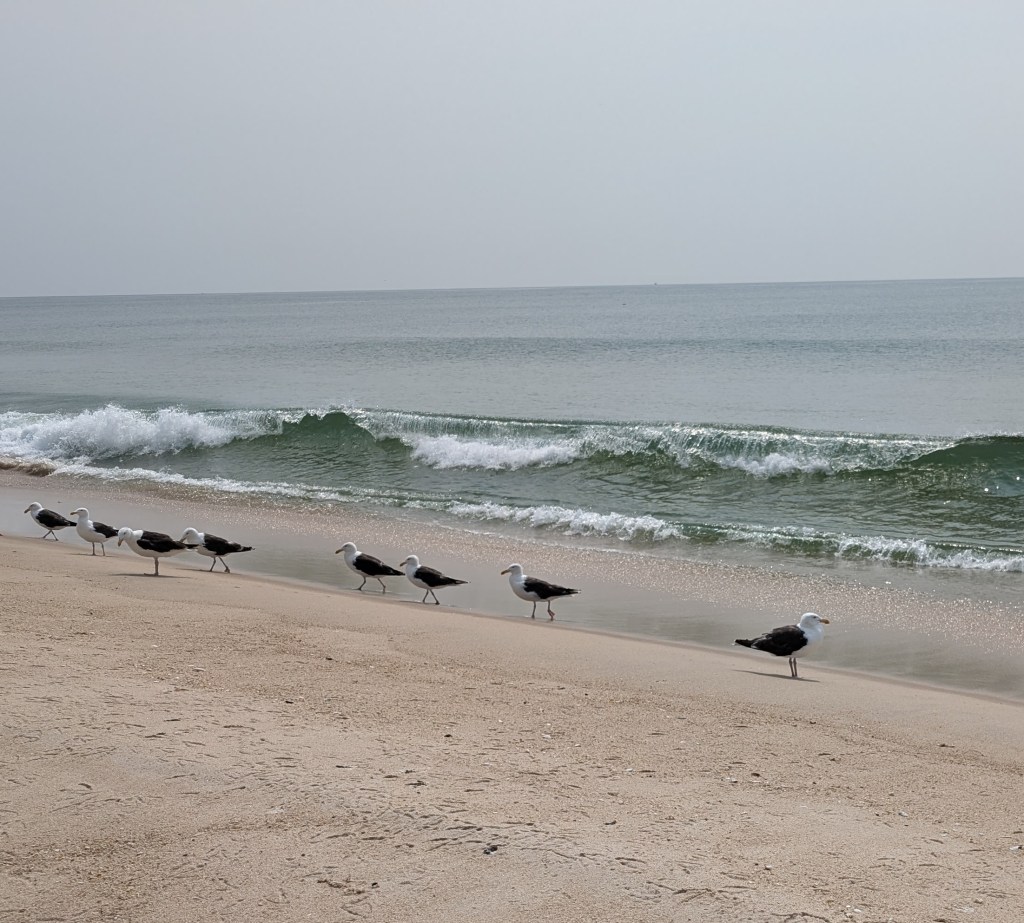
One day this summer marked a special series of milestones of mythological proportions in my life: for the first time ever, like this vigilant seagull, I was perched completely on my own, staring at a monumental decision that only affects me…no parents, no spouse, no siblings, no children, no grandchildren, no in-laws, no neighbors, no friends, no teachers, no professors, no dogs, no horses, no lambs, no governments, no embassies, no colleagues, no employers, no contractors, no priests nor priestesses, no nothing!
One of my brothers said, “Wow, go get a gerbil!”
I wonder how many philosophical essays have been written while pondering the uniqueness of making such types of decision? After all, to quote Robert Louis Stevenson,
“Everyone, soon or late, sits down to a banquet of consequences.”
You don’t just reap what you sow. You also sow what you reap.
Spending some time in one of the most beautiful beaches around, I came across a colony of seagulls. They didn’t fly away as I walked by. And they gave me food for thought. As I am delving into the Russian authors, I took this photo and thought of Fyodor Dostoevsky:
“Oh, how hard it is to be the only one who knows the truth!”
The more I walked, the more my lovely colony of seagulls made me reflect. Aesop came to mind.
By the way, I didn’t take the shunning personally!!!!!
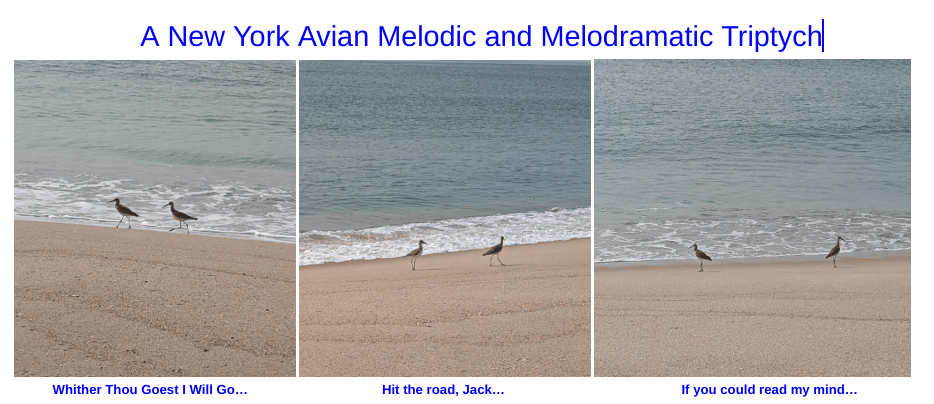
The next day I remembered the New York Avian melodrama above. She flew the coop. Or did she?
I had long forgotten a delightfully illustrated thin book that I used to read and sing to my children, many moons ago. It told the story of the Gitchy Manitou.
Ah, the cobweb tendrils of my life never cease to amaze me. I’ve had Québec on my mind for the last couple of months, because it is such a most beautiful city, rich in history, and so near to where I live.
The Sunday before Thanksgiving, I sat in a cold church, and, in the middle of the service, I heard the organist begin a song. The words and the melody tugged at my memory: “‘Twas in the moon of wintertime, When all the birds had fled…” I looked at the program and there it was, The Huron Carol.
The lyrics of the first Christmas Carol of North America are short and tell a story. For some it’s a meaningful story. For others it’s just a tradition that had consequences, bad and good.
However, for me, it was fascinating to discover that the author of this ancient Carol was a French Jesuit priest who hailed from Normandy. Jean de Brébeuf lived among the Hurons and is recognized as someone who produced so many ethnographic records on the Hurons that his efforts were pivotal in preserving the Huron (Wendat) language. His accounts were included in a collection of documents referred to as The Jesuit Relations, which are considered an important historical resource. He actually wrote a dictionary, among other things.
Brébeuf paid a dear price for being a missionary. All accounts (at least the ones I have read) point to his love for the Hurons. The Hurons’ archenemies were the Iroquois, who destroyed Huronia. Yet even the Iroquois were so impressed at his bravery in the face of excruciating torture that they ate his heart in a symbolic recognition of his fortitude. Or so they say. History is not pretty. But I can’t help but admire someone who took the time to study and create something that has been acknowledged as a legacy.
In my love of etymology, lo and behold, I discovered that Jean de Brébeuf wrote about a game being played among the Hurons in 1636 and it was he who named the game “lacrosse”, because the stick reminded him of a bishop’s shepherd’s staff or crozier.
The Huron Carol, or Jesous Ahatonhia, beautifully illustrated by Frances Tyrrell, was published in 1991, and sometime soon, after that year, my Mother gave it to my children for Christmas. They loved the story and the drawings. It was a gentle introduction to a far away land with familiar concepts.
At the time, little did my Mother know how one day, 25+ years, a little protestant church in the Blue Hill peninsula of Maine would spark memories of little children, pretty songs, tender memories of Québec, dictionaries and saints.
The below video was a joint production of the Aboriginal People’s Television Project and the CBC Radio Canada. It aired in 2002.
“In the time of my confession…” I identify with these words, after all the Dostoevsky, Dante, Solzhenitsyn, Cervantes, Becquer and others I have dabbled in these last 6 months.
At the sunset of my life, I find a need to hurry and catch up with what I have missed because of all the excuses I have ever had in front of me: lack of time, busy at home and at work, demands of others, acedia, inertia, melancholy, whatever!
And in hurrying to catch up I discovered that “I hear the ancient footsteps like the motion of the sea; sometimes I turn, there’s someone there, other times it’s only me…”
But serendipity is my companion, and I discover something new each day that gives me clarity of purpose, clarity of vision, clarity of understanding.
Like yesterday, when I was researching about Chorales and sacred music and trying to pin the correct biblical passages to the words. This is how my mind works.
And where did I land in this cacophony of beautiful music and lyrics? On a lamentation I had never heard of, sung by Bob Dylan, in that raspy voice that I have never quite liked! (I know, I know, unbelievable, right? Laugh. It’s true.) But today, I finally learnt to appreciate the poignancy of his voice.
Last night, I looked up to a black sky, peppered with stars, and one just fell down not too far from my horizon. It was a long and vivid wishing star, and I was thankful for:
– my living family,
– my long departed family,
– old loyal, trustworthy, real and compassionate friends,
– gentle and kind and empathetic new friends,
– a young car mechanic who spent time helping me just because, pro bono,
– a young professional who didn’t know me from Adam but reached out to guide me,
– an old man with tears in his eyes who gave me his shaking shoulder to lean on,
– a little boy who presented me with his dearest friend, Curly the Tarantula,
– a teenager who gave me her advice on affairs of the heart,
– my two loyal pups who have never ever failed me, Milly and Thibault,
– my “rock of Gibraltar” and best buddy who helps me decipher life’s labyrinths.
So much to be grateful for… Happy Thanksgiving to all of you. May you so be blessed as well.
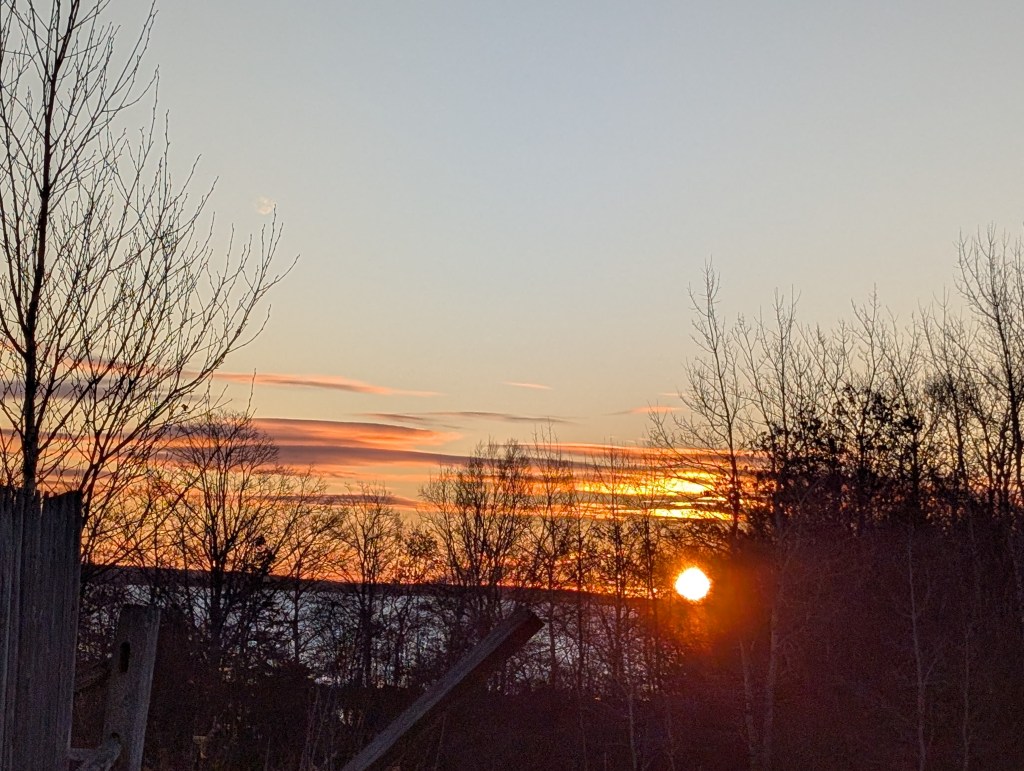
I woke up today to the view of 2 circles: the rising sun and the lingering moon. I thought of that carousel of life, the circle game. So I pondered about a washing machine, that I watched -mesmerized- the other day.
Why? Because it kept spinning right about two circles, but kept twirling left about 3 times, and then turning right again another 2 circles. And on and on for half an hour.
My mind was spinning as well, as I was reading yet about another circle (Solzhenitsyn’s In The First Circle), and reflected about my own life that sometimes has spun forward once or twice, and then backwards three or four times! And on and on.
For some reason, when I went back to read, the pages had flipped back to the beginning, to the Russian author’s note. I was struck with what he said about his novel,
“ In order to give it even a feeble life, to dare show it, and to bring it to a publisher, I myself shortened and distorted it—or, rather, took it apart and put it together anew, and it was in that form that it became known. And even though it is too late now, and the past cannot be undone—here it is, the authentic one. By the by, while restoring the novel, there were parts that I refined: after all, I was forty then, but am fifty now.”
Well, we cannot change our past, but old age gives us a chance to refine it! Of course, with some caveats. I do believe in karma, so you can’t really go quite “tabula rasa”.
That washing machine day happened to be my Father-in-Law’s birthday. He would have been 102 years old. He died at 70, way too young nowadays. So, looking at today’s circles on a beautiful morning, I thought of him, and the other old dead relatives of mine, and how strange the whole cycle of life is. Nasty surprises always await around a corner.
I am reminded of my poor Father who at 77 years of age went to buy his New York Times early one morning, strolling down his favorite sidewalk in his little town, only to be hit by an out of control Mercedes Benz, and ended up seriously injured for almost half a year. His big thick head cracked the windshield, and the totaled car cracked his bones. Yet, he recovered and lasted another 10 years.
One never knows when we will get either clobbered and wiped out, or get the news that our days are numbered.
The other day I took my dogs for a walk, and they instinctively went chasing after a flock of little white birds, and made me fall and dragged me a few inches. I didn’t break anything, but it was quite a wake up call. As my younger brothers jokingly said, “well, this is how it all starts, right? A broken bone that doesn’t heal and then POOF, that’s it!”. Never fails to have younger brothers with a macabre sense of humor.
I have always been attuned to serendipity, and lo and behold, I am reading various articles this morning, after my encounter with the circles, and came across a Psalm I had never read, and one section stood out:
“Seventy is the sum of our years,
or eighty if we are strong,
and most of them are fruitless toil,
for they pass quickly and we drift away” (Ps 90:10)
Old age, the carousel of life, the circle game, the fruitless toils, the alpha and the omega, birth and death, the seasons in between, the sun and the moon on a glorious Maine Sunday morning. Life is beautiful!
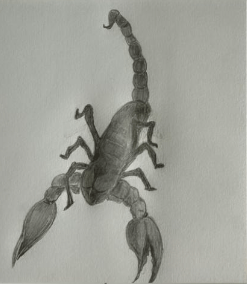
Ah, the scorpion as rendered by my talented sister Cynthia Dillon. Poor creature, it does not enjoy good fame. It has always been maligned, but, as the story goes, he can’t help himself. It stung the frog because it was his nature. The Smithsonian has a charming tango between 2 scorpions engaging in a mating ritual. Fun to watch.
However, some female scorpions will give the macho tango dancer a final coup de grâce, so to speak. Which brings to mind a few not-so-nice references to the arachnid:
Macbeth’s “O, full of scorpions is my mind, dear wife…” and Percy Bysshe Shelley’s “Falsehood is a scorpion that will sting itself to death.”
THE SCORPION, by Hilaire Belloc

The Scorpion is as black as soot,
He dearly loves to bite;
He is a most unpleasant brute
To find in bed at night.
THE SCORPION, by Roald Dahl

...The scorpion's name is Stingaling,
A most repulsive ugly thing,
And I would never recommend
That you should treat him as a friend...
Always marvel at nature, and how it can fool you! Because I used to think peepers were night time birds, I was the cause of a lot of mirth. When you are in unfamiliar territory, anything goes.
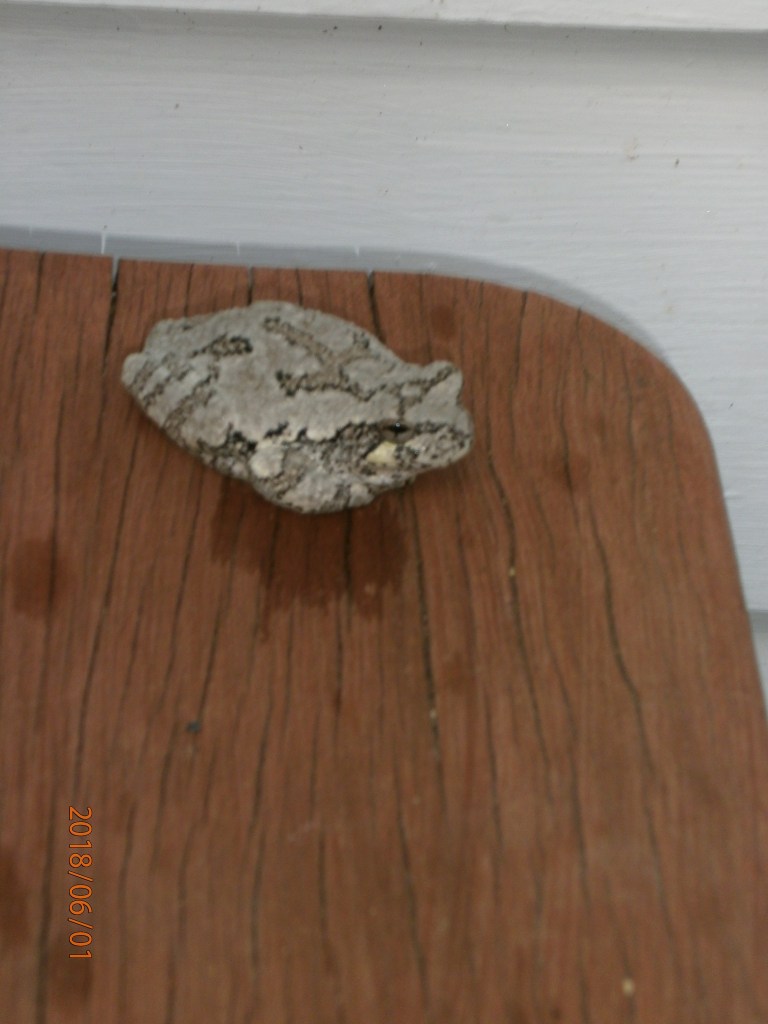
Which leads me to this blob below, that I thought was a marvelous stone/big pebble, that someone had placed on an outdoor table. I observed it, tried to pick it up, didn’t get close enough, it jumped and re-settled, and gave me enough of a shock but plenty of time to take the photo.
I woke up this morning to learn about psychological manipulations and how to re-wire brains, all in the context of computers, algorythms, robots, zombies, religion, the military, PTSD, survival, old age, trauma, chameleons, hospitals, internal organs, and disease.
This is too much fun for me, so I have to dig in and find the common link. And all because of a disguised rock that was, what, a “stone” frog? A “tree” frog?