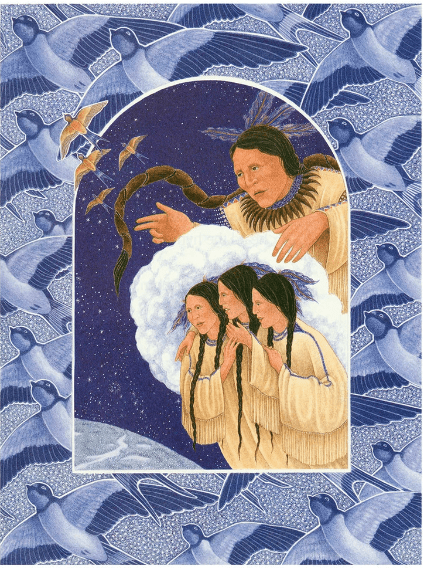
I had long forgotten a delightfully illustrated thin book that I used to read and sing to my children, many moons ago. It told the story of the Gitchy Manitou.
Ah, the cobweb tendrils of my life never cease to amaze me. I’ve had Québec on my mind for the last couple of months, because it is such a most beautiful city, rich in history, and so near to where I live.
The Sunday before Thanksgiving, I sat in a cold church, and, in the middle of the service, I heard the organist begin a song. The words and the melody tugged at my memory: “‘Twas in the moon of wintertime, When all the birds had fled…” I looked at the program and there it was, The Huron Carol.
The lyrics of the first Christmas Carol of North America are short and tell a story. For some it’s a meaningful story. For others it’s just a tradition that had consequences, bad and good.
However, for me, it was fascinating to discover that the author of this ancient Carol was a French Jesuit priest who hailed from Normandy. Jean de Brébeuf lived among the Hurons and is recognized as someone who produced so many ethnographic records on the Hurons that his efforts were pivotal in preserving the Huron (Wendat) language. His accounts were included in a collection of documents referred to as The Jesuit Relations, which are considered an important historical resource. He actually wrote a dictionary, among other things.
Brébeuf paid a dear price for being a missionary. All accounts (at least the ones I have read) point to his love for the Hurons. The Hurons’ archenemies were the Iroquois, who destroyed Huronia. Yet even the Iroquois were so impressed at his bravery in the face of excruciating torture that they ate his heart in a symbolic recognition of his fortitude. Or so they say. History is not pretty. But I can’t help but admire someone who took the time to study and create something that has been acknowledged as a legacy.
Brébeuf became one of the patron saints of Canada, and, as far as I know, he still remains one, despite modern-day criticisms of how he described some of his encounters with the Hurons.
In my love of etymology, lo and behold, I discovered that Jean de Brébeuf wrote about a game being played among the Hurons in 1636 and it was he who named the game “lacrosse”, because the stick reminded him of a bishop’s shepherd’s staff or crozier.
The Huron Carol, or Jesous Ahatonhia, beautifully illustrated by Frances Tyrrell, was published in 1991, and sometime soon, after that year, my Mother gave it to my children for Christmas. They loved the story and the drawings. It was a gentle introduction to a far away land with familiar concepts.
At the time, little did my Mother know how one day, 25+ years, a little protestant church in the Blue Hill peninsula of Maine would spark memories of little children, pretty songs, tender memories of Québec, dictionaries and saints.
The below video was a joint production of the Aboriginal People’s Television Project and the CBC Radio Canada. It aired in 2002.
 Dum Spiro Spero