“Corans brûlés”… I read the title doing a Google search, and, for an instance, found it amusing. For a fleeting moment, the term conjured up pleasant, sweet images. Yet, thanks to the “Corans brûlés” we had been on “lockdown” for a couple of days.
Life in Afghanistan, which, according to all expats I had spoken with, could be tediously monotonous, had the capacity of changing course in a blink. I was happily ensconced in our working compound, researching away, when word came out that the Security office of the US Embassy was enforcing a lockdown because it had been told the Korans had been burnt in one of our bases there.
It was odd, traipsing to our SUVs and starting the trek back to our living quarters. All of a sudden, I kept looking at the people standing on the sides of the roads with trepidation. The men one saw on those same roads, carrying weapons, who were they? Presumably, they were policemen. But who were they meant to protect?
We hit some traffic, but all went well.
The next day, the American and international advisors were all ready to leave to our work compound by 7:15AM, but by 9:30AM it became obvious we were not going anywhere (we followed what the US Embassy dictated). So we all stayed in our gilded cages, working from our rooms.
Yet, all the classes for Afghan judges, prosecutors, defense lawyers, and criminal investigators were still being held inside our compound, and all our Afghan staff (instructors, justice advisors, cooks, char force) was still there. The irony of our work environment and the monumental dangers these Afghans faced did not escape me and I marveled at their dedication and strength of spirit.
By the end of the day we knew that the compound called Green Village, where a large group of contractors and other foreigners lived (and where we had been the week before), had been accosted – so much so, that apparently the residents had to stay in the concrete bunkers for a while.
But our own Camp X had been calm, probably because it was right next door to the airport and the airbase out of which US military and State Department flights took off. The areas in my Camp containing what I thought were excess concrete dividers turned out to be where the bunkers had been set up to protect us. There had been no need to use these bunkers until that day.
The previous day, for some strange reason, they had lifted lockdown for a while, so that we ended up going to the office (even though all travel to all places – like ministries – had been cancelled). In the entire time I had been in Kabul, this was the first and only time that I was uncomfortable with the idea, because our Afghan driver was uncomfortable himself. Yet, the trip was uneventful, and we took a completely different route, far away from the madding crowd.
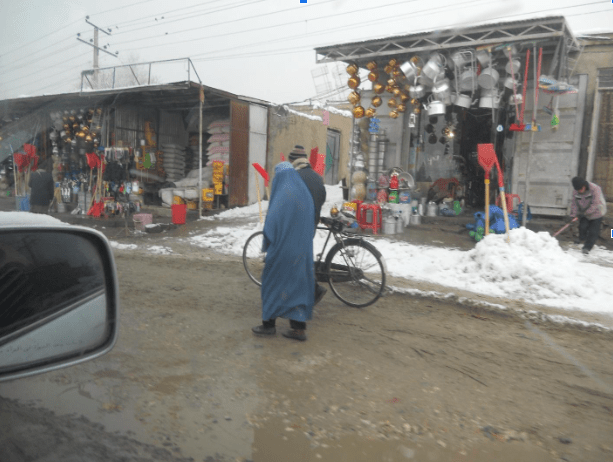
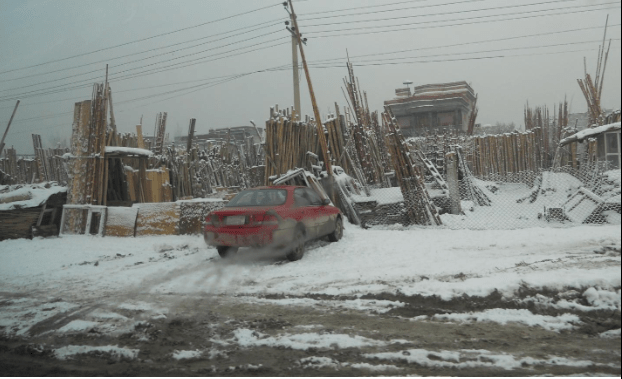
Because we left much later than usual (around 10AM), I noticed the squalid little stores all a-buzz with action: the butcher shops with their mutton carcasses hanging outside; the cobblers sitting on their dilapidated wooden boxes; the men clearing snow off little shelves where wooden planks and poles were kept for construction purposes; the tin pot stores with their glittery gold and silver wares shining pretty in an otherwise bleak setting; and everywhere the women in their burqas, walking with little high heels or heavy boots over filthy slush, or squeezed inside a mini-bus or taxi. I kept thinking I had never seen such pathetic penury with an eclectic whirring of sorts. However, in all the places I had ever been, I had never looked at a city with such sadness.
Despite it all, the morning commute turned into a veritable history lesson, and the 3 of us passengers, and the nervous Afghan driver, had a hilarious conversation that began when I tried to make light of a nerve-wracking trip. I asked my Pakistani Muslim colleague whether kids in Afghanistan had names signifying “barbarian”, like mine.
Thus the driver and my colleague began the story of Babur, a former king of Afghanistan, descendant of Genghis Khan and Tamerlane, who settled in Delhi and began the Moghul Dynasty in India, and whose great-grandson built the Taj Mahal.
They told me that Babur (or Babr in Persian) is very close to Barbara, and that Babur’s name really means “lion”. I pointed out that Babur and I had something in common -the lion- since my surname Dillon originally stems from “De Leon”. There were some guffaws and by the time we entered Compound Y, there was no longer nervous tension in the car, and I was not a “barbarian”, but rather “Barbara the double lion!”. I didn’t quite get why “double”, but maybe it had something to do with my gray hair? It turned out that Babur can also mean “tiger” in Arabic, but the beauty of the laughter that helped alleviate tension was not lost on me. With a sense of relief, I genuinely felt close to my driver and fellow passengers. And so what; tigers and lions (and bears, oh my) at the end of the day conveyed the same image of strength and might.
By late afternoon, we were told the sobering news that 2 US soldiers and countless others had been killed, and we were once again put in our armored SUVs, but this time we had a third SUV with a couple of “shooters” inside, to escort us back. Because it was Thursday afternoon, and the day before the Muslim “Sabbath”, there were few people in the streets, so our ride, thankfully, was uneventful as well, though we could see 3-4 helicopters flying in formation above the US compounds over my own Camp X.
Friday was the only day off at work, and we were also placed on lockdown, because it is the day when the Afghan males go to the mosque, and it was anticipated that the mullahs would be inciting the masses. We were all surely safely ensconced in our little nests inside the gilded cage of our compound. Other than the occasional helicopter flying over us, this was a totally calm and ordinary day in Kabul.
I had no idea what would happen the next day. The assumption was that we would all be getting ready to go to work. But we would not find out until the early morning. It turned out the lockdown continued. Alas, our work in preparing class curricula, presentations, and reports to headquarters and the US Government, was never interrupted.
And so ended another day.


See the water pump to the left and Nan bread to the right.

A bunker by the dining facilities.

Poles used in construction.
 Dum Spiro Spero