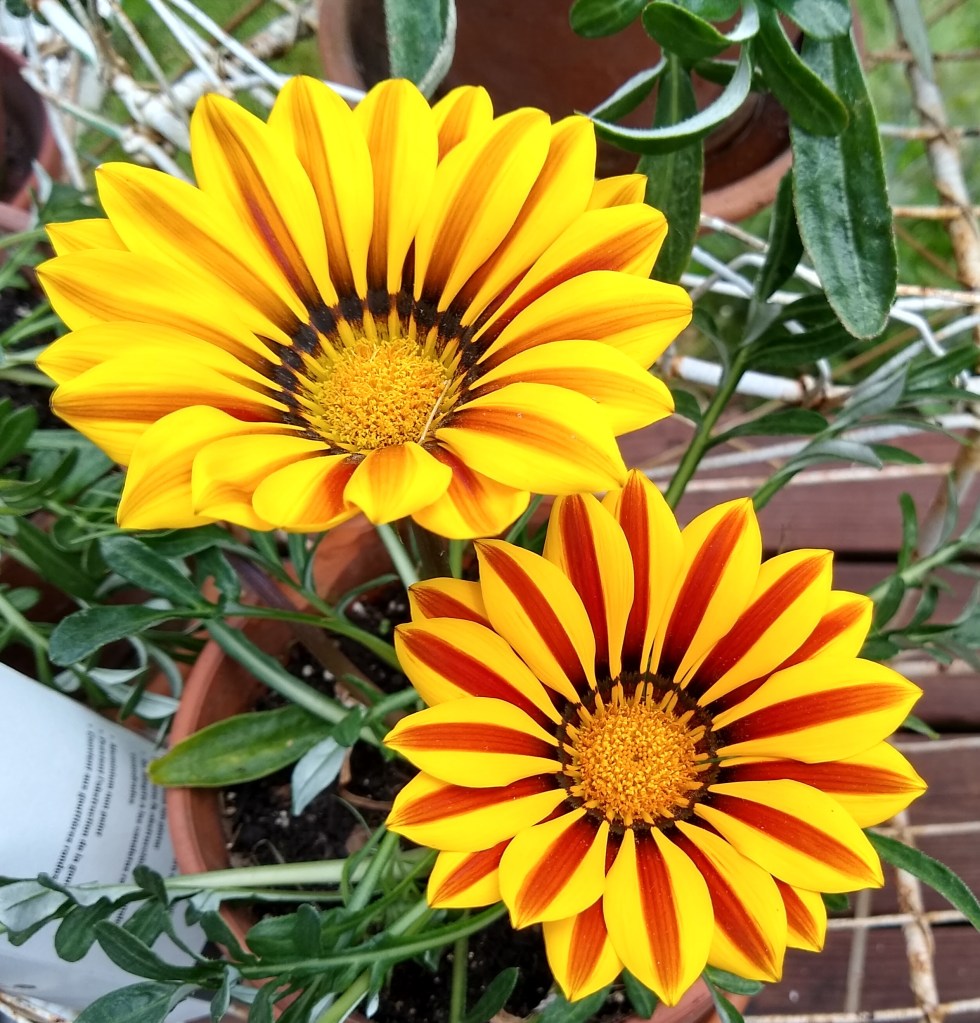
I remember so well the day I discovered these flowers. The promise of eternal summer blossoms (although they closed up after the sun went down or on cloudy days). They never disappointed.
They are called Gazania Rigens, but I like that they are referred to as the treasure flowers. They are native to South Africa, and named after a Greek philosopher, Theodorus of Gaza, who translated Aristotle and others into Latin during the Renaissance.
Summer has ended here in Maine, and with it all the expectations that I was anticipating in spring and which did not materialize for me, like the annual visits of family and friends. Like this flower, that closes up at sundown and in cloudy days, summer closed and then wilted away. The first frost has appeared, and more than ever, I am focused on what lies ahead.
Midway on our life’s journey, I found myself
In dark woods, the right road lost. To tell
About those woods is hard—so tangled and roughAnd savage that thinking of it now, I feel
The old fear stirring: death is hardly more bitter.
I am at the sunset of my life, not midway. However, at different stages in my peripatetic life I have been lost and have gone through quite a few dark woods to find the road, so to speak.
Many summers, while the gazinias were at their peak, my life’s journey brought me down to what I perceived to be rock bottom. Crises of family, health, friends, work. In retrospect, these crises were existential in nature and I flowed with the river of life, and eventually always reached a shore. Despite my insecurities and doubts, I retained a buoy of sorts, and never quite felt I was totally adrift.
Nowadays, I am on a quest to seek “clarity of vision, clarity of understanding, clarity of purpose”. So I am trying to read and understand Dante Alighieri, no small feat. I am approaching this adventure by doing research about the man and the epoch before immersing myself into the walk down to hell and back.
For example, why is Dante’s Inferno’s last circle the place reserved for the worst of sinners, who are tortured because of the worst of sins: treachery? Why do the nine circles spiral down, constricting themselves to a narrower and icier place? Isn’t our image of hell a raging fire?
There is a reason why, despite meting out punishment for heinous crimes, even the law recognizes that some of those such crimes and ensuing punishments can be mitigated when the crimes are committed in the heat of passion. There is no premeditation.
Yet, fraudulence and treachery are done deliberately, in cold blood. They are sought out in an icy calculating way: they are a choice usually justified by chewing on past resentments, anger, hatred. At the end of the day, it seems to me, that the evil transgressions we humans engage in, all involve pure and unadeltarted selfishness, thinking only of our own personal pleasures, and not of caring for others. It is the essence of what St. Augustine referred to as homo incurvatus in se, a Latin phrase that means “”humanity curved in on itself”, curving ourselves into our own little and insignificant mini-kingdoms.
I always felt uprooted, and that it was hard to belong somewhere, because of my itinerant life. But, my initial first excursions into researching the Inferno led to my AHA moment: finally understanding the true meaning of deracination. The Cambridge Dictionary’s definition states that to deracinate is “to make someone or something lose their connection to any particular place, background, way of life, etc.”

There is a difference between the meanderings of life as they take one on different voyages, and the calculating, callous and cruel dissevering of one’s tethered anchor or the tearing asunder of one’s soul, of all that was, is, and will be. The mind and heart cannot quite understand what is happening as it is happening. The closest description I can think of is the horror of becoming a prey to hyenas that do not kill their prey but, rather, tear them apart and eat them while they are alive. It is a most gruesome fate. Fittingly, the betrayers in Dante’s Ninth Circle are eternally chewed by Satan!
In the end, the only way up is down and an antidote to our transgressions is a good dose of humility. Humility has many synonyms; its etymology brings us to humus – the earth. The word human derives from humus as well. In Hebrew Adam is “man” and Adamah is “from the earth”. So much to learn, so little time left! I better start reading Dante sooner than later…
 Dum Spiro Spero