This past week I was greeted by a line. A vivid pink line. I marveled at it, thinking it reminded me of something, although “the what” escaped me. And yet, I kept observing, because I kept thinking of “crossing a line”. We cross so many lines in our lives, and seldom do we contemplate why. At least that’s me.
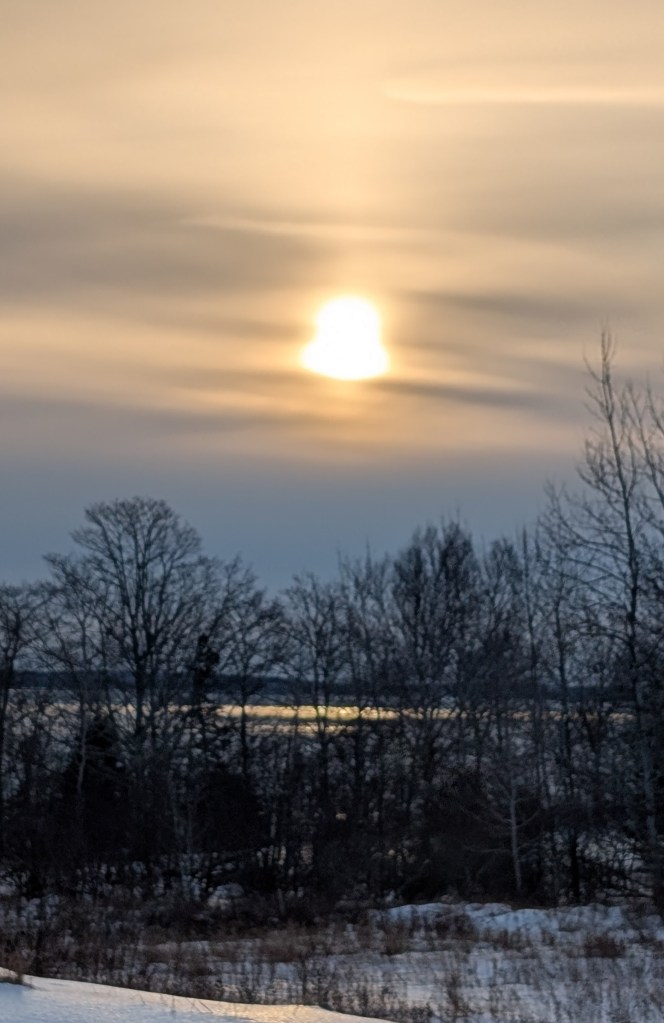
I turned away for a few minutes, and when I returned to keep observing, I was greeted with a different image altogether. Gone was the line and the pink. Instead, there was a silvery sun with its silvery reflection. It is times like these that I wish I were an artist, and could capture the beauty of a sunrise like this one.
Sea, sun, sky and a straight line. Crossing a line. I always think about my family and friends and acquaintances who are no longer here. Someone once said to me that I was “tetric” (meaning gloomy). Well, it is a common word in Spanish, and we used to use it in school in English, when I was growing up. It turns out that apparently, according to the Oxford English Dictionary, it is an obsolete word that has been out of common usage since 1810 or so. Go figure! I still use it, so, baloney.
And then it hit me, my tetrical self. The crossing of that line: a meditation on death! A boat, the sea, the light, the tides, the sand. And yes, the crossing of the bar.
CROSSING THE BAR
By Alfred, Lord Tennyson

Sunset and evening star,
      And one clear call for me!
And may there be no moaning of the bar,
      When I put out to sea,

   But such a tide as moving seems asleep,
      Too full for sound and foam,
When that which drew from out the boundless deep
      Turns again home.

   Twilight and evening bell,
      And after that the dark!
And may there be no sadness of farewell,
      When I embark;

   For tho' from out our bourne of Time and Place
      The flood may bear me far,
I hope to see my Pilot face to face
      When I have crost the bar.
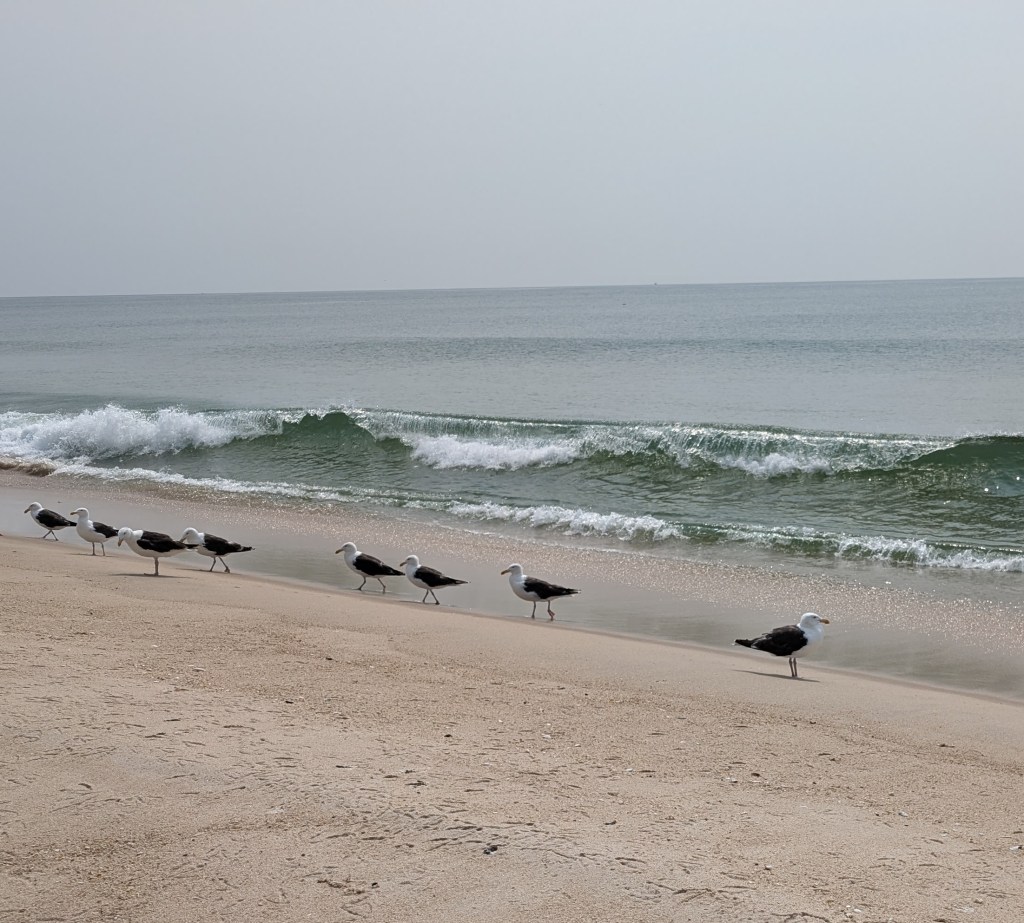
One day this summer marked a special series of milestones of mythological proportions in my life: for the first time ever, like this vigilant seagull, I was perched completely on my own, staring at a monumental decision that only affects me…no parents, no spouse, no siblings, no children, no grandchildren, no in-laws, no neighbors, no friends, no teachers, no professors, no dogs, no horses, no lambs, no governments, no embassies, no colleagues, no employers, no contractors, no priests nor priestesses, no nothing!
One of my brothers said, “Wow, go get a gerbil!”
I wonder how many philosophical essays have been written while pondering the uniqueness of making such types of decision? After all, to quote Robert Louis Stevenson,
“Everyone, soon or late, sits down to a banquet of consequences.”
You don’t just reap what you sow. You also sow what you reap.
Spending some time in one of the most beautiful beaches around, I came across a colony of seagulls. They didn’t fly away as I walked by. And they gave me food for thought. As I am delving into the Russian authors, I took this photo and thought of Fyodor Dostoevsky:
“Oh, how hard it is to be the only one who knows the truth!”
The more I walked, the more my lovely colony of seagulls made me reflect. Aesop came to mind.
By the way, I didn’t take the shunning personally!!!!!
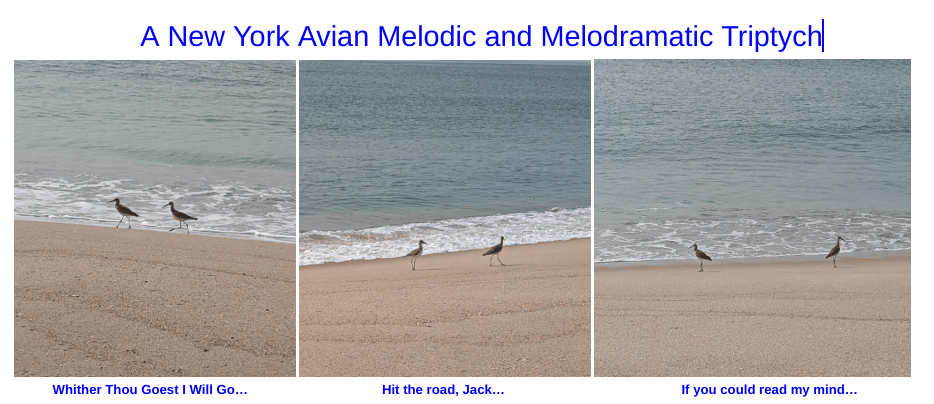
The next day I remembered the New York Avian melodrama above. She flew the coop. Or did she?
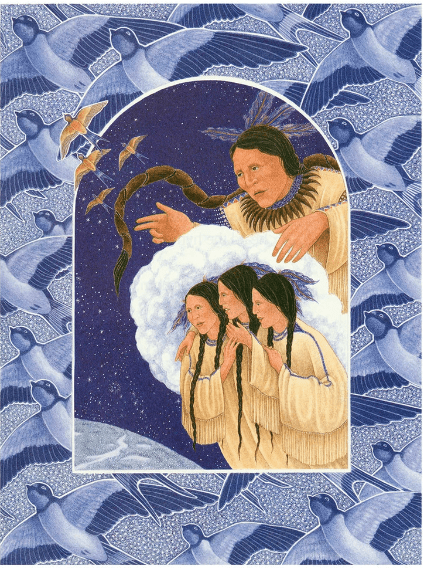
I had long forgotten a delightfully illustrated thin book that I used to read and sing to my children, many moons ago. It told the story of the Gitchy Manitou.
Ah, the cobweb tendrils of my life never cease to amaze me. I’ve had Québec on my mind for the last couple of months, because it is such a most beautiful city, rich in history, and so near to where I live.
The Sunday before Thanksgiving, I sat in a cold church, and, in the middle of the service, I heard the organist begin a song. The words and the melody tugged at my memory: “‘Twas in the moon of wintertime, When all the birds had fled…” I looked at the program and there it was, The Huron Carol.
The lyrics of the first Christmas Carol of North America are short and tell a story. For some it’s a meaningful story. For others it’s just a tradition that had consequences, bad and good.
However, for me, it was fascinating to discover that the author of this ancient Carol was a French Jesuit priest who hailed from Normandy. Jean de Brébeuf lived among the Hurons and is recognized as someone who produced so many ethnographic records on the Hurons that his efforts were pivotal in preserving the Huron (Wendat) language. His accounts were included in a collection of documents referred to as The Jesuit Relations, which are considered an important historical resource. He actually wrote a dictionary, among other things.
Brébeuf paid a dear price for being a missionary. All accounts (at least the ones I have read) point to his love for the Hurons. The Hurons’ archenemies were the Iroquois, who destroyed Huronia. Yet even the Iroquois were so impressed at his bravery in the face of excruciating torture that they ate his heart in a symbolic recognition of his fortitude. Or so they say. History is not pretty. But I can’t help but admire someone who took the time to study and create something that has been acknowledged as a legacy.
In my love of etymology, lo and behold, I discovered that Jean de Brébeuf wrote about a game being played among the Hurons in 1636 and it was he who named the game “lacrosse”, because the stick reminded him of a bishop’s shepherd’s staff or crozier.
The Huron Carol, or Jesous Ahatonhia, beautifully illustrated by Frances Tyrrell, was published in 1991, and sometime soon, after that year, my Mother gave it to my children for Christmas. They loved the story and the drawings. It was a gentle introduction to a far away land with familiar concepts.
At the time, little did my Mother know how one day, 25+ years, a little protestant church in the Blue Hill peninsula of Maine would spark memories of little children, pretty songs, tender memories of Québec, dictionaries and saints.
The below video was a joint production of the Aboriginal People’s Television Project and the CBC Radio Canada. It aired in 2002.
Always marvel at nature, and how it can fool you! Because I used to think peepers were night time birds, I was the cause of a lot of mirth. When you are in unfamiliar territory, anything goes.
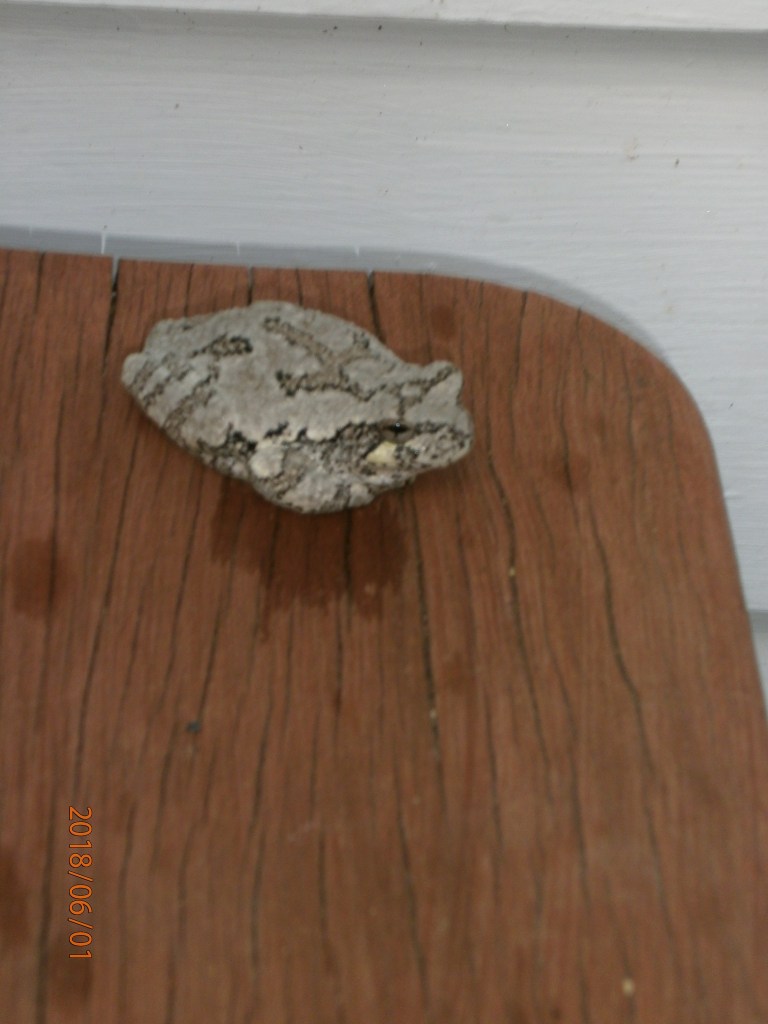
Which leads me to this blob below, that I thought was a marvelous stone/big pebble, that someone had placed on an outdoor table. I observed it, tried to pick it up, didn’t get close enough, it jumped and re-settled, and gave me enough of a shock but plenty of time to take the photo.
I woke up this morning to learn about psychological manipulations and how to re-wire brains, all in the context of computers, algorythms, robots, zombies, religion, the military, PTSD, survival, old age, trauma, chameleons, hospitals, internal organs, and disease.
This is too much fun for me, so I have to dig in and find the common link. And all because of a disguised rock that was, what, a “stone” frog? A “tree” frog?
When I first started working with Afghanistan, one of my job requirements was to prepare a presentation for future advisors in the justice sector. These advisors were primarily American and international lawyers, judges, corrections officers, and a sprinkling of other experts.
My research uncovered amazing stories and records of a time in the mid-20th century that seemed surreal. The shock of what had been versus what was. To wit, Once upon a Time in Afghanistan.
This research led me to a jewel of a movie, that I considered a love feast for the eyes, because in a short time, it captured the beauty of the country and its people. I had witnessed it myself, despite my being confined to a limited area in Kabul. This was around October 2012.
I never forgot that film, and that’s why I share it today.
I always think of Afghanistan, and everyone I met there, and I still feel sadness at how all our efforts seemed to go up in flames. Sometimes I wonder whether it was all for nought. Maybe, maybe, I am too pessimistic and there’s a glimmer of hope. Miracles do happen.
A story of how love still kills in Afghanistan (Author: Nushin Arbabzadah)
Dear Rabia,
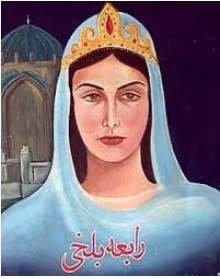
I am writing to you across centuries – from the land of the living to the realm of the dead. The year is 2012 and you were murdered exactly a thousand and sixty-nine years ago. You have the dubious privilege of being our first recorded case of honor killing.
I am caught in Love’s web so deceitful None of my endeavors turn fruitful. I knew not when I rode the high-blooded stead The harder I pulled its reins the less it would heed. Love is an ocean with such a vast space No wise man can swim it in any place. A true lover should be faithful till the end And face life’s reprobated trend. When you see things hideous, fancy them neat, Eat poison, but taste sugar sweet.
Rabia Balkhi lived in the 10th century. She fell in love with her brother’s slave. She was imprisoned by her brother and committed suicide after writing the last stanza of her last poem, Love, on her prison wall with her own blood.
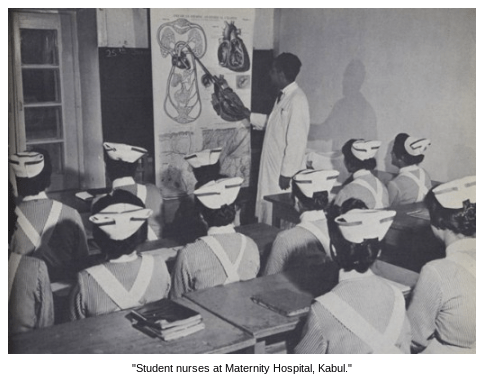
There used to be a busy woman’s hospital in Kabul named after the queen. It was supported by the International Committee of the Red Cross (ICRC). The last entry I read about the hospital by the ICRC is from 2022. I can find nothing else. I wonder, what has happened to it? Maybe the Taliban just changed the hospital’s name…
“Wojtek had the look of a bear but indeed had the heart of a Pole.”
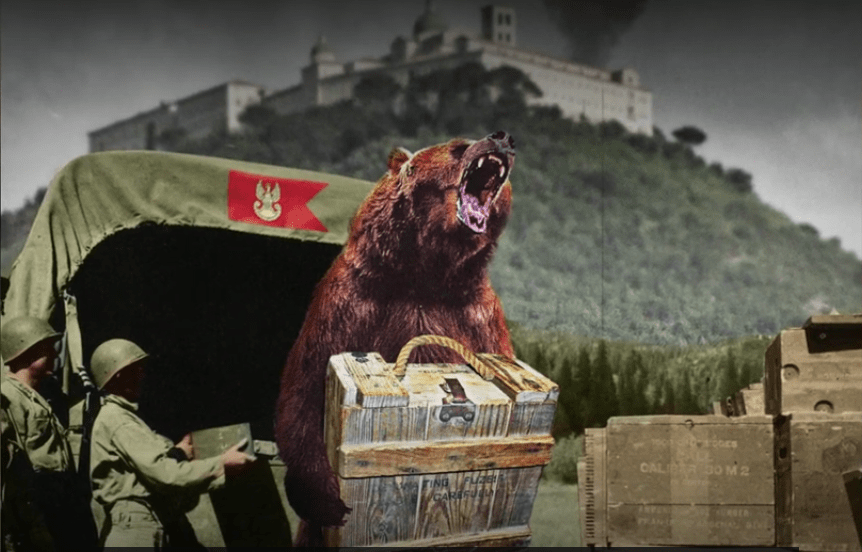
I love learning something new every day, and discovering the story of Wojtek, the Polish bear soldier, was one of the most remarkable surprises I ever had. He was born in Iran, was adopted by the Polish army, lived in Iraq and Egypt among other places, went to Italy and died in Scotland.
A magnificent 500lb military bear, he liked beer and cigarettes! Wojtek’s greatest moment may have been at the Battle of Monte Cassino in 1944.
In order to stay with the Polish Army when they joined the Allied military campaign in Italy, Wojtek was officially enlisted as a private, given a serial number, and was able to remain with his comrades in arms, the Polish soldiers. He not only carried artillery shells and ammunition crates between trucks and troops engaged in combat, but wounded soldiers as well. He received a promotion, to corporal. There was a documentary done about him in 2011.
How many people today remember that the Poles played a crucial role in the battle of Monte Cassino (1943), and that so many of them died there? It was on the fourth assault of the monastery, led by the Poles, that the Germans were defeated. The graveyard in Monte Cassino is numbing, and, in the context of history, it is overwhelming, because it was thanks to this assault that the road to Rome was opened and Rome was liberated 3 weeks later.
One of my favorite French words is “coquelicots“. Nowadays, I think of the jolie coquelicots, The Red Poppies of Monte Cassino, with a sadness and enduring admiration for all who fought there.
Wojtek, the Polish soldier, the bear that had the “heart of the Pole”, became emblematic of the determination and devotion to carry through against all odds, including the ultimate sacrifice.
Poland is a land of contrasts, incredible beauty, sad history, and unique resilience. Driving from the Czech Republic to Warsaw, it is easy to understand why it is a land that has been ravaged by enemies from all over… It is largely flat, like the pampas of Argentina.
While Prague is a magical city, that basically remained intact, Warsaw is a ravaged city (more than 85% of it was razed to the ground in World War II) that rebuilt itself from the smoldering ruins catapulted by the retreating Germans and gleefully observed by the Soviet army across the river.
Many have forgotten the cruelty that the Poles experienced 60+ years ago. But when you live in Poland, it is palpable (every street corner or so has a plaque memorializing the execution of Polish citizens by the Nazi Germans –the formula was for one German killed, 10 Poles would die-).
The Poles are a proud people, and rightly so. After all, the Poles were the only Europeans to mount a counterattack within its occupied country. It is amazing how little anyone knows of this uprising. People in general confuse it with the Jewish Ghetto uprising. The Poles are perplexed that the world doesn’t know that about 200,000 Poles died in the Warsaw uprising.
While there were some resistance movements among occupied European nations, none rose to the level of the Poles. How many people today remember that the Poles played a crucial role in the battle of Monte Cassino (1943), and that so many of them died there? It was on the fourth assault of the monastery, led by the Poles, that the Germans were defeated. The graveyard in Monte Cassino is numbing, and, in the context of history, it is overwhelming, because it was thanks to this assault that the road to Rome was opened and Rome was liberated 3 weeks later. There is a sad last stanza of a famous Polish poem, dedicated to those who shed their blood in the battle for Monte Cassino:
D`you see this row of white crosses? Polish soldiers did honour there wed. The further you go, the higher, The more of such crosses you’ll meet. This soil was won for Poland, Though Poland is far away, For Freedom is measured in crosses When history from justice does stray.
But I digress… As I said, Poland is a land of contrasts and, in many ways, it is a land that puts many of us to shame. Beginning in early November, we have no real sunny days in Warsaw. In fact, the sun may shine a few hours a couple of days, but, for the most part, the days are gray, cold, and very short. Sunlight creeps its way around 8AM and decides to disappear by 3:30PM. Luckily, the rainy days soon give way to snowy days. One has to have a happy heart, and a strong backbone, not to be depressed or enter into a state of perennial hibernation during the winter months. It takes great effort to get up in the morning and be ready to go.
I cannot help but be reminded every single time I walk through the streets of Warsaw that this is a city that, against all odds, fought the Germans only to be stomped by the Soviets, and had more than 85% of its buildings razed to the ground only to be re-built, brick by brick. There is not one Pole who has not said to me that theirs is an ugly city that it cannot compare to other cities, especially Prague, in its beauty. In many ways, it is true that you cannot compare Warsaw to Prague. Prague is a small jewel that reminds the visitor that sometimes time can stay still. Warsaw, on the other hand, screams out -at least to me- that no matter how horrible life turned out for the Poles, they defied their state in life and literally came up from the ashes.
I cannot help but be awed by the Poles, when I think of all the beautiful spots on Earth that I have seen or lived in, where the weather is beautiful, the sun shines all the time, where food grows wild, without the harshness of the cold, and yet everybody complains about everything, that their problems are caused by “them” and never by “us”.
The amazing thing for me is how little we have ever been taught about Poland, and how quickly the world forgot what Poland went through.
In a Kafkaesque moment, I had a young Russian telling me that she found Warsaw ugly, with all the dull gray buildings (built under communism), and that, compared to a Budapest or a Prague or a Paris, it was a hideous city. Some chutzpah! I just sat there, looking at her a bit wild-eyed, and tersely mentioned to her that, of course, the city had been all but destroyed by the retreating Germans, adding that the destruction had been done while the Russians watched across the Vistula river, and that communism’s legacy in the architectural field left a lot to be desired (the same hideous panelak buildings are seen all over Russia and Europe, especially in those countries that were enamored of social planning…the barren projects in Paris where the Muslim youth rioted come to mind).
Taking the train all the way to the Baltic Sea, I often visited the largest Gothic fort in the world, that was the seat of the Teutonic Knights, those pesky Crusaders who were invited to come to Poland by a Polish king, and overstayed their welcome by a couple of hundred years. Malbork Castle is a beauty, and it is astonishing to see how efficient in their engineering ingenuity these knights were. They actually had central heating!
I’m sure the Germans who returned during WWII truly enjoyed their stay there, recapturing -so to speak- what they believed was rightfully theirs… Unfortunately, half of Malbork had to be re-constructed after the war. Today, it is a UNESCO protected spot.
An hour or so away from Malbork is the city of Gdansk, the birthplace of Solidarity. It is a marvelous city and the architecture is delightful.
Visiting the boatyard, where Lech Walęsa became famous, I had a mixture of emotions… Shock at how much has happened in such a short time; admiration at what a few individuals were able to do against the odds; awe at the mystery of what makes people leaders for a good cause; sadness at how quickly we all forget what the world was like before Pope John Paul II and Solidarity; and happiness knowing that Poland finally after WWII and the Cold War is now enjoying what it should have had after V-day and did not.
So, echoing the Gdansk exhibit, it was thanks to Solidarity (with the Pope’s blessing, when he told them not to be afraid) that Hungary, Czechoslovakia, Latvia, Lithuania, Estonia, Bulgaria, Romania, Croatia, Serbia & Montenegro, Albania, Moldova, Slovenia, Macedonia, Georgia, Ukraine are free from the communist yoke. The Poles started it all! I did not know that the famous gigantic ballpoint pen that Walęsa had used to sign the agreement with General Jaruzelski to end the strike had a big photo of the Pope. The influence of this man on the Poles, as well as the impact of Catholicism in the lives of the Poles, are monumental and I believe it is what keeps the Poles forging ahead with patience and optimism, against all odds.
It is also what annoys the rest of Europe about them as well, because Europeans have lost their Christian roots.
The crooked house in Sopot
Malbork Castle
A Teutonic Knight
Gdansk
Lech Walęsa helps a suffering Jesus on the way to Golgotha
Meet Argentina’s famous tree: the ombú (Phytolacca dioica), that conjured in me images of a long-ago childhood, and poems that I did not appreciate -then- the beauty of their cadences. For example, a famous Argentine writer and statesman, wrote an ode to the tree:
Every region of the planet
Has a feature of importance:
Has Brazil its sun of ardor,
Mines of silver has Peru,
Montevideo its hillock,
Buenos Aires, land of beauty,
Has its grandiose spreading pampa,
And the pampa the ombu.

Or, in its original Spanish:

Cada comarca en la tierra
Tiene un rasgo prominente:
El Brasil, su sol ardiente;
Minas de plata el Pera,
Montevideo, su cerro;
Buenos Aires, patria hermosa,
Tiene su pampa grandiosa;
La pampa tiene el ombú…
The ombú’s magnificence is in its intricate roots and the thick foliage that protects cattle and man alike from the harsh elements. Yet the tree’s sap is poisonous.
Reconnecting with a friend of mine, whom I had not seen in decades, I discovered -to my amazement – that Afghanistan produces the one root that has medicinal powers and is widely used for flavoring: licorice (Glycyrriza glabra). In fact, licorice from Afghanistan used to be one of Afghanistan’s biggest exports to Europe and the United States. (Today, doing a cursory search, I could not find much data).
My last journal entry was a hopeful one: “Next time I visit Afghanistan I shall explore more about their abundant and unique root. In the meantime, I am enjoying reconnecting with the beautiful roots that, in my travels, I have only seen in Argentina: the ombu’s.”
A long time ago I had a blog. It gave me great pleasure, because I recorded my impressions of places I visited, people I admired, events that impacted me. But then, one day, POOF. I updated something and it was not the right thing to do. It now is a soul lost in the ethereal world of the interwebs. Every now and then I find an old essay, which triggers back memories of yester years. I want to return to Dubrovnik and I want to reread the beautiful book I read then.
———————————————–
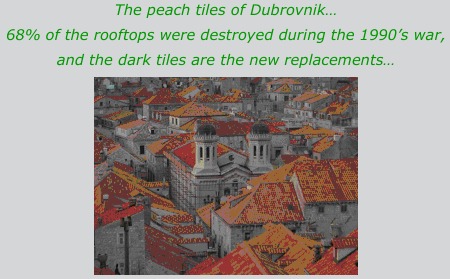
THE BELLS OF DUBROVNIK ring every hour and half hour, although they are silent throughout the night, when the local cats begin their hellish meows. From where I sat in the evening many summers ago, overlooking the city’s mosaic of pale-peach and red tiled roofs, I could admire a large sliver of Adriatic blue, sometimes speckled by imposing cruisers or elegant yachts that came and went.
Croatia is a special place… Its coast is magnificent. I kept comparing: gorgeous Italy vis-à-vis this incredibly beautiful, but more pristine version of a Mediterranean coast…
One of the saddest things to see were the gaping holes, some large, some small, sometimes many, sometimes few, on the façades of regular-looking buildings along the way… These are the scars of war left by the many bullets and shells on apartment complexes, houses overlooking the Adriatic, clusters of village dwellings… These wounds, unfortunately, are so recent, it’s almost embarrassing to remember! I mentioned to my sons that all of their contemporaries in Croatia were exposed to the horrors of war in the heart of Europe, while they were playing soccer with their classmates in Rome, having a wonderful and peaceful childhood, so very near by. Hard to believe – except for the physical scars on buildings – that Croatia experienced such savagery just a few years ago!
We visited the island of Lokrum, where the Benedictine monks settled many centuries ago, and where a few mortar shells landed a few years ago… Does the world remember?
A beautiful island 15 minutes away from Dubrovnik, Lokrum’s water at the time was very refreshing, crystalline as can be, and snorkeling in it was unbelievable. Something out of National Geographic: the waters were magnificent in what they delivered: underground gorges, multi-colored fish, and schools of gray and black fish…
On a cursory trip to Cartvat, an old city about 16 kms from Dubrovnik, we didn’t find the right beach (it was too crowded for my taste) and we went back to the little one we discovered a few days earlier, which once held a big hotel and apartment complexes, and which are now boarded up because of the gunfire they withstood…modern monuments to modern disasters… I liked the guy who had the concession stand and sold us ice cream (50% cheaper than in Dubrovnik)…
The days we spent in Dubrovnik and its surroundings were beautiful and I know, for certain, that I shall remember this place forever: it is a gem. The white marble of the city’s buildings, staircases, and streets absorbed the heat, so that in the evening one could feel the warmth irradiating from the marble streets and the building walls.
To anyone who ever wants to begin to understand how we could have had such a savage war in the heart of Europe, I recommend reading The Bridge over the Drina. It is a beautiful story written by a Nobel Laureate, a former Yugoslav diplomat, Ivo Andric. With poignant melancholy, it recounts the traumas and tragedies, joys and woes, loves and hatreds of a multi-ethnic, multi-cultural, multi-religious multitude in a town in Bosnia, from the Middle Ages until the outbreak of World War I. It is a formidable epic, and the perfect book to read in Croatia!
I discovered Vinko Coce, in one of our trips to the island of Lokrum… He is a crooner, a balladeer. Croatian melodies are sad, gypsy-like and harmonious. We listened to Vinko as we drove out of the walled-city, a fitting way to end our stay. It was hard to depart… Maybe soon I will see that beautiful and melancholic Dubrovnik again.








 Dum Spiro Spero