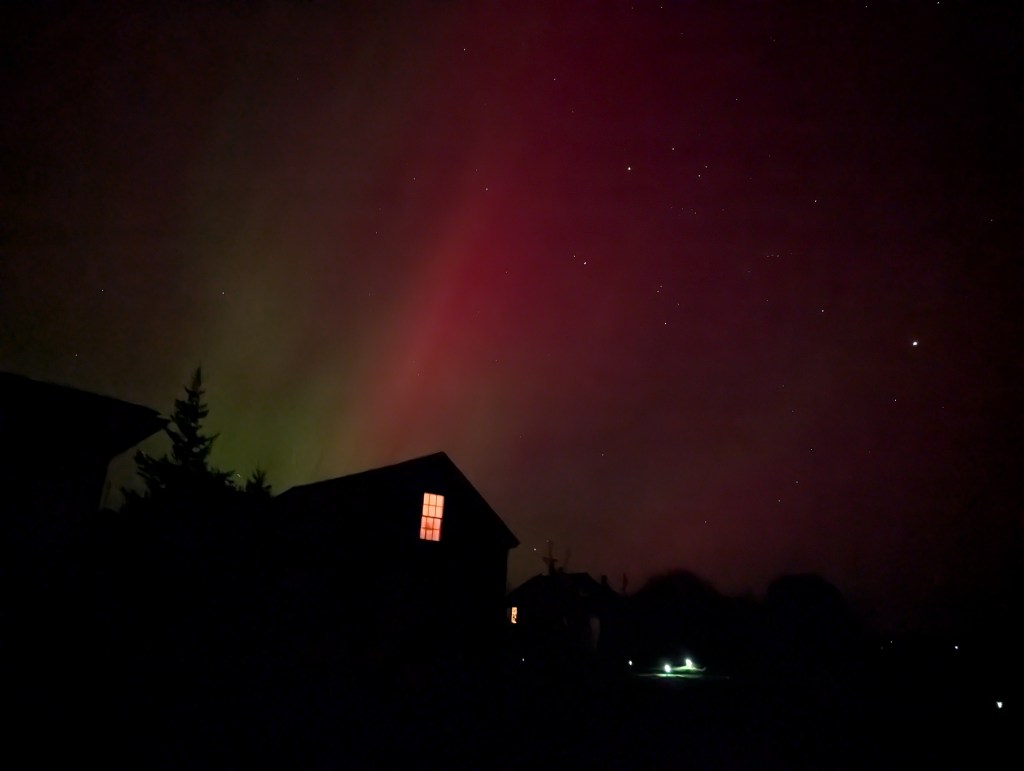
Last night I thought the earth and the heavens were smiling at me, auguring good days ahead. There was a shooting star to boot! I thanked God for all my blessings and for having given me the chance to see such beauty on a chilly night.
I ventured outside to capture the magic, and was jolted 3 times by hissing and jumping creatures (the foxes? last night’s coyotes? do they hiss and make clicking sounds?), but I overcame my fright and stayed out for a bit, relishing in the changing view.
I have yet to explore the state of Maine. I have never been to Mt. Katahdin, nor the Appalachian trail, nor any of the myriad fishing lakes and other scenic places members of my family and others have explored. I will get there, God willing. However, last night, I was thrilled to be in the Blue Hill Peninsula, a slice of heaven on earth.
I thought of my long-gone parents and was reminded of one of my Mother’s favorite little poems, a beautiful rhyme (XVII) written by a famous Spanish Romantic poet, Gustavo Adolfo Bécquer:
Today the earth and the heavens smile at me; today the sun reaches the depths of my soul; today I have seen her… I have seen her and she has looked on me… Today I believe in God! *** Hoy la tierra y los cielos me sonríen, hoy llega al fondo de mi alma el sol, hoy la he visto… La he visto y me ha mirado… ¡Hoy creo en Dios!
The poem has a subliminal message. I finally understand its significance.
I have always found solace in the peaceful beauty of a wonderful landmark in my neck of the woods, the little Catholic Chapel called Our Lady of Holy Hope in Castine. It is unpretentious but commands a most spectacular view. Someone once made a disparaging comment that it was an afterthought built for the “help” of the more affluent citizens of the town. Maybe. But I have my doubts.
The little Church sits where Fort Pentagoet was, and an old plaque inscribed in Latin showed that the French had built it. “A University of Maine archaeological team recently established that a Catholic chapel was originally built by the French in 1635 on the site of the present Our Lady of Holy Hope chapel in Castine. From all indications this mission was one of the first in Maine and in the United States.”
I have gone to this place many a time to think, meditate, ponder about the joys and vicissitudes of life, feel closer to my parents and other dead relatives, and reflect on the role that the French Catholic priests of the day played in establishing relationships with the indigenous population.
In fact, it was a Jesuit priest, Father Sebastien Râle, who spent most of his life among the Abenaki, who produced an Abenaki-French dictionary that is recognized as an opus because it helped preserve the language.
I perused that dictionary and it is why I came up with the name “K’chi Casco” for our little farm (meaning Great Heron).
Earlier on a breezy summer day, wondering when or if children and grandchildren might visit, fishing and hiking trips might end, thinking about the University of Maine end-of-summer picnic we were hosting, anticipating an upcoming trip to Europe to reunite with friends (and how I hate to fly, which is a real curse for me), I came across the two sailing ships. Lo and behold, thank God for the phone. I caught them competing with each other and then the Cross providing a magnificent frame…(I think so!).
And now, uploading these photos, I remembered an ancient song based on Charles Kingsley‘s poem, that I had learnt as a kid, thanks to my formidable Great-Aunts, who were steeped in old English literature and lore. I used to sing it with them, and it was the saddest of tunes and lyrics.
However, one day, when I was 10 or so, I heard a young Joan Baez singing it mournfully like a loon, the way I thought ought to be sung. I still do.
I sometimes wonder if I am the only one who takes these labyrinthine journeys through the memories in my heart and mind.
Three fishers went sailing away to the West, Away to the West as the sun went down; Each thought on the woman who loved him the best, And the children stood watching them out of the town; For men must work, and women must weep, And there's little to earn and many to keep, Though the harbor bar be moaning.
Three wives sat up in the lighthouse tower, And they trimmed the lamps as the sun went down; They looked at the squall, and they looked at the shower, And the night-rack came rolling up ragged and brown. But men must work, and women must weep, Though storms be sudden, and waters deep, And the harbor bar be moaning.
Three corpses lay out on the shining sands In the morning gleam as the tide went down, And the women are weeping and wringing their hands For those who will never come home to the town; For men must work and women must weep, And the sooner it's over, the sooner to sleep; And goodbye to the bar and its moaning.
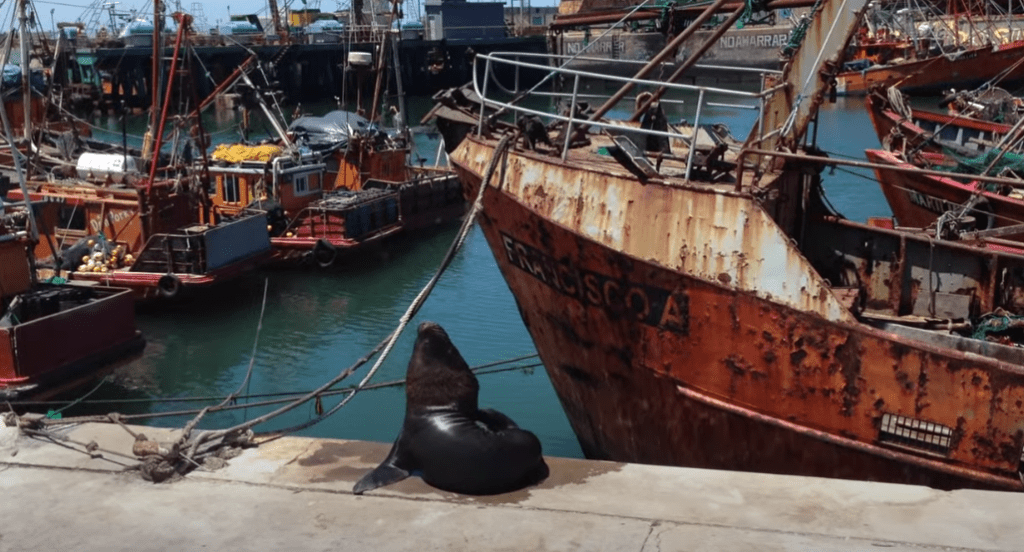
This old photo that I had taken long ago, of a dilapidated boat with a beautiful sea lion by its side, made me think about death, loss and hope. Go figure!
In my own experience with loss, I recognize how important it is for those who remain behind to share in the suffering of the stricken one. The dénouement that sometimes is slow in coming, and which eventually affects us all, can help us prepare for the inevitability of death, of shuffling off our mortal coils, and put things in perspective: that is, truly understand what is significant and what is not. This is something that I, for certain, have failed to distinguish repeatedly.
The sufferer may not realize it, in the midst of his pain and suffering, but the impact of his predicament has a ripple effect on those who love him, and, for the most part, makes the witness a better person for it.
In my experience, faith does play an integral part in all of this. Nihilism brings only despair. The back pages of my memory of heady college days discussing Nietsche’s nihilism, and other philosophers’ perspectives on death and dying, confirm this to me.
My own reaction to reading others’ descriptions of coming to grip with their mortality validates to me that, as the antidote to nihilism, John Donne aptly meditated: “No man is an island, entire of itself; every man is a piece of the continent, a part of the main; if a clod be washed away by the sea, Europe is the less…any man’s death diminishes me, because I am involved in mankind…”
However, I have discovered that death does not just involve a human body that withers away. Death can come in a myriad of ways.
Sometimes we are dealt blows that seem insurmountable: a major disease, estranged relationships, abuse, betrayals, financial woes and other traumatic events, and our lives are unmoored, like a boat being tossed aimlessly in a sea of trouble.
But, every now and then, the boat does not crack open and sink. Miraculously, sometimes it finds a place of shelter, and maybe, maybe it can even be salvaged. The thread of life that is unwound by the Fates may not necessarily end up severed…frayed, maybe, but not severed, and life goes on.
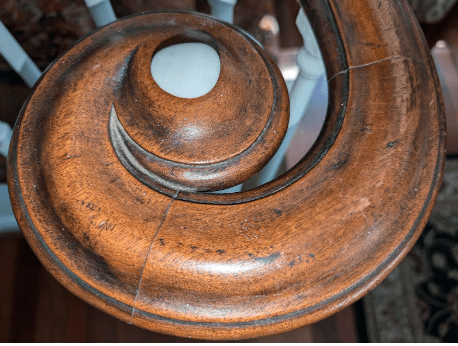
Well, this poor birch bark dropped down and lies asunder, despite having been joined together to the tree, Robert Frost. I think the weight of life was just a bit too much to bear.
....Earth’s the right place for love:
I don’t know where it's likely to go better.
I'd like to go by climbing a birch tree,
And climb black branches up a snow-white trunk
Toward heaven, till the tree could bear no more,
But dipped its top and set me down again.
That would be good both going and coming back.
One could do worse than be a swinger of birches.
Or, maybe, it suffered from the suppressed anger that not only leads to the destruction of one, but to the moral corruption of the other.
A POISON TREE
By William Blake

I was angry with my friend;
I told my wrath, my wrath did end.
I was angry with my foe:
I told it not, my wrath did grow.
And I waterd it in fears,
Night & morning with my tears:
And I sunned it with smiles,
And with soft deceitful wiles.
And it grew both day and night.
Till it bore an apple bright.
And my foe beheld it shine,
And he knew that it was mine.
And into my garden stole,
When the night had veild the pole;
In the morning glad I see;
My foe outstretched beneath the tree.
“A long long time ago, a young and exuberant romantic picked up a white smooth pebble by the shore, on an unusually gray and cold summer day. No blue sapphire nor gleaming diamond could surpass the value of that white small pebble.
He was penniless, and yet, holding in his hand was the most precious of treasures and bounty: the representation of a promise…”
So, I like to write stories that are never published. They live in my imagination. They may reflect my life experiences, stories my friends told me, stories that have laid dormant in my life, fantasies or fables. Who cares. However, whenever I read a poem or a story written by a famous author that reflects a flash of what I was thinking, I am fulfilled and tickled pink. The story of the alabaster stone is true. However, it was only a few days ago that I discovered this poem that awed me. Sharing just because.
DOVER BEACH
by Matthew Arnold

The sea is calm tonight.
The tide is full, the moon lies fair
Upon the straits; on the French coast the light
Gleams and is gone; the cliffs of England stand,
Glimmering and vast, out in the tranquil bay.
Come to the window, sweet is the night-air!
Only, from the long line of spray
Where the sea meets the moon-blanched land,
Listen! you hear the grating roar
Of pebbles which the waves draw back, and fling,
At their return, up the high strand,
Begin, and cease, and then again begin,
With tremulous cadence slow, and bring
The eternal note of sadness in.

Sophocles long ago
Heard it on the Ægean, and it brought
Into his mind the turbid ebb and flow
Of human misery; we
Find also in the sound a thought,
Hearing it by this distant northern sea.

The Sea of Faith
Was once, too, at the full, and round earth’s shore
Lay like the folds of a bright girdle furled.
But now I only hear
Its melancholy, long, withdrawing roar,
Retreating, to the breath
Of the night-wind, down the vast edges drear
And naked shingles of the world.

Ah, love, let us be true
To one another! for the world, which seems
To lie before us like a land of dreams,
So various, so beautiful, so new,
Hath really neither joy, nor love, nor light,
Nor certitude, nor peace, nor help for pain;
And we are here as on a darkling plain
Swept with confused alarms of struggle and flight,
Where ignorant armies clash by night.




 Dum Spiro Spero