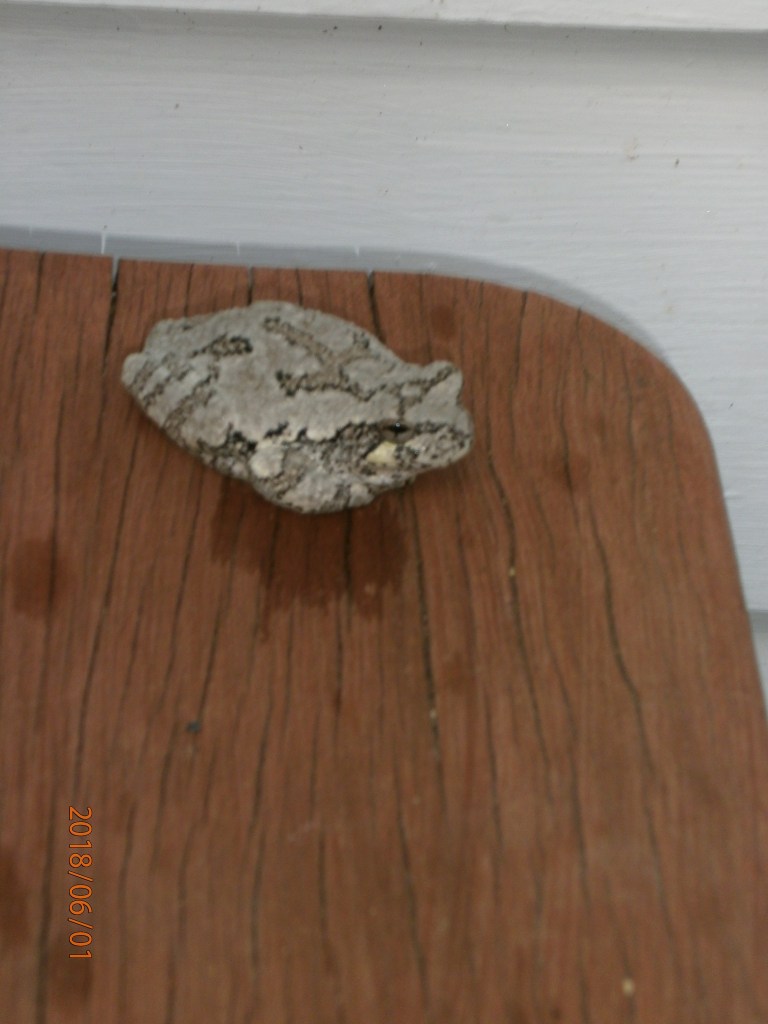
The Frog

Always marvel at nature, and how it can fool you! Because I used to think peepers were night time birds, I was the cause of a lot of mirth. When you are in unfamiliar territory, anything goes.

Which leads me to this blob below, that I thought was a marvelous stone/big pebble, that someone had placed on an outdoor table. I observed it, tried to pick it up, didn’t get close enough, it jumped and re-settled, and gave me enough of a shock but plenty of time to take the photo.

I woke up this morning to learn about psychological manipulations and how to re-wire brains, all in the context of computers, algorythms, robots, zombies, religion, the military, PTSD, survival, old age, trauma, chameleons, hospitals, internal organs, and disease.

This is too much fun for me, so I have to dig in and find the common link. And all because of a disguised rock that was, what, a “stone” frog? A “tree” frog?
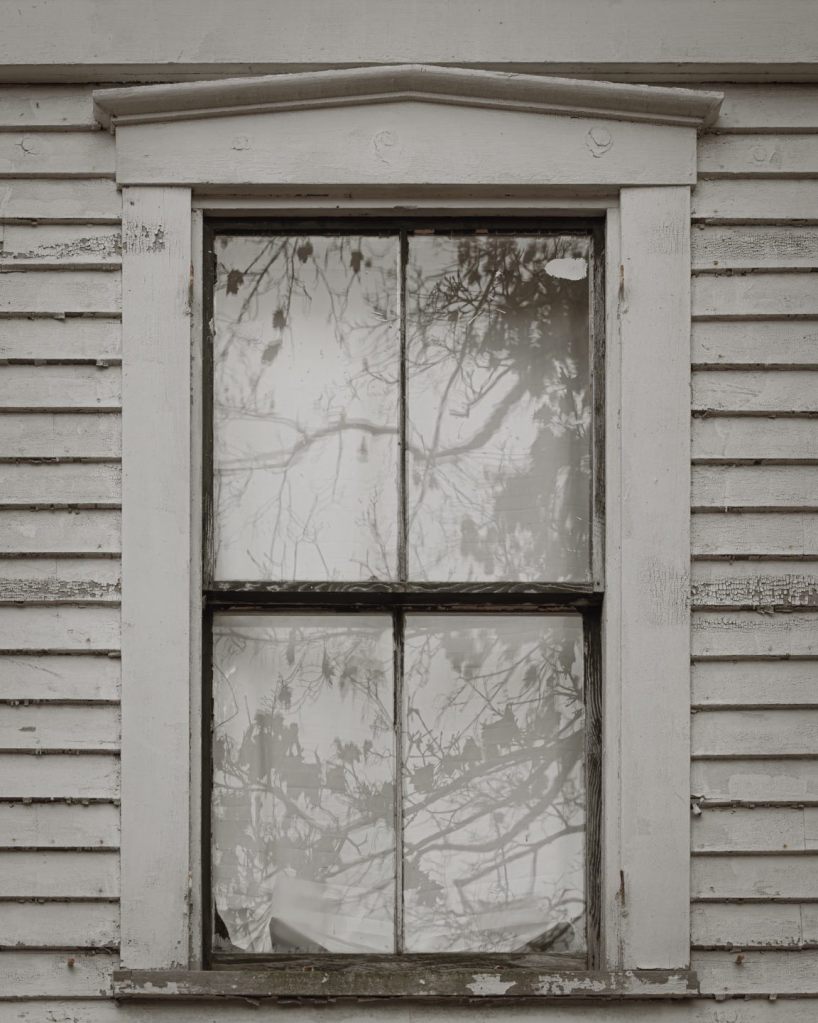
The Love of Bare November Days with Its Withered Trees

An amazing photographer, Kim Allen Goff, posted this beautiful photo on social media and commented,

“I’ve loved to peer into windows since I was a child and the older the house the better! The reflections on these windowpanes spoke the language of November.”

Immediately, her comment and photo reminded me of this Robert Frost poem, below. I read somewhere that, in this particular poem, “Sorrow finds beauty in its desolation”.

It is true.

Sorrow does bring forth reflection, and from that reflection springs clarity of understanding, and from that clarity -eventually- those turbulent waters reach their destination and may turn into a beautiful and calm and crystalline cove or lake. So there. I have to thank Kim for making me be happy about my birthday month! There is beauty in those reflections of the bare, the withered tree…

MY NOVEMBER GUEST
by Robert Frost

My Sorrow, when she's here with me,
Thinks these dark days of autumn rain
Are beautiful as days can be;
She loves the bare, the withered tree;
She walks the sodden pasture lane.

Her pleasure will not let me stay.
She talks and I am fain to list:
She's glad the birds are gone away,
She's glad her simple worsted grey
Is silver now with clinging mist.

The desolate, deserted trees,
The faded earth, the heavy sky,
The beauties she so truly sees,
She thinks I have no eye for these,
And vexes me for reason why.

Not yesterday I learned to know
The love of bare November days
Before the coming of the snow,
But it were vain to tell her so,
And they are better for her praise.

Full Moon over Mount Ktaadn

I’ve never been to Mt. Katahdin, but I have heard stories about the place, seen video taken by my nephew via drone, and watched my nephews traverse what’s called (I think) Knife’s Edge. Even today, the Wabanaki look to Katahdin as a sacred place, where the Spirit roams freely and powerfully. Because I was privy to some nightmare stories of scoundrels soiling the beauty of the place and violating the mountain’s sanctity, I sometimes have thought of Edgar Allan Poe and Alfred Hitchcock and what a tale the two combined could tell. Horror and torture.

But, when I saw this picture recently, I went back to Thoreau. He wrote about Ktaadn (as he called it) in a beautiful book called The Maine Woods.

I hope one day to go explore Ktaadn with someone who is a curious and kind soul, with a lyrical appreciation of majestic beauty and sensitive enough to have read the author and absorb the spell of what Thoreau and others tried to convey. And treat the place with the respect it deserves.

Thoreau climbed Ktaadn, but never made it to the summit. However, he did actually go fishing and caught his own trout!

From The Maine Woods:

“In the night I dreamed of trout-fishing; and, when at length I awoke, it seemed a fable that this painted fish swam there so near my couch, and rose to our hooks the last evening, and I doubted if I had not dreamed it all. So I arose before dawn to test its truth, while my companions were still sleeping. There stood Ktaadn with distinct and cloudless outline in the moonlight; and the rippling of the rapids was the only sound to break the stillness. Standing on the shore, I once more cast my line into the stream, and found the dream to be real and the fable true. The speckled trout and silvery roach, like flying-fish, sped swiftly through the moonlight air, describing bright arcs on the dark side of Ktaadn, until moonlight, now fading into daylight, brought satiety to my mind, and the minds of my companions, who had joined me.”

Argentina and Afghanistan: a root discovery.

Meet Argentina’s famous tree:  the ombú (Phytolacca dioica), that conjured in me images of a long-ago childhood, and poems that I did not appreciate -then- the beauty of their cadences. For example, a famous Argentine writer and statesman, wrote an ode to the tree:

Every region of the planet
Has a feature of importance:
Has Brazil its sun of ardor,
Mines of silver has Peru,
Montevideo its hillock,
Buenos Aires, land of beauty,
Has its grandiose spreading pampa,
And the pampa the ombu.

Or, in its original Spanish: 

Cada comarca en la tierra
Tiene un rasgo prominente:
El Brasil, su sol ardiente;
Minas de plata el Pera,
Montevideo, su cerro;
Buenos Aires, patria hermosa,
Tiene su pampa grandiosa;
La pampa tiene el ombú…

The ombú’s magnificence is in its intricate roots and the thick foliage that protects cattle and man alike from the harsh elements.  Yet the tree’s sap is poisonous.

Reconnecting with a friend of mine, whom I had not seen in decades, I discovered -to my amazement – that Afghanistan produces the one root that has medicinal powers and is widely used for flavoring: licorice (Glycyrriza glabra).  In fact, licorice from Afghanistan used to be one of Afghanistan’s biggest exports to Europe and the United States. (Today, doing a cursory search, I could not find much data).

My last journal entry was a hopeful one: “Next time I visit Afghanistan I shall explore more about their abundant and unique root.  In the meantime, I am enjoying reconnecting with the beautiful roots that, in my travels, I have only seen in Argentina:  the ombu’s.”

Of Trees and Destruction

May be an image of tree

Well, this poor birch bark dropped down and lies asunder, despite having been joined together to the tree, Robert Frost. I think the weight of life was just a bit too much to bear.

....Earth’s the right place for love:
I don’t know where it's likely to go better.
I'd like to go by climbing a birch tree,
And climb black branches up a snow-white trunk
Toward heaven, till the tree could bear no more,
But dipped its top and set me down again.
That would be good both going and coming back.
One could do worse than be a swinger of birches.

Or, maybe, it suffered from the suppressed anger that not only leads to the destruction of one, but to the moral corruption of the other.

A POISON TREE
By William Blake

I was angry with my friend;
I told my wrath, my wrath did end.
I was angry with my foe:
I told it not, my wrath did grow.
And I waterd it in fears,
Night & morning with my tears:
And I sunned it with smiles,
And with soft deceitful wiles.
And it grew both day and night.
Till it bore an apple bright.
And my foe beheld it shine,
And he knew that it was mine.
And into my garden stole,
When the night had veild the pole;
In the morning glad I see;
My foe outstretched beneath the tree.