A while ago I discovered this artist, Thomas Deininger, who intrigued me. I am highly allergic to bee stings, but I like the little busy insects.
So my museful perambulations made me realize that there is a paradox in their behavior. While bees trust their hives completely, their lives are lonely and selfless, and create a tapestry of collective nurturing out of a solitary endeavor. Somewhere, once, I read about striking the balance between individual sacrifice and communal benefit.
When I was targeted by a single bee that caused me so much pain, I realized, somewhat with glee, that AHAH! the little monster had met its well-deserved demise. I felt the same when I removed gazillion bee stingers from my dogs’ floppy ears and snouts.
But then I wrote a little story on bees for my grandchildren, and came to the realization that those little bees had died away from their hive, leaving those barbed stingers in their victims or perceived enemies, but having their little abdomens torn in the process. From the buzzing life of their hive to the solitude of their lonely death, what an end nature’s harsh cycle bestows.
At the end of the day, isn’t that the crux of our lives?
And then I came across this little bee below. Many times, things are just not what they appear to be… first appearances can be deceiving. (Plato, right?).
Always marvel at nature, and how it can fool you! Because I used to think peepers were night time birds, I was the cause of a lot of mirth. When you are in unfamiliar territory, anything goes.
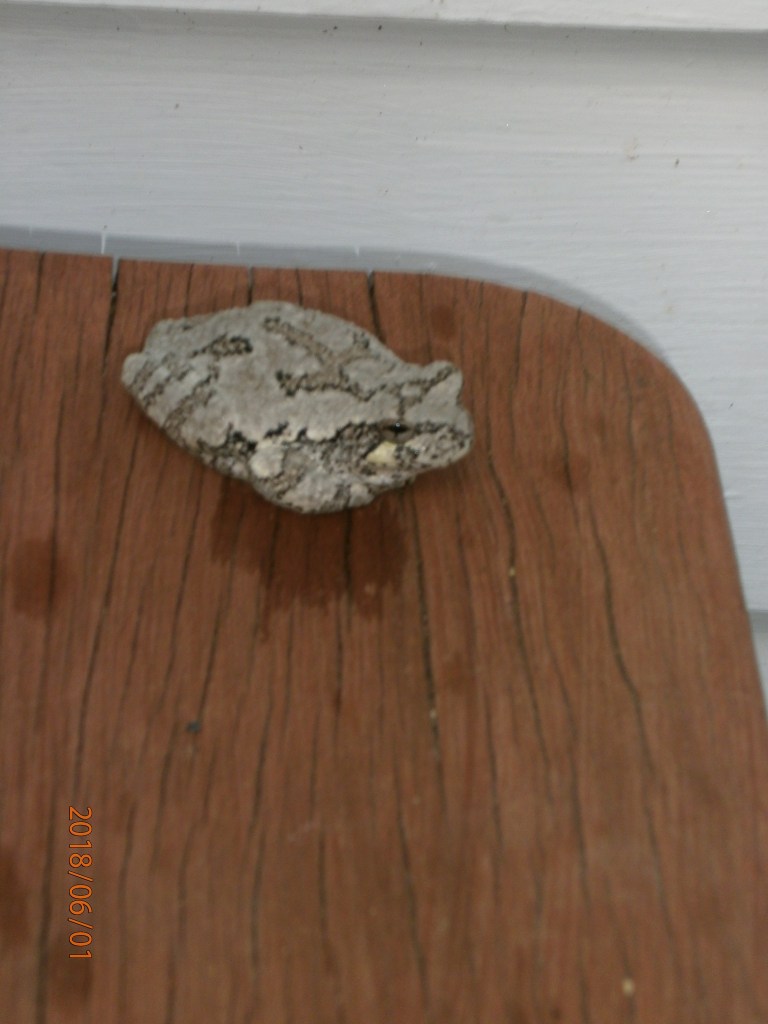
Which leads me to this blob below, that I thought was a marvelous stone/big pebble, that someone had placed on an outdoor table. I observed it, tried to pick it up, didn’t get close enough, it jumped and re-settled, and gave me enough of a shock but plenty of time to take the photo.
I woke up this morning to learn about psychological manipulations and how to re-wire brains, all in the context of computers, algorythms, robots, zombies, religion, the military, PTSD, survival, old age, trauma, chameleons, hospitals, internal organs, and disease.
This is too much fun for me, so I have to dig in and find the common link. And all because of a disguised rock that was, what, a “stone” frog? A “tree” frog?
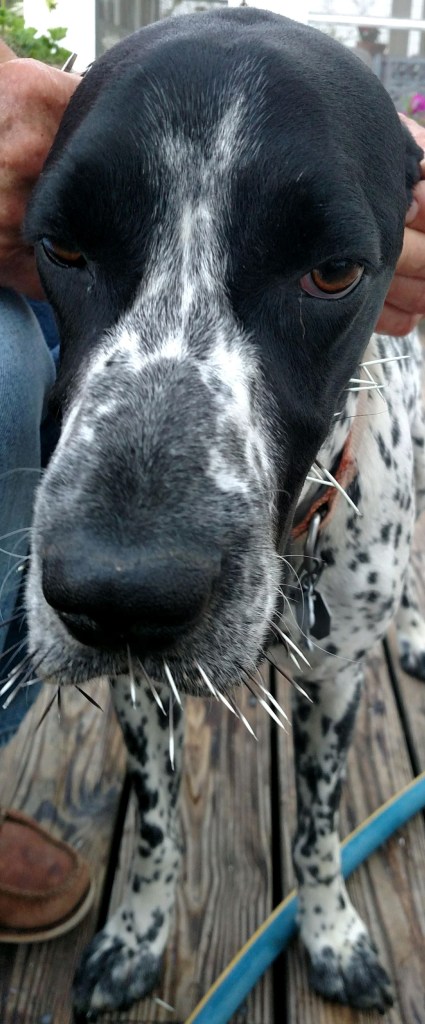
I have journaled much about the role of friends, especially as it involves those “old old” friends that disappoint to the core. I am learning that the sting of disappointment is like being stuck with porcupine quills.
The barbed tip hurts, and removing by yanking on the quill is painful. However, like everything else in life, you begin to evaluate how to ease the pain of extrication. If I had only known when Milly got these quills what I do now, she would not have suffered so much. Tip: you first have to cut them in half so that they go limp, the fish-hook tip relaxes, and you can pull them out softly and with reduced pain because the quills become flaccid and pliable!
I am spending much time with good friends. Some I have known for a few months. Others, for a couple of decades. And some, for a few weeks. I value their support, compassion, and their reaching out when you least expect it. Most of all, I cherish the laughter we share together. A hearty good laugh is a balm for the soul.
Recently, I heard from friends from my youth. They brought back a torrent of emotions, for they helped me remember some of the “good old days” of yore, when we were studying and working and carefree. How lucky can one be?
I am blessed.
The Arrow And The Song
Long, long afterward, in an oak I found the arrow, still unbroke; And the song, from beginning to end, I found again in the heart of a friend.
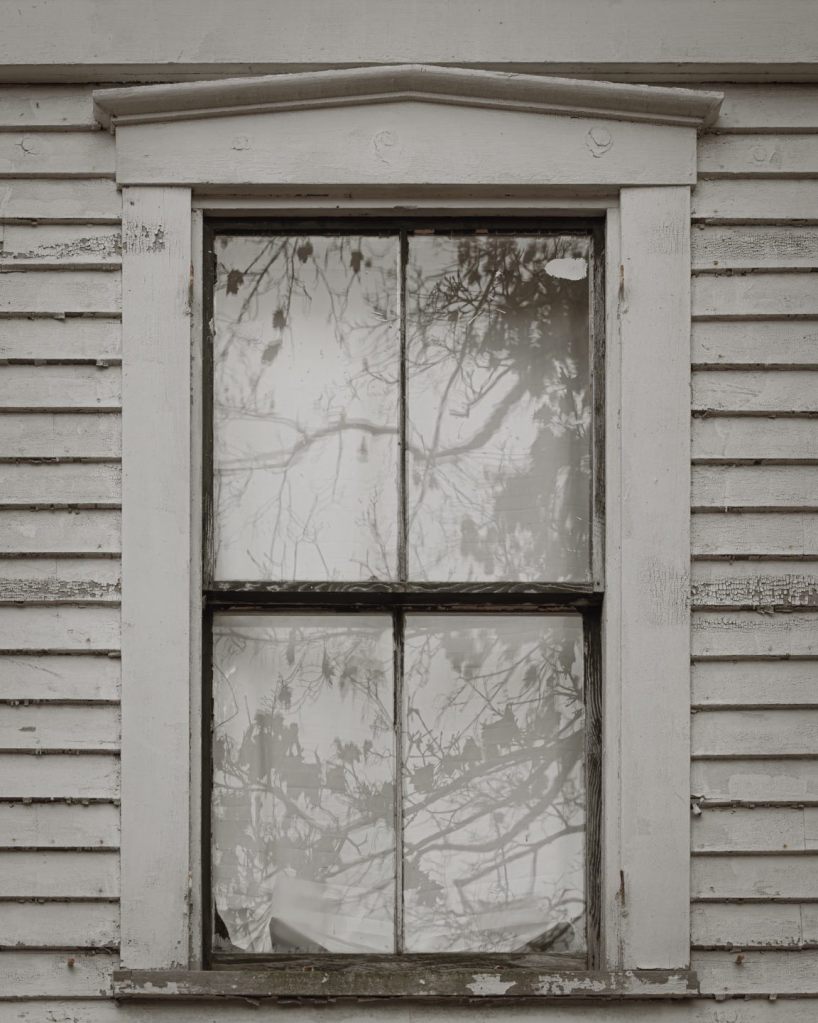
An amazing photographer, Kim Allen Goff, posted this beautiful photo on social media and commented,
“I’ve loved to peer into windows since I was a child and the older the house the better! The reflections on these windowpanes spoke the language of November.”
Immediately, her comment and photo reminded me of this Robert Frost poem, below. I read somewhere that, in this particular poem, “Sorrow finds beauty in its desolation”.
It is true.
Sorrow does bring forth reflection, and from that reflection springs clarity of understanding, and from that clarity -eventually- those turbulent waters reach their destination and may turn into a beautiful and calm and crystalline cove or lake. So there. I have to thank Kim for making me be happy about my birthday month! There is beauty in those reflections of the bare, the withered tree…
My Sorrow, when she's here with me, Thinks these dark days of autumn rain Are beautiful as days can be; She loves the bare, the withered tree; She walks the sodden pasture lane.
Her pleasure will not let me stay. She talks and I am fain to list: She's glad the birds are gone away, She's glad her simple worsted grey Is silver now with clinging mist.
The desolate, deserted trees, The faded earth, the heavy sky, The beauties she so truly sees, She thinks I have no eye for these, And vexes me for reason why.
Not yesterday I learned to know The love of bare November days Before the coming of the snow, But it were vain to tell her so, And they are better for her praise.
I’ve never been to Mt. Katahdin, but I have heard stories about the place, seen video taken by my nephew via drone, and watched my nephews traverse what’s called (I think) Knife’s Edge. Even today, the Wabanaki look to Katahdin as a sacred place, where the Spirit roams freely and powerfully. Because I was privy to some nightmare stories of scoundrels soiling the beauty of the place and violating the mountain’s sanctity, I sometimes have thought of Edgar Allan Poe and Alfred Hitchcock and what a tale the two combined could tell. Horror and torture.
I hope one day to go explore Ktaadn with someone who is a curious and kind soul, with a lyrical appreciation of majestic beauty and sensitive enough to have read the author and absorb the spell of what Thoreau and others tried to convey. And treat the place with the respect it deserves.
Thoreau climbed Ktaadn, but never made it to the summit. However, he did actually go fishing and caught his own trout!
“In the night I dreamed of trout-fishing; and, when at length I awoke, it seemed a fable that this painted fish swam there so near my couch, and rose to our hooks the last evening, and I doubted if I had not dreamed it all. So I arose before dawn to test its truth, while my companions were still sleeping. There stood Ktaadn with distinct and cloudless outline in the moonlight; and the rippling of the rapids was the only sound to break the stillness. Standing on the shore, I once more cast my line into the stream, and found the dream to be real and the fable true. The speckled trout and silvery roach, like flying-fish, sped swiftly through the moonlight air, describing bright arcs on the dark side of Ktaadn, until moonlight, now fading into daylight, brought satiety to my mind, and the minds of my companions, who had joined me.”
I love my little pond. It was the source of incredible joy for both my Mother in Law and my Father, in their eighties. So, every time I walk around it I feel their presence. It attracts strange characters, between herons, ospreys, kingfishers, snakes, and gazillion frogs.
Sometimes, walking around at night can be beautiful. However, I worry about the coyotes and bears that are too real around here. The Pepe Le Pews I can handle. Skiddle doo. And the porcupines: am ashamed to say I only learnt recently that they don’t hurl the quills; that’s cartoon nonsense. HAH! I believed the cartoons, and am a bit deflated knowing that it was nonsense.
Yet, the big bucks have butted heads with our benches, hurling them into the pond… not once, nor twice… (by the way, all old saltwater little farms in this area must have a pond, because there are no fire hydrants around!).
My Father would stare at the great blue heron and ask me for the umpteenth time: “Barbara, what is heron in Spanish?” “Garza,” I would reply. “Oh, my, watch that garza, how stealthily it walks…” And on and on. How I wish he were here today with me asking the same question, over and over again. I never got tired of it. I loved it.
It is this dear little pond with its many bullfrogs and frogs, that finally made me understand a beautiful Argentine folk song, which I have loved since I was a 7 year old. Because, whenever there is a moon, it rises and reflects on this little pond.
Isn’t it weird that a little pond in the far away North of the USA, close to the Canadian border, helped me fully understand the poignancy of a folk song that originated way, way South, in the southern tip of the Americas, close to Antarctica?
I identify with the toad, and now realize that my melancholy about the lyrical toad song was prescient. Life’s trials and tribulations have confirmed to me that the moon can be cold, because it gave its blood to form the stars, and that life can be dismal if we don’t live it with any hope.
Toad of the night, lyrical toad, Who lives dreaming next to your lagoon, Tenor of the puddles, grotesque troubadour, You're bewitched by your love for the moon.
I know of your life devoid of glory; And know the tragedies of your restless soul Likewise, that madness of loving the moon Is the eternal madness of every poet.
Lyrical toad, Sing your song, Because life is dismal If we don't live it with any hope
You know that you're ugly, ugly and misshapen; That's why by day you hide your ugliness And by night you sing your melancholy And your song resounds as a litany.
Your voices ring out in candid obstinacy; Your verses are in vain for their striking beauty; Don't you know, perchance, that the moon is cold, Because it gave its blood to form the stars?
Lyrical toad Sing your song, Because life is dismal If we don't live it with any hope.
Lately, I seem to run into serendipity every time I turn a corner, or so it seems. Pure chance? I don’t know. I have my suspicions. Sometimes, I do think I am being gently guided to discover and understand and be in awe of what was, what is, and what may be.
Such is the case with a beautiful song I have been practicing, in a new venture of mine, singing with an amazing group of professional choristers.
The song is called The Snow, based on a poem written by Lady Caroline Alice Elgar. Her husband, Sir Edward Elgar (he of Pomp and Circumstance fame) wrote the music.
What struck me was the melody and the poignancy of the lyrics.
In essence, it is a meditation: why the soul in its purest form ought to be as white as snow. But life happens, and one’s heart should strive to be strong in the face of adversity, bleakness and dejection.
For under a blanket of snow, lies the sadness of the wilting flora. Eventually, though, the snow melts and is no longer pure and white. It fades away. It is fleeting. Here today and gone tomorrow. But the cadence of nature continues, and the soul should propagate clarity, integrity and faith in sombre and stinging times.
And when inevitably we lose our luster and fade away, like the melting snow, we should “endure through all the years full sure “: that is, cling as best we can to our core values, nurturing our principles, staying true to ourselves, and never giving up regardless of fate.
Below is a beautiful rendition by the University of Manchester Chorus.
THE SNOW
by Caroline Alice Elgar

O snow, which sinks so light,
Brown earth is hid from sight
O soul, be thou as white as snow,
O snow, which falls so slow,
Dear earth quite warm below;
O heart, so keep thy glow
Beneath the snow.

O snow, in thy soft grave
Sad flow'rs the winter brave;
O heart, so sooth and save, as does the snow.
The snow must melt, must go,
Fast, fast as water flow.
Not thus, my soul, O sow
Thy gifts to fade like snow.

O snow, thou'rt white no more,
Thy sparkling too, is o'er;
O soul, be as before,
Was bright the snow.
Then as the snow all pure,
O heart be, but endure;
Through all the years full sure,
Not as the snow.
Well, this poor birch bark dropped down and lies asunder, despite having been joined together to the tree, Robert Frost. I think the weight of life was just a bit too much to bear.
....Earth’s the right place for love:
I don’t know where it's likely to go better.
I'd like to go by climbing a birch tree,
And climb black branches up a snow-white trunk
Toward heaven, till the tree could bear no more,
But dipped its top and set me down again.
That would be good both going and coming back.
One could do worse than be a swinger of birches.
Or, maybe, it suffered from the suppressed anger that not only leads to the destruction of one, but to the moral corruption of the other.
A POISON TREE
By William Blake

I was angry with my friend;
I told my wrath, my wrath did end.
I was angry with my foe:
I told it not, my wrath did grow.
And I waterd it in fears,
Night & morning with my tears:
And I sunned it with smiles,
And with soft deceitful wiles.
And it grew both day and night.
Till it bore an apple bright.
And my foe beheld it shine,
And he knew that it was mine.
And into my garden stole,
When the night had veild the pole;
In the morning glad I see;
My foe outstretched beneath the tree.
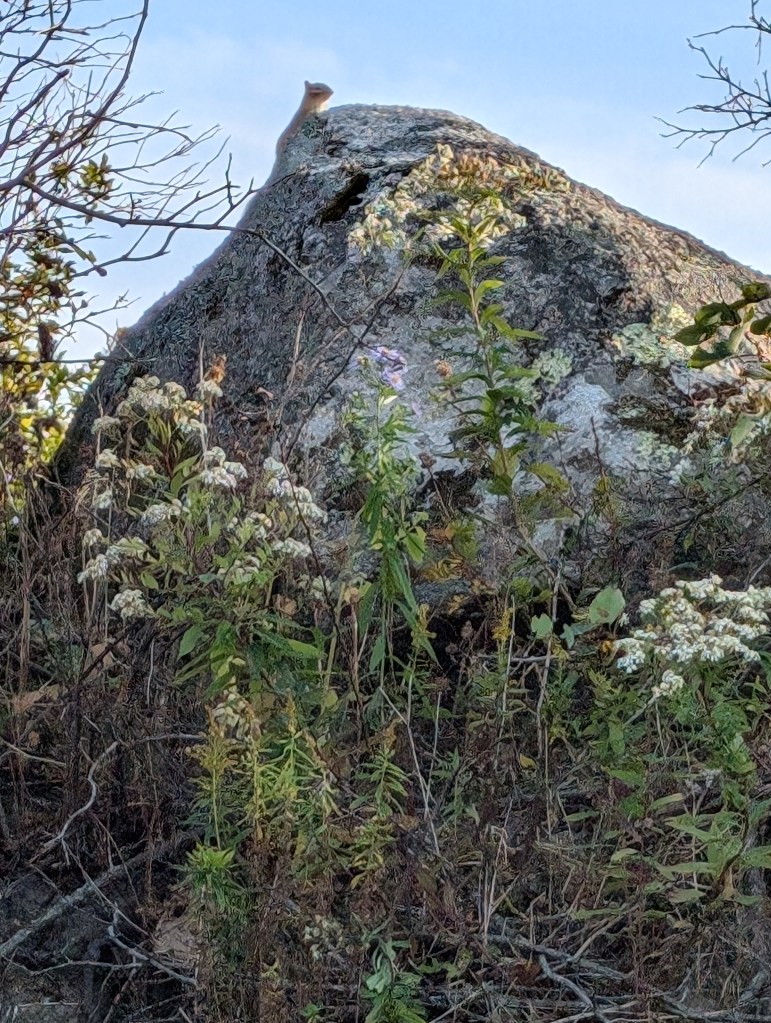
She stood almost at the peak of the glacial erratic. She never budged, despite my getting near. The foxes abound, the seagulls hovered around, and yet she was not scared.
There are acorns everywhere, and the chipmunks and the squirrels are busily burying them in a hurry. Diligent and peculiar little things! She gave me food for thought. I also had stepped up on a rock, looking at the horizon, deep in introspection until I heard the squeaky chirp. It turns out that the sounds squirrels make are identified as kuks, quaas, moans, twitches and flags. What a collection of names! Hunters can buy squirrel callers to lure them. Apparently, the squirrels are considered a nuisance everywhere since they chew on aluminum siding.
FABLE
By Ralph Waldo Emerson

The mountain and the squirrel
Had a quarrel;
And the former called the latter ‘Little Prig.’
Bun replied,
‘You are doubtless very big;
But all sorts of things and weather
Must be taken in together,
To make up a year
And a sphere.
And I think it no disgrace
To occupy my place.
If I'm not so large as you,
You are not so small as I,
And not half so spry.
I'll not deny you make
A very pretty squirrel track;
Talents differ; all is well and wisely put;
If I cannot carry forests on my back,
Neither can you crack a nut.’
I don’t know. She is too cute, even though she may be the very squirrel that dragged about 3 meters of toilet paper from my bathroom, and shredded it in places, I guess to start making its nest for the winter. I’d rather think of her as the one that quarrelled with the mountain.



 Dum Spiro Spero