Huronia, the Land of Canada’s and North America’s Oldest Christmas Carol

I had long forgotten a delightfully illustrated thin book that I used to read and sing to my children, many moons ago.  It told the story of the Gitchy Manitou

Ah, the cobweb tendrils of my life never cease to amaze me.  I’ve had Québec on my mind for the last couple of months, because it is such a most beautiful city, rich in history, and so near to where I live.

The Sunday before Thanksgiving, I sat in a cold church, and, in the middle of the service, I heard the organist begin a song.  The words and the melody tugged at my memory:  “‘Twas in the moon of wintertime, When all the birds had fled…”  I looked at the program and there it was, The Huron Carol.  

The lyrics of the first Christmas Carol of North America are short and tell a story.  For some it’s a meaningful story.  For others it’s just a tradition that had consequences, bad and good.

However, for me, it was fascinating to discover that the author of this ancient Carol was a French Jesuit priest who hailed from Normandy.  Jean de Brébeuf lived among the Hurons and is recognized as someone who produced so many ethnographic records on the Hurons that his efforts were pivotal in preserving the Huron (Wendat) language.  His accounts were included in a collection of documents referred to as The Jesuit Relations, which are considered an important historical resource. He actually wrote a dictionary, among other things.

Brébeuf paid a dear price for being a missionary.  All accounts (at least the ones I have read) point to his love for the Hurons.  The Hurons’ archenemies were the Iroquois, who destroyed Huronia.  Yet even the Iroquois were so impressed at his bravery in the face of excruciating torture that they ate his heart in a symbolic recognition of his fortitude.  Or so they say.  History is not pretty.  But I can’t help but admire someone who took the time to study and create something that has been acknowledged as a legacy.  

Brébeuf became one of the patron saints of Canada, and, as far as I know, he still remains one, despite modern-day criticisms of how he described some of his encounters with the Hurons.

In my love of etymology, lo and behold, I discovered that Jean de Brébeuf wrote about a game being played among the Hurons in 1636 and it was he who named the game “lacrosse”, because the stick reminded him of a bishop’s shepherd’s staff or crozier.  

The Huron Carol, or Jesous Ahatonhia, beautifully illustrated by Frances Tyrrell, was published in 1991, and sometime soon, after that year, my Mother gave it to my children for Christmas.  They loved the story and the drawings.  It was a gentle introduction to a far away land with familiar concepts.   

At the time, little did my Mother know how one day, 25+ years, a little protestant church in the Blue Hill peninsula of Maine would spark memories of little children, pretty songs, tender memories of Québec, dictionaries and saints. 

The below video was a joint production of the Aboriginal People’s Television Project and the CBC Radio Canada. It aired in 2002.

Happy Thanksgiving!

“In the time of my confession…” I identify with these words, after all the Dostoevsky, Dante, Solzhenitsyn, Cervantes, Becquer and others I have dabbled in these last 6 months.

At the sunset of my life, I find a need to hurry and catch up with what I have missed because of all the excuses I have ever had in front of me: lack of time, busy at home and at work, demands of others, acedia, inertia, melancholy, whatever!

And in hurrying to catch up I discovered that “I hear the ancient footsteps like the motion of the sea; sometimes I turn, there’s someone there, other times it’s only me…”

But serendipity is my companion, and I discover something new each day that gives me clarity of purpose, clarity of vision, clarity of understanding.

Like yesterday, when I was researching about Chorales and sacred music and trying to pin the correct biblical passages to the words. This is how my mind works.

And where did I land in this cacophony of beautiful music and lyrics? On a lamentation I had never heard of, sung by Bob Dylan, in that raspy voice that I have never quite liked! (I know, I know, unbelievable, right? Laugh. It’s true.) But today, I finally learnt to appreciate the poignancy of his voice.

Last night, I looked up to a black sky, peppered with stars, and one just fell down not too far from my horizon. It was a long and vivid wishing star, and I was thankful for:

– my living family,

– my long departed family,

– old loyal, trustworthy, real and compassionate friends,

– gentle and kind and empathetic new friends,

– a young car mechanic who spent time helping me just because, pro bono,

– a young professional who didn’t know me from Adam but reached out to guide me,

– an old man with tears in his eyes who gave me his shaking shoulder to lean on,

– a little boy who presented me with his dearest friend, Curly the Tarantula,

– a teenager who gave me her advice on affairs of the heart,

– my two loyal pups who have never ever failed me, Milly and Thibault,

– my “rock of Gibraltar” and best buddy who helps me decipher life’s labyrinths.

So much to be grateful for… Happy Thanksgiving to all of you. May you so be blessed as well.

Every Grain of Sand

Along Came a Spider

Along Came a Spider…

I noticed the boy keenly observing me through a glass door as I walked to a friend’s house for dinner the other night. I smiled at him, and he darted inside. But after all the initial hellos among the adult guests, the little boy quickly approached me and stared at me. So I introduced myself, and he looked me up and down, and then we began an enchanting conversation that basically lasted a couple of hours!

He is 10 years old, loquacious, inquisitive, and ready to share what he knows. He sat down next to me and proceeded to tell me all about a racist bully he has to contend with in school (the boy, as he explained to me, is a mix of white and black, and that’s why he has light coffee-colored skin and there are very few blacks if any at his school. The bully is 9.).

He then moved on to talk about the video games he enjoys playing, the collection of Pokemon cards that one day will cost $500,000 on Ebay because they are collectors’ items, and the beauty of ghost crabs that only come out at night time to stare at the moon. “They are shy, you know”. He tried to play the ukulele that was on a chair, but with no success. “Hah, I’ve never tried to play the ukulele!”. I told him about my “charango”, an Argentine ukulele-sort of instrument made out of a real armadillo body. “Wow!” I promised him I would show it to him.

He then darted off somewhere and quickly returned with his second most prized trophy: a brown cap with a gold medal insignia that belonged to a member of the military, part of the uniform in World War 2. (I believe it is an USAAF officer’s visor crusher cap with a round insignia). He ruefully admitted it was not in such great shape, but it was ancient he said, so he loved it because he will be joining the Special Operations Command Forces. No ifs, or buts. He can’t wait.

He gave me a side glance and asked me if I liked Snoop Dogg, because he is his favorite rapper. I could genuinely answer yes, miracle of miracles! And he smiled. I told him I didn’t really know the songs, though. “Oh, yes”, he said. “ If you know of him you’ve heard his songs. I will play you some of them next time we see each other”. “It’s a deal”, I said. Dear God, I thought. What are the chances that I would know Snoop Dogg? But the boy was pleased.

He gave me a quizzical look and said, “You are very Christian, huh?” “Well”, I replied, “I do believe in Jesus and that there are good people and bad people who ought to know better. But I probably could be a better Christian”. “Oh! One of my Grandmothers who is not related by blood says she is very Christian but is mean to me, and says she doesn’t like me”. And barely pausing, he then mentioned the poisonous scorpion that he owns, but had to leave with a friend because, well, it’s poisonous and his Mother did not want it in the house. I mentioned the story of Coyotito, who is stung by a scorpion in Steinbeck’s The Pearl. Wide eyes stared at me.

Then, with the biggest smile, the boy said “Well, I want you to meet Curly”. “And who is Curly?” I asked. I thought of a labradoodle or poodle. “Oh, she is my best friend, a curly haired tarantula bigger than my hand. I can bring her over right now”. And with that, I snapped: “Oh, no, you won’t. I have a phobia about spiders. And I am not staring at a hairy thing before bed tonight!”. He burst into peals of laughter and then, calming down, he said he would bring me to his house the next day, during day time, to show me his most valuable possession, Curly, and that she is the sweetest, gentlest creature that ever walked the Earth.

Today, I heard a soft knock on the door, and I opened it surprised, because it was early evening and I was not expecting anyone. There was my new friend, holding a box with a couple of slices of pizza. His Mother was waiting in her car. He smiled and said he had thought of me while having dinner with his Mom and that he knew I would like pizza. “So here! Oh, and by the way, tomorrow I come to take you to meet Curly. You’ll love her!”.

Terezin: The Paradise Ghetto

PROLOGUE: Because I thrive on music and philosophy and an insatiable curiosity (my own Balm of Gilead), and am trying to make sense of the river of life, I discovered a little slice of what I wrote in my now defunct blog on July 19, 2010, which I thought I would share. Am re-constructing my blog, which used to be a repository of things that maybe some of my friends and family and colleagues would have found of interest. So, here it goes, with a couple of updates:

————————————————–

What a lovely way to perpetuate the legacy of a young musician and composer, Gideon Klein, whose life was destroyed in the German concentration camps of World War II. Thrice he wrote in a letter smuggled out of Auschwitz, “Don’t Forget About Me.” How many of us have had this thought?

Birkenau, or Auschwitz II, is where all the Jews from the Terezin Ghetto were sent. Terezin is also known for the devastating loss of children… Among the many who perished in Auschwitz and other extermination camps after having “transited” in Terezin was Peter Ginz, an 11-year old boy, who drew his vision of travel in space in the early 1940’s. Ironically, his drawing survived him; it eventually ended up in the national museum in Israel.

It was a replica of this particular drawing that Ilan Ramon, the Israeli astronaut who died in the Columbia shuttle accident, took with him on his fateful journey. More than 50 years after this boy’s life was snuffed, this replica was destroyed in an overwhelmingly dramatic accident, a terribly sad tribute to the boy’s violent death! Amazingly, the shuttle flight happened on February 1, 2003: Peter Ginz would have celebrated his 75th birthday.

If you like to go down rabbit holes like I do, here is a great read on Gideon Klein.

Below is a short video from Radio Free Europe/Radio Liberty that attests that despite his short life, Gideon Klein was never forgotten. Watch this special short story – it is so poignant:.

“Terezin’s Musical Legacy: A recent Prague Spring concert honored musicians and artists in the Terezin concentration camp who died in the Holocaust. Terezin Music Foundation founder Mark Ludwig pays special homage to composer Gideon Klein, who died aged 26.”

The Crooked Fingers

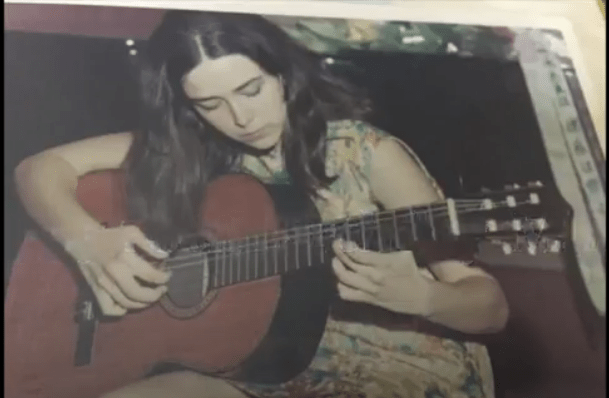
They stopped the air conditioning.  The little hall went silent.  Except for my parents, siblings, and my High School dear friend, the audience was Japanese.  I was petrified.  My Japanese guitar teacher had insisted that, part of his teaching me meant that I had to perform in his annual repertoire of students.  I was his only “gaijin”, that is, the only foreigner.  

Mind you, he seemed so old!  He was probably in his 30’s, but I was a teenager, I was 16 years old.   He did not speak English nor Spanish nor French.  I knew enough Japanese to take a taxi or shop.  But we communicated on a weekly basis through our mutual understanding of clefs, crotchets and quavers.  Isn’t that a universal language?

He was so formal!  He always bowed when he came to my house – 9-11 Minami 3-chome, Ebisu, Shibuya-ku, Tokyo- impeccably removing his shoes and putting on the slippers.  I bowed back, but not quite well.   Under the severe thick black-rimmed glasses, he had a twinkle in his eye, a beautiful smile, and the most amazing fingers that plucked the guitar and made it weep. 

But I did not notice these things then.  I was too immature.  I was ambivalent about my lessons with him, and I knew I always disappointed him.  I never practiced enough.  Ie, ie ie.  No, no no.  Hai, hai, hai.  Yes, yes, yes.

Somehow, we understood each other.  He came dressed in a dark suit and a dark tie.  He seemed severe, but when he took that guitar and strummed it, all his Japanese formality of those days melted away.  He loved classical guitar and would get exasperated with me because he did not find in me the same enthusiasm.  Little did he know that I did have it, though it was a bit dormant.  I was too young then!

So the day arrived when I had to perform at the concert.  Invitations had been sent, beautifully calligraphed on thick rice paper.  バーバラ ディロン.  Barbara Dillon, in Katakana.

If memory serves me, I played 3 musical compositions.  Within the first couple of minutes of my taking the stage, the air conditioning was turned off because it made a purring sound.  For some reason, someone in that hall decided to give me total silence for the performance.  It then became quiet, like a tomb.  I had stage fright, my fingers were trembling, but I wanted to make my professor proud.  After all, I was, as the Argentines say, “sapo de otro pozo” (a toad from another well). 

In that deep silence, I took the plunge.  I still remember plucking those strings and how, soon enough, I fell into the right rhythm and cadence and mood.  The silence of the hall was deafening.  But, miracles of miracle, I never ever made a mistake!  At the end, the applause was overwhelming.  I looked up and saw my family and friend beaming.  And, standing in the back of the room was that gentleman and gentle professor with the biggest smile I had ever seen.

I studied classical guitar through college and my Father got me the Argentine equivalent of a Stradivarius.  He had high hopes.  I did not deliver.  Life interfered.

I have always returned to my guitar especially when I have needed succor and relief from sorrows.  Today, my fingers are no longer spry.  They are a little bit crooked and stiff with age.

Yet, I am soon getting back together again with my guitar and music scores of days gone by…and these crooked fingers will get the exercise that my soul has been longing for, finally!