Moonlit Maze of Sorrows

This last Sunday brought back many memories of long lost family members and friends, some exceedingly beautiful, some heart wrenchingly sad.

A magnificent Flower Moon rose up from the trees and, beneath its tender glow, I pondered how fragile and fleeting life is —here one breath, gone the next.

Because someone dear to my heart – who a few months ago was a total stranger whom I met through a purely business transaction, but soon reached out to me with a gentle and comforting hand – suffered a life altering traumatic experience that very Sunday: a shattered backbone.

As I looked at that Flower Moon I realized how insignificant our own problems can be. How a freak accident alters the course of our lives and makes us stumble under fate’s cruel weight. Sometimes the pain we survive comes from a broken body. Other times, from a broken soul.

There’s not much I can do, other than provide encouragement and trivial support. I find prayer has always helped me cope, heal and recuperate.

Last year, when I found out someone was facing a major health downturn, I discovered that the patron saint of sick people and doctors and surgeons is St. Luke. Yes, the one who wrote one of the Gospels. I know, I know. Leave it to the Catholic Church to have a patron saint or two for anything that ails us or spooks us. Yeah, yeah, yeah. I get it.

However, I had forgotten that St. Luke had been the “beloved physician”. So he is not just an à-la-carte saint du jour. So, in the spirit of ecumenical brotherhood, since Luke was most likely a Jew and my friend is a Jew, I told my friend I would reach out to the patron saint of surgeons before the delicate operation. What do we have to lose, right? And as my friend said, at this juncture, we take all the help coming from any which way.

As I stared at my Flower Moon I reflected on how fleeting life is and on how we can navigate a moonlit maze of sorrows while dancing the eternal dance between life, love and death.


Crossing The Line

This past week I was greeted by a line.  A vivid pink line.  I marveled at it, thinking it reminded me of something, although “the what” escaped me.  And yet, I kept observing, because I kept thinking of “crossing a line”.  We cross so many lines in our lives, and seldom do we contemplate why.  At least that’s me.

I turned away for a few minutes, and when I returned to keep observing, I was greeted with a different image altogether.  Gone was the line and the pink.  Instead, there was a silvery sun with its silvery reflection.  It is times like these that I wish I were an artist, and could capture the beauty of a sunrise like this one.

Sea, sun, sky and a straight line.  Crossing a line.  I always think about my family and friends and acquaintances who are no longer here.  Someone once said to me that I was “tetric” (meaning gloomy).  Well, it is a common word in Spanish, and we used to use it in school in English, when I was growing up.  It turns out that apparently, according to the Oxford English Dictionary, it is an obsolete word that has been out of common usage since 1810 or so.  Go figure!  I still use it, so, baloney.  

And then it hit me, my tetrical self.  The crossing of that line:  a meditation on death!  A boat, the sea, the light, the tides, the sand.  And yes, the crossing of the bar.

CROSSING THE BAR
By Alfred, Lord Tennyson

Sunset and evening star,
      And one clear call for me!
And may there be no moaning of the bar,
      When I put out to sea,

   But such a tide as moving seems asleep,
      Too full for sound and foam,
When that which drew from out the boundless deep
      Turns again home.

   Twilight and evening bell,
      And after that the dark!
And may there be no sadness of farewell,
      When I embark;

   For tho' from out our bourne of Time and Place
      The flood may bear me far,
I hope to see my Pilot face to face
      When I have crost the bar.

Surely Goodness and Mercy shall Follow Me all the Days of My Life

Sunrise somewhere in Maine.

I just found a sermon a Presbyterian pastor once shared with me, because it made such an impact on me after the many deaths I had witnessed. It was his love song about the famous Psalm 23, The Lord is my Shepherd.

Beholding a most beautiful sunrise over calm waters this morning, the serendipitous encounter with the sermon I received in March 2019 made me reflect on a myriad of things. I share one paragraph of a series of many that the Reverend encapsulated as the essence of life:

“Surely goodness and mercy shall follow me all the days of my life”…

So what about the mess I have made of my life from time to time? What about the loved ones I disappointed, the people I deceived, the compromises I made with my conscience, the scars I left on those I harmed? No one likes to be followed, but in this case I take comfort in the possibility that goodness and mercy might not get too far out ahead of me, but might follow me, picking up the broken pieces of my past and putting them back together again. The assurance here is that goodness, which is the benefit of forgiveness; and mercy, which is the basis of every new chance at life, will follow me all the days of my life.

A Daughter’s Tribute to Her Mother

Today would have been Adriana Dillon’s 97th birthday. It has been 14 years since my Mother left us. 

Amazingly, though I spent many years remembering the dénouement, I am not sad thinking about her loss.  In fact, I don’t think of her as being absent from my life the way I did when it happened.  In many ways, she is ever more present than she ever was.

As my Mother was leaving this world, I emailed my children, who were not at her side, what their Grandfather, Aunt and Uncles and I were going through:

We have spent a lot of time laughing and crying together with her.  We have rosaries blessed by John Paul II and pray our Our Fathers and Holy Mary’s and St. Francis’ prayers… and then we will make jokes and laugh …

We are at peace, and know that Grannie is better off going to meet her parents, the Pope, Jane Austen, Charles Dickens, Thackeray, Balzac, Victor Hugo, and all her beloved authors.

Grannie always said she knew God would keep her in this world until we no longer needed her.  She needs to know now that we are strong enough to let go of her.

Reflecting on those last moments, I realize how lucky we were to be able to mix laughter with the tears, and to share until the very end the strong family bond that was at the heart of my Mother’s life.

I also realized then, after a full year of her death, the meaning behind the tradition of wearing black for mourning.  It was a way to let the world know that the mourner was going through a stage in his/her life that required others to understand, at the very least, his/her constant void and woeful sorrow.

I once wrote that “not all women who give birth are good Mothers, and many women who do not have children themselves make formidable Mothers. For the essence of Motherhood is in giving of oneself in a selfless manner.”  My Mother was the most unselfish person I have known.

Two years after her death I embarked on a new venture, one that would take me to Afghanistan, something that I found exhilarating and approached with trepidatious anticipation.  How I wish I could have shared with her my discoveries of Afghanistan’s history and poetry and art. There was enduring beauty I came across, despite the incessant danger and sadness of a war-ravaged place.

Her constant reflections and wisdom are my ever-guiding principles.  God’s mills grind slowly, but they grind exceedingly small was one of her favorite quotes. In my own experience, it is absolutely true.

She also made the best scones and empanadas one could ever dream of, and her High Teas were a feast to behold, like Babette’s.

I am grateful that she was spared the biggest viscissitudes that some in her family have encountered since her death. I miss her physical presence, her big eyes and warm smile.  She left an indelible mark that withstands the ebb and flow of time. 

Since death is inescapable, one of these days we will all be with my Mother again.   She was an incurable romantic.  What I would give to watch Pride & Prejudice with her one more time.

If only I could leave a minuscule fraction of good will for my children to reflect on, I shall leave this world like my Mother said, when God no longer thinks I am needed around.


Unmoorings

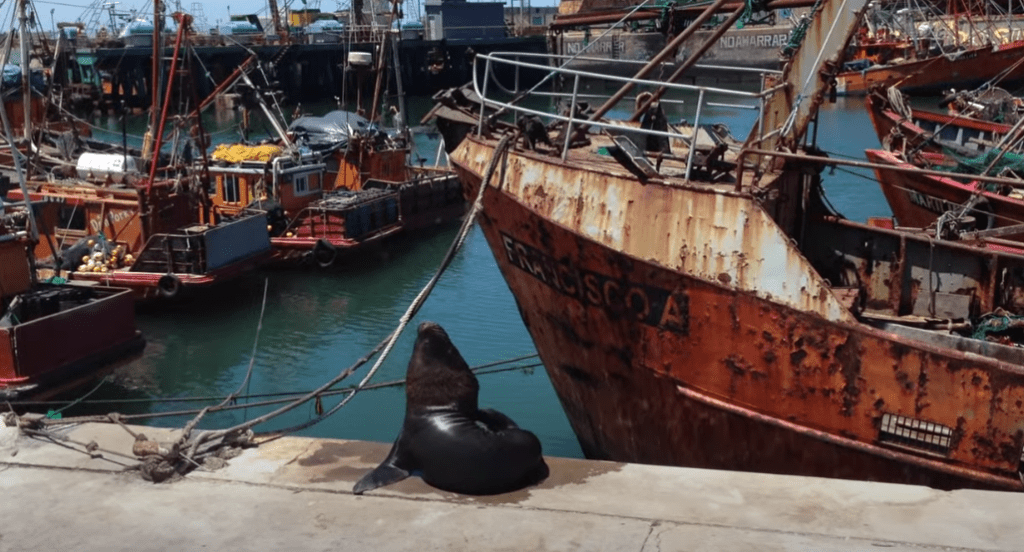
This old photo that I had taken long ago, of a dilapidated boat with a beautiful sea lion by its side, made me think about death, loss and hope.  Go figure!  

In my own experience with loss, I recognize how important it is for those who remain behind to share in the suffering of the stricken one. The dénouement that sometimes is slow in coming, and which eventually affects us all, can help us prepare for the inevitability of death, of shuffling off our mortal coils, and put things in perspective: that is, truly understand what is significant and what is not. This is something that I, for certain, have failed to distinguish repeatedly.

The sufferer may not realize it, in the midst of his pain and suffering, but the impact of his predicament has a ripple effect on those who love him, and, for the most part, makes the witness a better person for it.

In my experience, faith does play an integral part in all of this. Nihilism brings only despair.  The back pages of my memory of heady college days discussing Nietsche’s nihilism, and other philosophers’ perspectives on death and dying, confirm this to me.

My own reaction to reading others’ descriptions of coming to grip with their mortality validates to me that, as the antidote to nihilism, John Donne aptly meditated:  “No man is an island, entire of itself; every man is a piece of the continent, a part of the main; if a clod be washed away by the sea, Europe is the less…any man’s death diminishes me, because I am involved in mankind…”

However, I have discovered that death does not just involve a human body that withers away.  Death can come in a myriad of ways. 

Sometimes we are dealt blows that seem insurmountable:  a major disease, estranged relationships, abuse, betrayals, financial woes and other traumatic events, and our lives are unmoored, like a boat being tossed aimlessly in a sea of trouble.

But, every now and then, the boat does not crack open and sink.  Miraculously, sometimes it finds a place of shelter, and maybe, maybe it can even be salvaged.  The thread of life that is unwound by the Fates may not necessarily end up severed…frayed, maybe, but not severed, and life goes on.

Ah, but I was so much older then

I’m younger than that now