When I first started working with Afghanistan, one of my job requirements was to prepare a presentation for future advisors in the justice sector. These advisors were primarily American and international lawyers, judges, corrections officers, and a sprinkling of other experts.
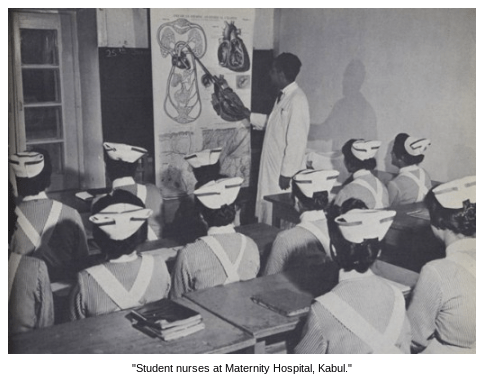
My research uncovered amazing stories and records of a time in the mid-20th century that seemed surreal. The shock of what had been versus what was. To wit, Once upon a Time in Afghanistan.
This research led me to a jewel of a movie, that I considered a love feast for the eyes, because in a short time, it captured the beauty of the country and its people. I had witnessed it myself, despite my being confined to a limited area in Kabul. This was around October 2012.
I never forgot that film, and that’s why I share it today.
I always think of Afghanistan, and everyone I met there, and I still feel sadness at how all our efforts seemed to go up in flames. Sometimes I wonder whether it was all for nought. Maybe, maybe, I am too pessimistic and there’s a glimmer of hope. Miracles do happen.
I have always found solace in the peaceful beauty of a wonderful landmark in my neck of the woods, the little Catholic Chapel called Our Lady of Holy Hope in Castine. It is unpretentious but commands a most spectacular view. Someone once made a disparaging comment that it was an afterthought built for the “help” of the more affluent citizens of the town. Maybe. But I have my doubts.
The little Church sits where Fort Pentagoet was, and an old plaque inscribed in Latin showed that the French had built it. “A University of Maine archaeological team recently established that a Catholic chapel was originally built by the French in 1635 on the site of the present Our Lady of Holy Hope chapel in Castine. From all indications this mission was one of the first in Maine and in the United States.”
I have gone to this place many a time to think, meditate, ponder about the joys and vicissitudes of life, feel closer to my parents and other dead relatives, and reflect on the role that the French Catholic priests of the day played in establishing relationships with the indigenous population.
In fact, it was a Jesuit priest, Father Sebastien Râle, who spent most of his life among the Abenaki, who produced an Abenaki-French dictionary that is recognized as an opus because it helped preserve the language.
I perused that dictionary and it is why I came up with the name “K’chi Casco” for our little farm (meaning Great Heron).
Earlier on a breezy summer day, wondering when or if children and grandchildren might visit, fishing and hiking trips might end, thinking about the University of Maine end-of-summer picnic we were hosting, anticipating an upcoming trip to Europe to reunite with friends (and how I hate to fly, which is a real curse for me), I came across the two sailing ships. Lo and behold, thank God for the phone. I caught them competing with each other and then the Cross providing a magnificent frame…(I think so!).
And now, uploading these photos, I remembered an ancient song based on Charles Kingsley‘s poem, that I had learnt as a kid, thanks to my formidable Great-Aunts, who were steeped in old English literature and lore. I used to sing it with them, and it was the saddest of tunes and lyrics.
However, one day, when I was 10 or so, I heard a young Joan Baez singing it mournfully like a loon, the way I thought ought to be sung. I still do.
I sometimes wonder if I am the only one who takes these labyrinthine journeys through the memories in my heart and mind.
Three fishers went sailing away to the West, Away to the West as the sun went down; Each thought on the woman who loved him the best, And the children stood watching them out of the town; For men must work, and women must weep, And there's little to earn and many to keep, Though the harbor bar be moaning.
Three wives sat up in the lighthouse tower, And they trimmed the lamps as the sun went down; They looked at the squall, and they looked at the shower, And the night-rack came rolling up ragged and brown. But men must work, and women must weep, Though storms be sudden, and waters deep, And the harbor bar be moaning.
Three corpses lay out on the shining sands In the morning gleam as the tide went down, And the women are weeping and wringing their hands For those who will never come home to the town; For men must work and women must weep, And the sooner it's over, the sooner to sleep; And goodbye to the bar and its moaning.


 Dum Spiro Spero