The Waving Porcupine and The Peculiarity of My Idiosyncrasies
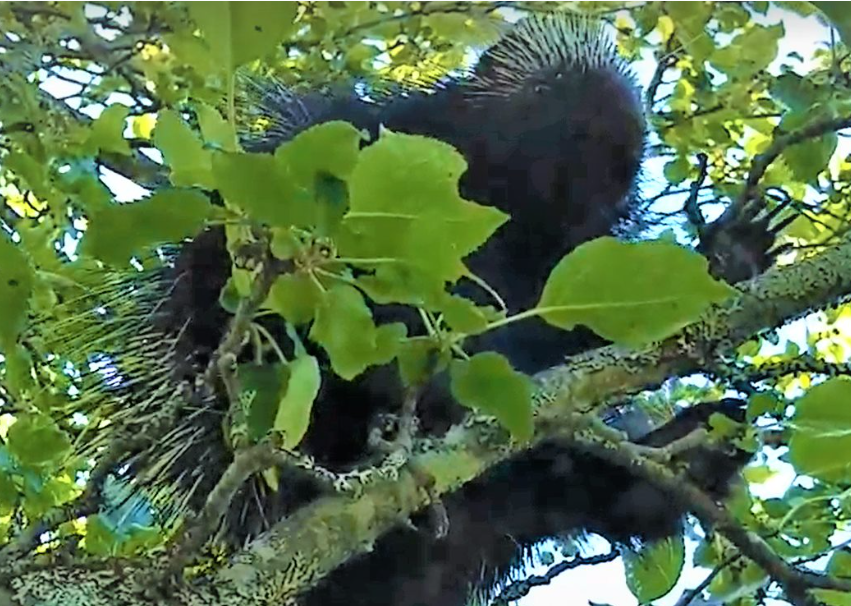
A couple of years ago I met this fellow.  

I was talking to my loyal friends, Thiebault and Milly, about the incongruences of life, imagining what other stories I could write for my grandchildren about life in Maine with Aesopian morals to the stories.  A peculiarity of my idiosyncrasies, so to speak.

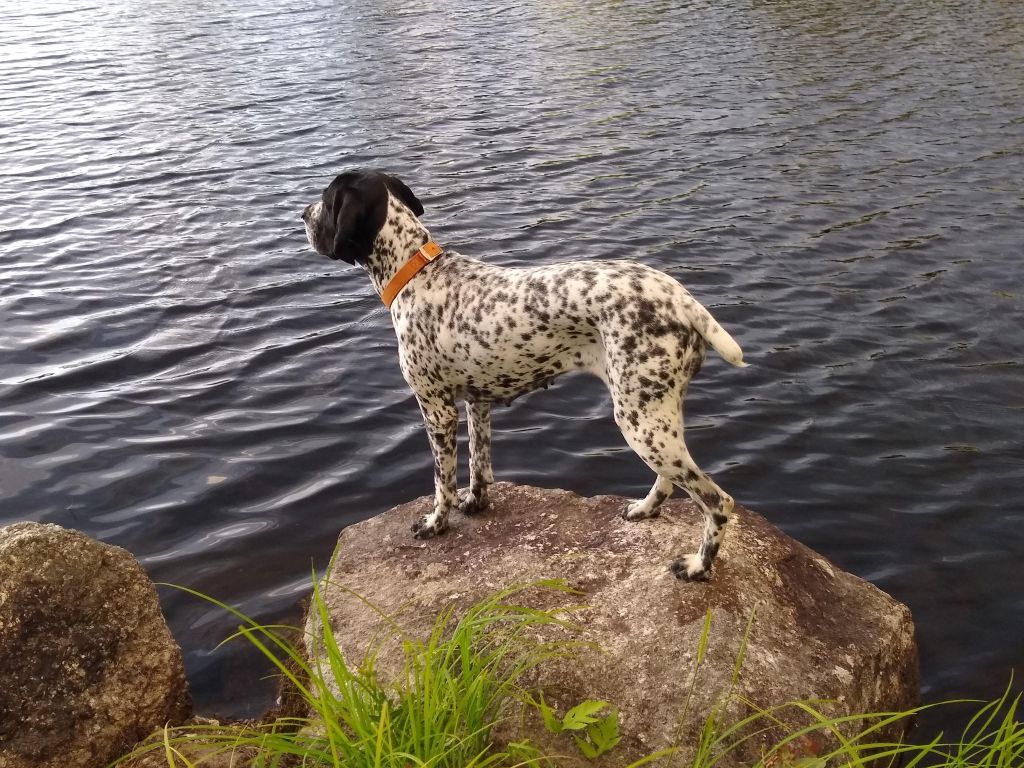
When I first moved to Maine full time, I had an indescribable urge to write stories for my grandkids -a welcome change from writing government contracts and reports-, describing life by a pond full of frogs and visiting herons, feisty spring lambs, buzzing bees, running bears, suicidal deer, wailing coyotes, hungry goldfish, swooping eagles, and yes, the ubiquitous and shy porcupines that the dogs and I followed too closely. Milly and Thiebault got quite a few quills on their snouts.  I got around 3 on my middle finger.  I later learnt that key to removing the quills was to cut them first so that they would go limp and could easily slide off.  But, oh well.  Suffice it to say I didn’t suffer as much as the dogs!

Sometimes, though, life gets in the way, and I just wrote drafts and more drafts, but failed to produce the finished product.  Nonna of Penobscot, as my grandchildren know me in stories (if they ever read them!), putt-putt-puttered to a halt.  Not because of writer’s block, mind you. 

It took me a while to realize that my problem wasn’t anthropomorphizing, but the reverse: I was projecting adult human traits and behaviors onto my animal characters, which restricted their growth by tainting their noble qualities with the often uglier and truculent aspects of adulthood.  I was dehumanizing them because I was having a hard time finding redeeming qualities among my fellow earthlings!

On Mother’s Day, I stumbled upon this grainy photo that I took a lifetime ago.  Have you ever seen a porcupine wave?  I remember how mesmerized I was by its intense stare and the slow raising of its paw.  And oh, those fingers!  After a wonderful chat with my children, I went back to my darling porcupine.

Before I knew it, I shed the veil or scales clouding my brain.  I already have the draft of the next Nonna of Penobscot fable.  Will it come to fruition?  Who knows.  But I am embracing the peculiarity of my idiosyncrasies:  why not tackle playful or absurd imagery like a spiky creature in a tree delivering a sassy farewell—while delving into serious themes of suffering, yearning, pride, deceit, betrayal, greed, cruelty and redemption. 

Might there be a knack for blending whimsy with a sharp disdain for disloyalty, like imagining a porcupine waving goodbye to backstabbers from a tree. All of a sudden I found myself once again gravitating towards my own concoctions, which may be my own special way of processing emotional boundaries through quirky, symbolic scenarios. If I can quote myself, “I’ll laugh at the absurdity of life, but I’m dead serious about cutting out the deadbeats and the riffraff of life!”

So, I have been jotting things down left and right.  Now, will I finally finish my stories?  Who knows.  But I feel happy!  And all because of a little porcupine that waved my stumbling conundrum away.

Crossing The Line

This past week I was greeted by a line.  A vivid pink line.  I marveled at it, thinking it reminded me of something, although “the what” escaped me.  And yet, I kept observing, because I kept thinking of “crossing a line”.  We cross so many lines in our lives, and seldom do we contemplate why.  At least that’s me.

I turned away for a few minutes, and when I returned to keep observing, I was greeted with a different image altogether.  Gone was the line and the pink.  Instead, there was a silvery sun with its silvery reflection.  It is times like these that I wish I were an artist, and could capture the beauty of a sunrise like this one.

Sea, sun, sky and a straight line.  Crossing a line.  I always think about my family and friends and acquaintances who are no longer here.  Someone once said to me that I was “tetric” (meaning gloomy).  Well, it is a common word in Spanish, and we used to use it in school in English, when I was growing up.  It turns out that apparently, according to the Oxford English Dictionary, it is an obsolete word that has been out of common usage since 1810 or so.  Go figure!  I still use it, so, baloney.  

And then it hit me, my tetrical self.  The crossing of that line:  a meditation on death!  A boat, the sea, the light, the tides, the sand.  And yes, the crossing of the bar.

CROSSING THE BAR
By Alfred, Lord Tennyson

Sunset and evening star,
      And one clear call for me!
And may there be no moaning of the bar,
      When I put out to sea,

   But such a tide as moving seems asleep,
      Too full for sound and foam,
When that which drew from out the boundless deep
      Turns again home.

   Twilight and evening bell,
      And after that the dark!
And may there be no sadness of farewell,
      When I embark;

   For tho' from out our bourne of Time and Place
      The flood may bear me far,
I hope to see my Pilot face to face
      When I have crost the bar.

Three Avian Musings from Days at The Beach

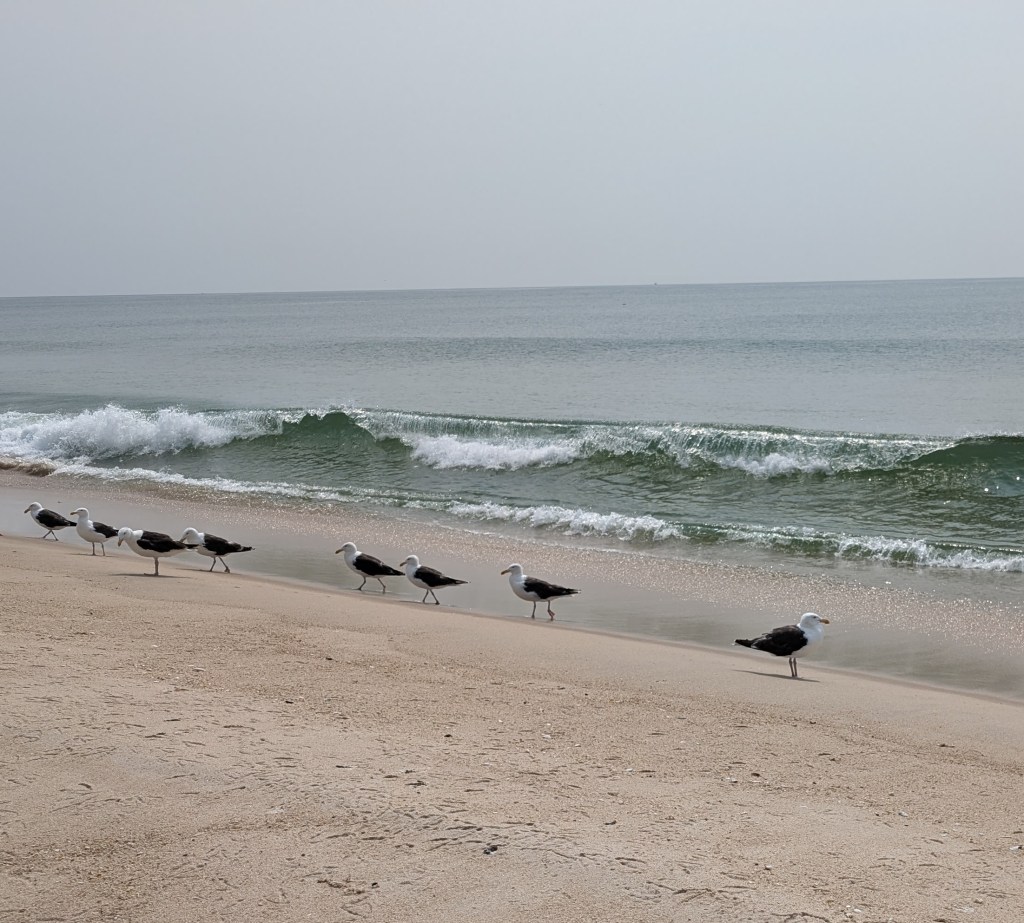
One day this summer marked a special series of milestones of mythological proportions in my life: for the first time ever, like this vigilant seagull, I was perched completely on my own, staring at a monumental decision that only affects me…no parents, no spouse, no siblings, no children, no grandchildren, no in-laws, no neighbors, no friends, no teachers, no professors, no dogs, no horses, no lambs, no governments, no embassies, no colleagues, no employers, no contractors, no priests nor priestesses, no nothing!

One of my brothers said, “Wow, go get a gerbil!”

I wonder how many philosophical essays have been written while pondering the uniqueness of making such types of decision? After all, to quote Robert Louis Stevenson,

“Everyone, soon or late, sits down to a banquet of consequences.”

You don’t just reap what you sow. You also sow what you reap.

Spending some time in one of the most beautiful beaches around, I came across a colony of seagulls. They didn’t fly away as I walked by. And they gave me food for thought. As I am delving into the Russian authors, I took this photo and thought of Fyodor Dostoevsky:

“Oh, how hard it is to be the only one who knows the truth!”

The more I walked, the more my lovely colony of seagulls made me reflect. Aesop came to mind.

By the way, I didn’t take the shunning personally!!!!!

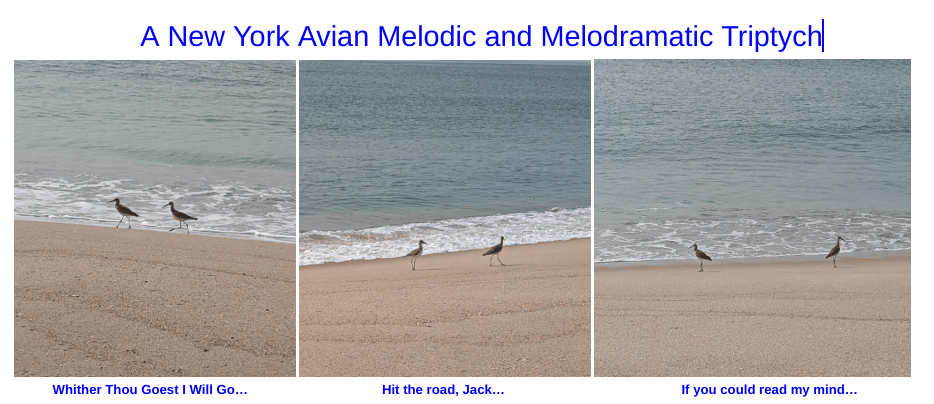
The next day I remembered the New York Avian melodrama above. She flew the coop. Or did she?

Happy Thanksgiving!

“In the time of my confession…” I identify with these words, after all the Dostoevsky, Dante, Solzhenitsyn, Cervantes, Becquer and others I have dabbled in these last 6 months.

At the sunset of my life, I find a need to hurry and catch up with what I have missed because of all the excuses I have ever had in front of me: lack of time, busy at home and at work, demands of others, acedia, inertia, melancholy, whatever!

And in hurrying to catch up I discovered that “I hear the ancient footsteps like the motion of the sea; sometimes I turn, there’s someone there, other times it’s only me…”

But serendipity is my companion, and I discover something new each day that gives me clarity of purpose, clarity of vision, clarity of understanding.

Like yesterday, when I was researching about Chorales and sacred music and trying to pin the correct biblical passages to the words. This is how my mind works.

And where did I land in this cacophony of beautiful music and lyrics? On a lamentation I had never heard of, sung by Bob Dylan, in that raspy voice that I have never quite liked! (I know, I know, unbelievable, right? Laugh. It’s true.) But today, I finally learnt to appreciate the poignancy of his voice.

Last night, I looked up to a black sky, peppered with stars, and one just fell down not too far from my horizon. It was a long and vivid wishing star, and I was thankful for:

– my living family,

– my long departed family,

– old loyal, trustworthy, real and compassionate friends,

– gentle and kind and empathetic new friends,

– a young car mechanic who spent time helping me just because, pro bono,

– a young professional who didn’t know me from Adam but reached out to guide me,

– an old man with tears in his eyes who gave me his shaking shoulder to lean on,

– a little boy who presented me with his dearest friend, Curly the Tarantula,

– a teenager who gave me her advice on affairs of the heart,

– my two loyal pups who have never ever failed me, Milly and Thibault,

– my “rock of Gibraltar” and best buddy who helps me decipher life’s labyrinths.

So much to be grateful for… Happy Thanksgiving to all of you. May you so be blessed as well.

Every Grain of Sand

The Broken Nest

Silence everywhere
Like that of a birds’ nest bereft of birds
On the bough of a songless tree.
With the lifeless light of the waning moon was now blended
The pallor of dawn
Spreading itself over the greyness of my empty life.
I walked towards your bedroom
For no reason.
Outside the door
Burnt a smoky lantern covered with soot,
The porch smelt of the smouldering wick.
Over the abandoned bed the flaps of the rolled-up mosquito-net
Fluttered a little in the breeze.
Seen in the sky outside through the window
Was the morning star,
Witness of all sleepless people
Bereft of hope.

From “At the Last Watch“.

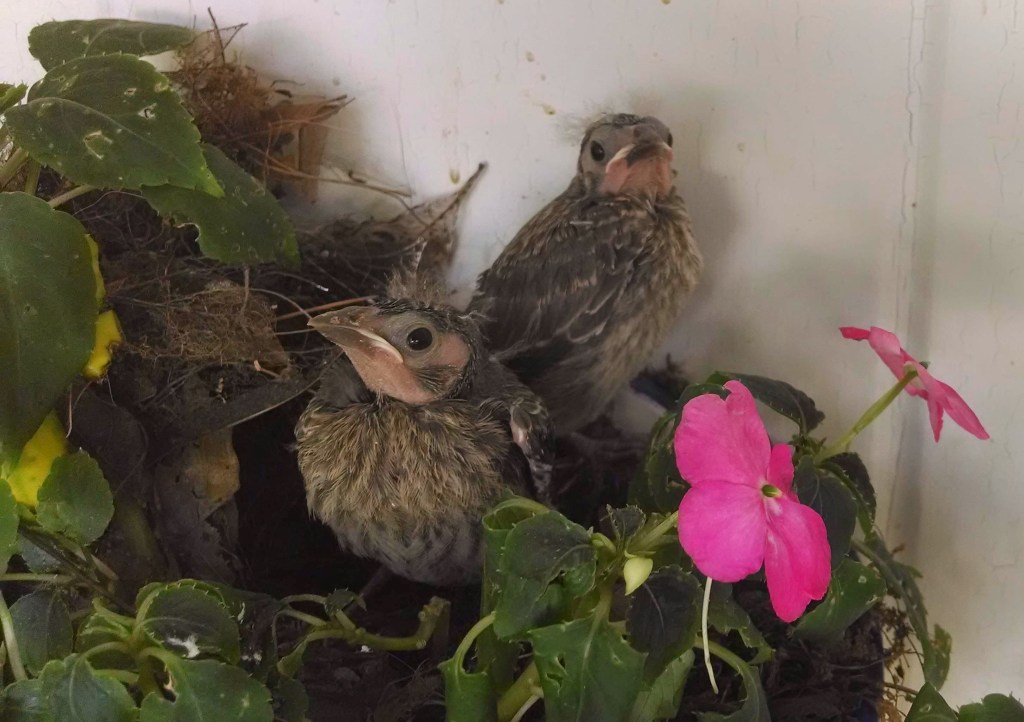
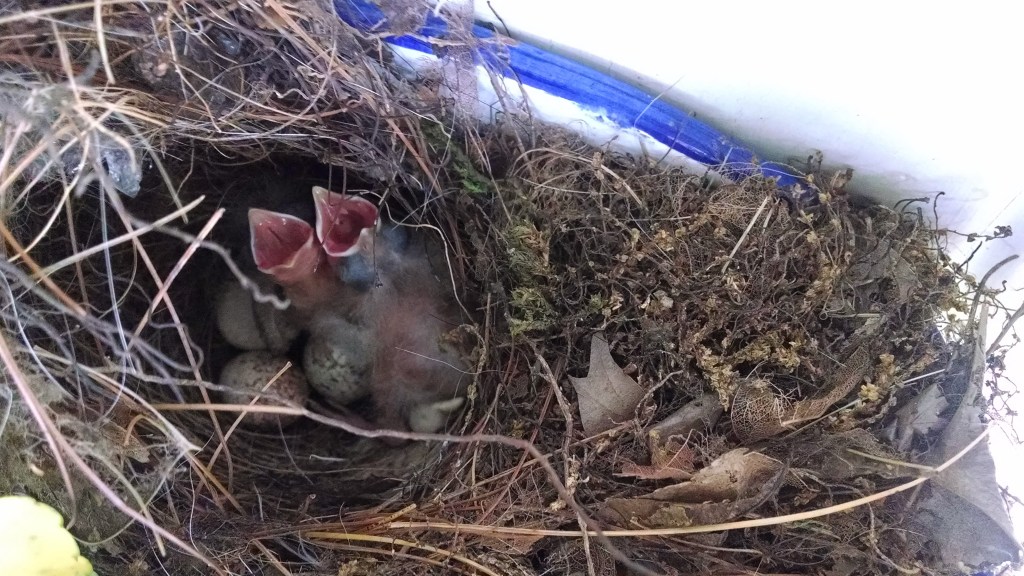
My image of what is a home has always been that of a nest. A carefully protected nest meant to hold fragile beings. I always balked at the idea of having to host individuals of dubious or unsavory character, because I felt the urge to guard my nest against prying eyes, and other ugly intrusions. I was not always successful, and people whom I trusted -or was willing to give them the benefit of the doubt- betrayed my trust, harmed my family, and essentially tried to dismantle my nest. Sometimes, life in the Foreign Service produces some negative personal results. There were some unfortunate incidents abroad. But then, a few nasty surprises also have occurred here at home as well. No one is immune to nefarious behavior.

My Mother kept “mothering” not just her children, but her grand-children as well. And, thanks to her efforts to expose them to what she thought was an important life message, I discovered a rare gem of an author and movie.

My Mother sought to use books and film as a way to expose her grand-children to philosophical, moral, cultural, and historical debate. Ever the perspicacious pedagogue, she realized that movies, accurately chosen, could expand a youngster’s horizon. She undertook this cinematographical pursuit with gusto, and my children were the recipients of her indefatigable research and search for the ultimate examples of the “morals of a story”.

Which brings me back to my strange remembrance of a forgotten author – poet, philosopher, Nobel laureate- of whom I had no deep knowledge. By happenstance, American TV had aired a beautiful Indian film and my Mother recorded it and shared it with us. We were living abroad at the time. The film was based on Rabindranath Tagore‘s novel, Nastanirh or The Broken Nest.

Until that time, I did not know much about Rabindranath Tagore, a friend of Ghandi’s, other than he had been a recipient of the 1913 Nobel Prize in Literature and had visited Argentina, in 1924 before my parents were born. A world famous Argentine poet and writer, Victoria Ocampo, hosted Tagore while he was recovering from influenza, and in their Autumn-Spring differences, they developed a love tenderness, a platonic relationship that resulted in a burst of literary exchanges. To understand this Indo-Argentine experience, the Edinburgh University Press has a fascinating article describing the ethos of the times.

My Mother had read Rabindranath Tagore. In researching about the man and his writings, I can now fully understand why my parents were culturally so immersed in his poetry and prose.

She made us watch the film “Charulata” (The Lonely Wife). I must confess, I was not too keen to watch the movie, since I had seen a few Indian movies in the USSR in the late 1980′s and I just could not relate to them. The USSR primarily showed Indian movies in those days, and I now realize I was too immature to want to spend the time to understand them.

The story of Charulata triggers some odd memories. Why? Because I remember my Mother’s intensity when she told us that it was this author that made her realize that, regardless of culture, when distilling the human essence, one discovers that human beings are all the same, feeling the same passions, suffering the same betrayals. This is not to say that we all behave, morally, the same.

Charulata, the film, transcends cultural barriers. It exquisitely and delicately captures the eternal themes of loneliness, contumacious neglect, good intentions that go awry, the yearning for understanding and compassion and companionship, a budding love affair that transcends consummation, the tenderness and harshness of youth, betrayal, and maybe, maybe, the possibility of redemption.

‘Sesh Basanta’ (The Last Spring)
by Rabindranath Tagore, 1924
You will experience many springs in your life,
Let me beg one of it…
Have no misgivings;
In your blossoming flower garden
I’ll not linger endlessly
Nor look back
When the day ends and it’s time for leave-taking.”

I would like to know that one day my children and grandchildren might remember me for my sprinkling some lyrics, or melody, or story because I sometimes go off on what some believe are tangents going nowhere, though I just see my perambulations as always returning to where I left off, albeit taking a bit of a long and windy way. It’s because I lack my Mother’s wonderful way with quotes of proverbs, poems, and sayings that had a concise application to whatever topic we were discussing.

Of all the memories I have of my Mother, I always return to her dear Charulata movie. Her protection of our nest was paramount. Her fledglings are old birds now. More or less, we have weathered the storms of life. If only I could give my children a legacy such as my Mother’s…

Rabia Balkhi, the First and Only Afghan Queen and Persian Poetess

I found this “letter to Rabia” quite a statement, from a Western perspective. 

The Princess and the Slave

A story of how love still kills in Afghanistan (Author: Nushin Arbabzadah)

Dear Rabia,

I am writing to you across centuries – from the land of the living to the realm of the dead. The year is 2012 and you were murdered exactly a thousand and sixty-nine years ago. You have the dubious privilege of being our first recorded case of honor killing.

I am caught in Love’s web so deceitful
None of my endeavors turn fruitful.
I knew not when I rode the high-blooded stead
The harder I pulled its reins the less it would heed.
Love is an ocean with such a vast space
No wise man can swim it in any place.
A true lover should be faithful till the end
And face life’s reprobated trend.
When you see things hideous, fancy them neat,
Eat poison, but taste sugar sweet.

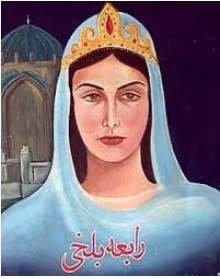
Rabia Balkhi lived in the 10th century.  She fell in love with her brother’s slave.  She was imprisoned by her brother and committed suicide after writing the last stanza of her last poem, Love, on her prison wall with her own blood. 

Rabia Balkhi was the first and only Afghan queen.  Her tomb, presumably, is in the now familiar city of Mazar-e-Sharif.  A movie of her life survived destruction by the Taliban.

There used to be a busy woman’s hospital in Kabul named after the queen. It was supported by the International Committee of the Red Cross (ICRC). The last entry I read about the hospital by the ICRC is from 2022. I can find nothing else. I wonder, what has happened to it? Maybe the Taliban just changed the hospital’s name…

Solzhenitsyn’s Gulag

The daffodil represents rebirth and hope.

I have just discovered this Russian television miniseries “In the First Circle”, which is based on Solzhenitsyn’s Gulag Archipelago, and Solzhenitsyn himself was the playwright and narrator. I just finished watching it, and it is fascinating. 

Many years ago, I had discovered a Russian film adaptation of Alexander Solzhenitsyn’s autobiographical novel “In the First Circle”.  And, before I could watch it, life hurried by me, and I forgot all about it.  

While perusing old musings of mine, I found my reference to this gold nugget of a Russian TV miniseries in my defunct blog.  I finally started watching it a couple of nights ago and went through the ten 45-minute episodes in two sittings.  

It is profoundly beautiful, poignant, sad and, despite the anguish presented, it is deeply hopeful and redemptive.  No wonder!  Solzhenitsyn himself worked on the adaption of his novel for the series, and wrote its screenplay.  

It is a 2006 beautiful series directed by Gleb Panfilov, who had been thinking of adapting Solzhenitsyn for over 30 years.  The music score is perfection. The composer, Vadim Bibergan’s romance at the end evoked memories of Ashokan Farewell of Ken Burns’ Civil War series.

The actors are amazing in their portrayals of the characters, and how I wish I knew Russian well enough to understand the intricacies of the dialogue.  Their eyes, their faces capture the turmoil of a disastrous time in Russia and the moral dilemma they all face, whether victim or foe, while attempting to survive under a draconian and unjust episode of history. 

The portrayal of the eternal conflict between good and evil and the moral choice between escaping horror and inhumanity and not compromising one’s own principles and conscience is deeply moving. 

While some people hate all things Russian nowadays, it is interesting to note that Solzhenitsyn himself was half Russian and half Ukrainian.  

The English subtitles are not optimal.  For those who have never heard of Solzhenitsyn or have not read the book, it might be frustrating initially.  Give it more than 15 minutes.  

This is not your typical boom-boom/ka-boom series.  It is not a documentary, although Stalin seems so real in the film!  It is a lyrical series, with intertwining historical and philosophical dialogue that invites retrospection.

Am sharing because I found it to be a gem of a film.  I am still searching for my own “ataraxia”.  Come to think of it, I did not realize that it was “ataraxia” I was chasing, until I delved into In The First Circle!

“They could look forward to nothing but the worst. Yet in their hearts they were at peace with themselves. They were gripped by the fearlessness of people who have lost absolutely everything-such fearlessness is difficult to attain, but once attained it endures.” In the First Circle.

The Ripple Effect of a Tiny Gift

Sometimes, we tend to forget that actions have consequences and relegate our own to the dust bin of irrelevance or oblivion. A while back, I discovered this is not necessarily true, and that our actions can have surprising consequences.

About 20 years ago, a lady I knew adopted a Russian child. She brought the 6-year old to my home, to a party we were hosting. At the time, this new Mother was thrilled with her new status, but trepidatious, because there was an enormous chasm between her and her son: they just could not communicate. The boy was shy and withdrawn, and she ached to hold him and comfort him, but it was oh so very difficult to penetrate the boy’s world.

I happened to have a lot of children’s stories in Russian (including Tolstoy’s stories), because I once had had BIG dreams that my sons would learn the language, having lived in Moscow. It didn’t work out. None were interested. To my chagrin, they preferred the romance languages.

Listening to this lady’s plight, I remembered my precious little Russian children’s stories, and, without hesitating, I gathered all these books and gave them to her. Before doing so, I chatted with the little boy in my elementary Russian and his eyes lit up. Seeing that flicker of recognition in that boy’s eyes made me think that, maybe, these stories would help a little Russian boy lost in America.

Fast forward 7 years. I return to the US after many years abroad, and I meet a strapping young 15-16 year old young man accompanied by his Mother, who is selling Boy Scout Christmas wreaths. I don’t recognize the young man, and his Mother looks vaguely familiar, but I cannot quite place where we have met. (This is a phenomenon that has happened to me a lot during my life in the Foreign Service!).

The lady greets me warmly and tells me that I may not have realized it, but I had helped both her and her son many years before. I am baffled. She then proceeded to tell me that through the gift of a bunch of Russian stories I had made a long time ago, she and her adopted son had bonded. Although it would take a little while for them to overcome the language barrier, those books brought the two of them together. That little boy, many years back, could find solace in something so familiar, and could read in his language… and she, at least, could hold the books while he snuggled with her, delighting in their content.

I had totally forgotten what I had done. Yet the memories came pouring out of the recesses of my mind. I was humbled and touched as I have never been. Today, the little Russian boy is a young man. I wonder what he is doing nowadays.

Actions do have consequences. One sometimes is blind to the ripple effect of a tiny gift. So, my sons did not learn Russian – they closed that door. But, for a little boy out of a Russian orphanage, lost in his new home in the US, a window was opened.

And for me? The boy’s Mother gave me the biggest gift of all: discovering that I had, unknowingly, helped open that window!