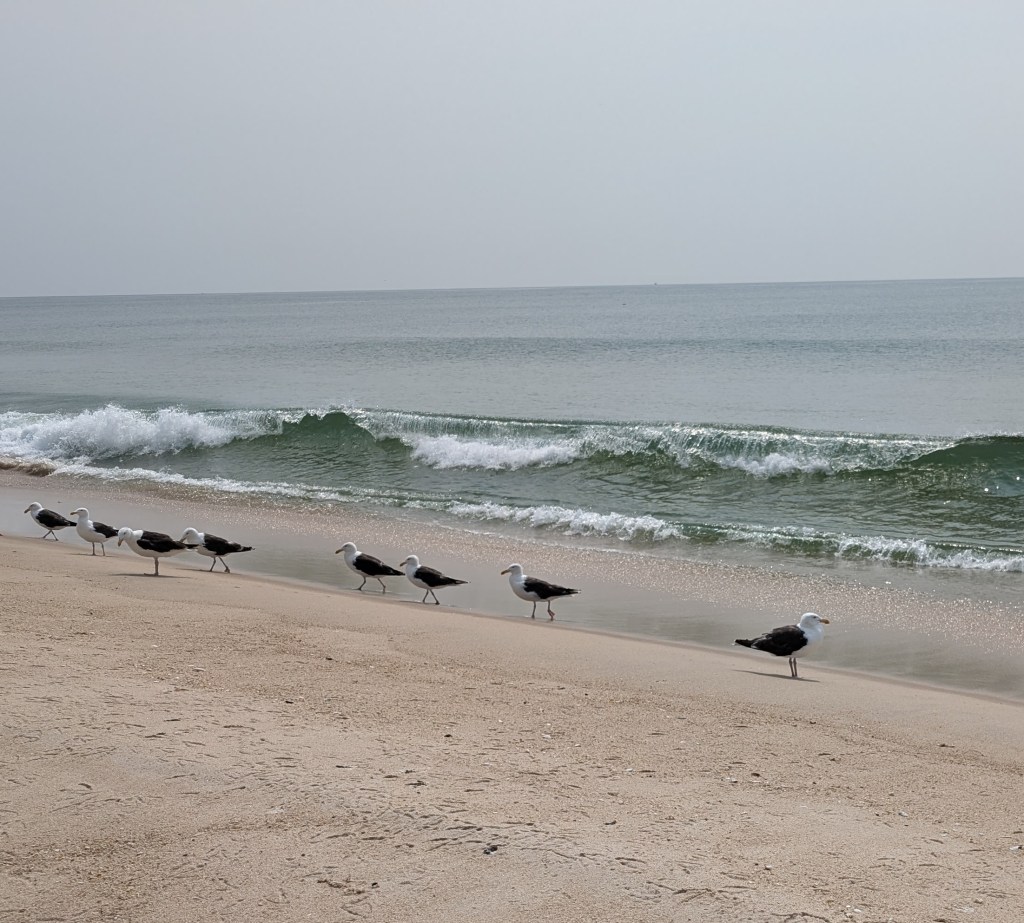
One day this summer marked a special series of milestones of mythological proportions in my life: for the first time ever, like this vigilant seagull, I was perched completely on my own, staring at a monumental decision that only affects me…no parents, no spouse, no siblings, no children, no grandchildren, no in-laws, no neighbors, no friends, no teachers, no professors, no dogs, no horses, no lambs, no governments, no embassies, no colleagues, no employers, no contractors, no priests nor priestesses, no nothing!
One of my brothers said, “Wow, go get a gerbil!”
I wonder how many philosophical essays have been written while pondering the uniqueness of making such types of decision? After all, to quote Robert Louis Stevenson,
“Everyone, soon or late, sits down to a banquet of consequences.”
You don’t just reap what you sow. You also sow what you reap.
Spending some time in one of the most beautiful beaches around, I came across a colony of seagulls. They didn’t fly away as I walked by. And they gave me food for thought. As I am delving into the Russian authors, I took this photo and thought of Fyodor Dostoevsky:
“Oh, how hard it is to be the only one who knows the truth!”
The more I walked, the more my lovely colony of seagulls made me reflect. Aesop came to mind.
By the way, I didn’t take the shunning personally!!!!!
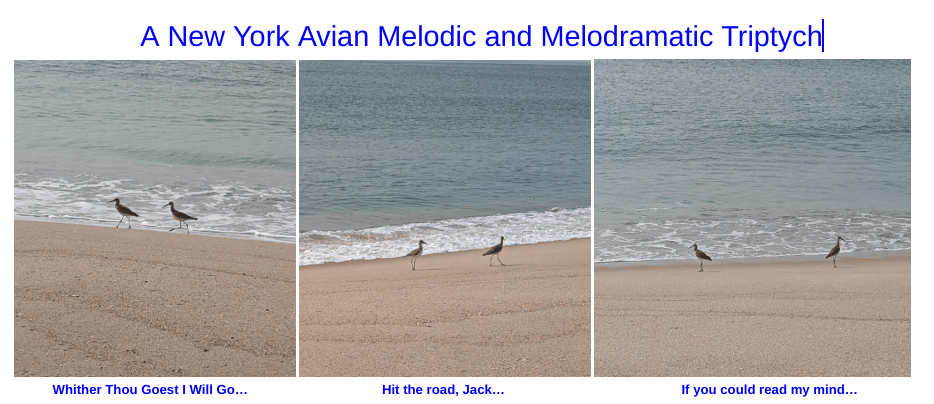
The next day I remembered the New York Avian melodrama above. She flew the coop. Or did she?
“In the time of my confession…” I identify with these words, after all the Dostoevsky, Dante, Solzhenitsyn, Cervantes, Becquer and others I have dabbled in these last 6 months.
At the sunset of my life, I find a need to hurry and catch up with what I have missed because of all the excuses I have ever had in front of me: lack of time, busy at home and at work, demands of others, acedia, inertia, melancholy, whatever!
And in hurrying to catch up I discovered that “I hear the ancient footsteps like the motion of the sea; sometimes I turn, there’s someone there, other times it’s only me…”
But serendipity is my companion, and I discover something new each day that gives me clarity of purpose, clarity of vision, clarity of understanding.
Like yesterday, when I was researching about Chorales and sacred music and trying to pin the correct biblical passages to the words. This is how my mind works.
And where did I land in this cacophony of beautiful music and lyrics? On a lamentation I had never heard of, sung by Bob Dylan, in that raspy voice that I have never quite liked! (I know, I know, unbelievable, right? Laugh. It’s true.) But today, I finally learnt to appreciate the poignancy of his voice.
Last night, I looked up to a black sky, peppered with stars, and one just fell down not too far from my horizon. It was a long and vivid wishing star, and I was thankful for:
– my living family,
– my long departed family,
– old loyal, trustworthy, real and compassionate friends,
– gentle and kind and empathetic new friends,
– a young car mechanic who spent time helping me just because, pro bono,
– a young professional who didn’t know me from Adam but reached out to guide me,
– an old man with tears in his eyes who gave me his shaking shoulder to lean on,
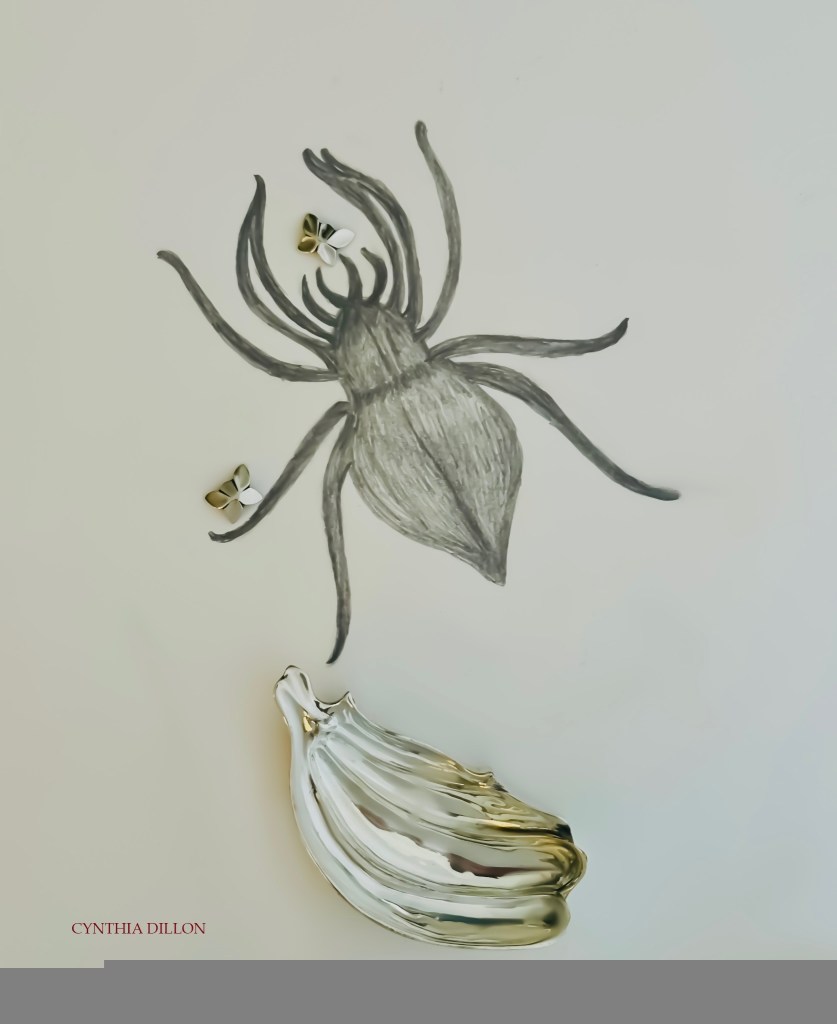
– a little boy who presented me with his dearest friend, Curly the Tarantula,
– a teenager who gave me her advice on affairs of the heart,
– my two loyal pups who have never ever failed me, Milly and Thibault,
– my “rock of Gibraltar” and best buddy who helps me decipher life’s labyrinths.
So much to be grateful for… Happy Thanksgiving to all of you. May you so be blessed as well.
A long, long time ago I worked at Tiffany & Co., when the archetypal store was the epitome of elegance and grace in everything, from design to service.
I have fond memories of the old Tiffany’s, and was initially shocked and heartbroken to find out that the French had bought the American store.
“In an ever-changing world, perhaps Tiffany & Co.’s most consistent relationship with the public over the last century is its daily advertisement on page A3 of The New York Times, which began running in 1896.”
Alas, Tiffany’s new French owners had a nouveau vision, now that the American quintessential jewel was no more: her own Belle Époque had come to an end.
There may be some who still read the print edition of newspapers, who will feel a pang of nostalgie, and wonder if la mort d’une campagne publicitaire had to be done with such sang-froid.
On May 8, 2009 I discovered Ramblings from a Painter, a painter’s ramblings of his Iraq military tour of duty. At the time I had noted in my defunct old blog that artist Skip Rhode had a wonderful gift, and made some ugly landscapes look delightful! For example, his painting of a Containerized Housing Unit or CHU (a shipping container used for living quarters by the US military in Iraq and Afghanistan) makes it seem inviting and cozy.
What got my attention was just how normal these drawings are. They could have been done by any kid in the United States. Here are happy families with little houses in the countryside with flowers and trees and puffy clouds. I’m not quite sure what that thing is in the sky in the bottom picture – a bird? a bug? – but for sure it isn’t threatening. All the figures have big happy smiles on their faces. These are happy drawings from happy kids.
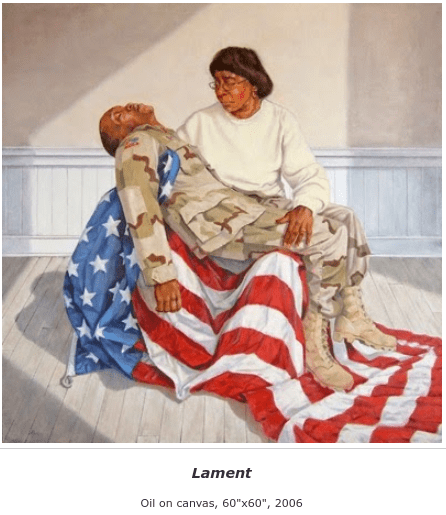
Lament, the Pietà-like painting above, evokes a sorrow, an anguish that is hard to fathom. It is the inescapable grief of a Mother who has lost her son, seemingly forever. The Mother’s pained look displays some determination, in my humble opinion. This Lament makes me think that she is a woman of faith, so that beyond the sadness there is a glimmer of hope.
What a poignant painting that encapsulates the senseless horrors of feckless times.
Apparently, 1 out of 200 college students has synesthesia. One can also learn languages seeing colors and numbers! An explanation for this may be that synesthetes played with those colorful magnetic numbers and letters that, at least in my home, graced the fridge door for quite a long time. I’ve never asked my children if they see words or hear sounds in colors. I sure wish I did, so that I could have mastered Russian, Czech and Polish after just a few weeks!
Tammet is a savant. As a child he had epileptic seizures. Doctors later diagnosed him with Asperger’s Syndrome, a mild form of autism. He mastered the world of emotions only through hard training.
Numbers and foreign words, on the other hand, come to him naturally. He sees colors and shapes where most people see only plain words and numbers. He’s memorized the number pi to 22,514 digits. He knows instantly that January 10, 2017, will be a Tuesday. And he’s a fleet-footed traveler in the rocky terrain of languages.
Tammet can speak Romanian, Gaelic, Welsh and seven other languages. He learned Icelandic in a week for a TV documentary, at the end of which he gave a live interview on television. He felt somewhat nervous, but was able to speak quite fluently with the show’s host. He even dared to make a joke in Icelandic, which is generally dreaded for its complexity. He still speaks the language today.
The history of the study of synesthesia stretches all the way back to Ancient Greece, when philosophers attempted to understand the chroia (what we now refer to as timbre), or color, of music and how to quantify it. Many eager investigations were conducted on the subject in the late-19th and early-20th centuries, until the ascension of behaviorism within psychology rendered the study of such subjective and internal experiences a ticket to academic oblivion. Since the cognitive revolution of the 1980s, however, there has been more and more study of synesthesia, bringing to light some exceptional insights into the functioning of the human mind.
Below is a video that provides a clue about this alternate perception.









 Dum Spiro Spero