One day this summer marked a special series of milestones of mythological proportions in my life: for the first time ever, like this vigilant seagull, I was perched completely on my own, staring at a monumental decision that only affects me…no parents, no spouse, no siblings, no children, no grandchildren, no in-laws, no neighbors, no friends, no teachers, no professors, no dogs, no horses, no lambs, no governments, no embassies, no colleagues, no employers, no contractors, no priests nor priestesses, no nothing!
One of my brothers said, “Wow, go get a gerbil!”
I wonder how many philosophical essays have been written while pondering the uniqueness of making such types of decision? After all, to quote Robert Louis Stevenson,
“Everyone, soon or late, sits down to a banquet of consequences.”
You don’t just reap what you sow. You also sow what you reap.
Spending some time in one of the most beautiful beaches around, I came across a colony of seagulls. They didn’t fly away as I walked by. And they gave me food for thought. As I am delving into the Russian authors, I took this photo and thought of Fyodor Dostoevsky:
“Oh, how hard it is to be the only one who knows the truth!”
The more I walked, the more my lovely colony of seagulls made me reflect. Aesop came to mind.
By the way, I didn’t take the shunning personally!!!!!
The next day I remembered the New York Avian melodrama above. She flew the coop. Or did she?
This year alone will end for me, yet again, with many, many experiences with worthless but dangerous “chantapufis”. I periodically revisit an old journal entry, because I keep encountering these unsavory human beings all the time! So, here it goes:
Chantapufis are totally worthless because their only contribution to society is bullying. But they are dangerous because, when cloaked under the mantle of authority, they can turn regular decent individuals into cowards and servile vassals.
The latest example of a chantapufi that I have experienced is an obnoxious type, someone who wields power because of his/her position, who issues “orders” like a master to his dog: “Come”… And who resents what he/she perceives to be an underling who ought not to have better access to information and/or powerful individuals than he/she. Yet, as always, when the chantapufiis revealed, he/she crawls back into the shell of isolation, like one of those crabs that move into another crab’s shell.
I ought to feel benign at this juncture, because I like to think I am a better person. But, right now, I want to squish the chantapufi like the cockroach that he/she is. Not very noble nor charitable. Shame on me.
Sometimes we are our own worst enemies, especially when doubt in one’s principles and abilities creeps in. Everyone is prone to tsk-tsk clichés and proverbs and fables alike (though not many seem to have heard of Aesop or La Fontaine nowadays), because they sometimes invoke stereotypes. But, stereotypes are not necessarily all evil and sometimes they do help identify a certain character or characteristic, based on the cumulative knowledge that we amass through the centuries of experience.
One particular such stereotype is what the Argentines refer to as a “chantapufi”, a slang term that means someone who has no qualms lying or deceiving in order to gain something. More specifically, it is a person whose word has no value because he or she has no honor.
There are many “chantapufis” in this world, and I have come across them quite often, though -in some cases- it took me a long time to figure some of them as such. The problem is that these “chantapufis” are hard to decipher initially, because they are master liars and obfuscators. They are very dangerous when they come cloaked in the veneer of reputable professions and organizations.
But “chantapufis” will forever be “chantapufis” so, when we are afraid of our imaginary fears, it makes sense to figure out who or what is originating that fear. If it comes from a “chantapufi”, chances are we are hearing from a charlatan, like the fox in the Aesop’s fable….
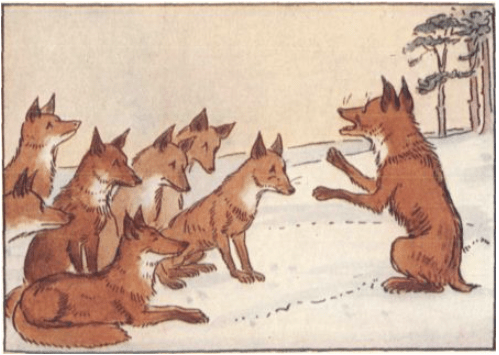
A fox lost his tail in escaping from a steel trap. When he began to go about again, he found that every one looked down upon or laughed at him. Not liking this, he thought to himself that if he could persuade the other foxes to cut off their tails, his own loss would not be so noticeable.
Accordingly he called together the foxes and said: “How is it that you still wear your tails? Of what use are they? They are in the way, they often get caught in traps, they are heavy to carry and not pretty to look upon. Believe me, we are far better without them. Cut off your tails, my friends, and you will see how much more comfortable it is. I for my part have never enjoyed myself so much nor found life so pleasant as I have since I lost mine.”
Upon this, a sly old fox, seeing through the trick, cried, “It seems to me, my friend, that you would not be so anxious for us to cut off our tails, if you had not already lost yours.”
One of the things I used to try to inculcate in my children was the importance of never lying, because once one is categorized as a liar, the link of trust is broken, and it really can’t be repaired. The worst thing that can happen to a person is to be seen as a liar, because their word will be forever doubted, even when they speak the truth (Peter and the Wolf comes to mind).
Lately, I keep returning to a conundrum of my making, and this is how my mind works: why would I lie, not to protect myself or hide my shame, but rather, to protect someone else’s misdeed, when I know full well that there is misconduct involved? There’s the rub that led me to a vortex of etymological discovery and legal peregrination.
The Greek word “diaballein” means “to slander, attack, cast apart”. “Dia” meaning “across, through” and “ballein” meaning “to throw”. It literally means “to throw across, to scatter” (e.g., families get scattered, communities get divided). It is the source of another Greek word “diavolos” , which is the provenance of the term we all know, “the devil”.
Now this led me to discover the origin of that other name for devil, “ho sataunus”, which is also Greek and based on the Hebrew word that means “The Accuser”, and is the origin of the name Satan.
A philosopher I read somewhere even stated that in today’s world, The Accuser’s role could be seen as that of a Prosecuting Attorney, whose job is to blame and blame the accused: he/she did it! (Poor lawyers, they never get a break!).
We mere mortals engage in accusations all the time when we gossip, point the finger, play the shame and blame game, and/or destroy someone’s character. How many times are we oblivious to carelessly wounding others by saying or implying an untruth that may wreck their family life, their reputation and character, all done through a lie?
At the end of the day, the Bible calls the devil the father of lies… and for good reason.
I leave it to better writers than me to share my conclusions through their thoughts on lies and lying:
A liar will not be believed, even when he speaks the truth. (Aesop)
No man has a good enough memory to be a successful liar. (Abraham Lincoln)
You can always lie to others and hide your actions from them… but you can not fool yourself. (Also A. Lincoln).
A little lie is like a little pregnancy; it doesn’t take long before everyone knows. (C.S. Lewis)
A truth can walk naked…but a lie always needs to be dressed. (Khalil Gibran)









 Dum Spiro Spero

