…when men were not afraid to be men…and they were sexy!
I love this song… it may not be PC, but it captures an era…and the rhythm and beat of the song that, -in my humble opinion- have NEVER been matched. Dean Martin has fun singing this song…and he exudes a masculine trait that is no longer acceptable, but that I am sure some young women today would love to witness. I certainly miss this.
Lately, I have been watching an old series from the late 1950s, early 1960s, called Naked City. In the old days of black and white TV in Argentina, where there were 4 channels or so, my parents watched it every week in Buenos Aires, and they let me join them as a little girl. I remember being mesmerized because of the way the city was presented. All those tall buildings, the NY harbor, the lights. I knew there were strange police stories, what with the sirens and old-fashioned uniforms, but the crux of the weekly subject of the series was lost on me.
Today, I realize it depicts a New York that no longer exists: the cars, the grittiness, the fashion. Even the hoodlums wore nice suits and fedoras!
There are stereotypical characters galore, the police, the lawyers, the Italians, the Poles, the Mexicans, the Germans, the upper East Side types, the bohemians, the old, the young, the neurotics, the alcoholics, the betrayers, the blondes and the brunettes. The narrator always brings either humor, foreboding, or morality to the screen. In this day and age, it could be seen as a bit pedantic. However, it is a window to life as it was, at least in the naked city, a city that had captured my own parents’ imagination. How they loved New York and longed to return. They eventually did.
I grew up listening to their stories of what seemed like a magical world so far away up North, from where I lived way down South. The one thing that comes to mind, in a world pre-globalization, was my Mother’s depiction of what a New York Cheesecake was all about. Her description was mouth-watering, but there was no Philadelphia Cream Cheese at the time, when I was growing up. There wasn’t even a substitute. I just had to imagine, until the day when I returned to New York as a teenager and dug my fork into a slice of it at Chock-full-o’Nuts.
In my retrospection to a more innocent time, I came across an old slide. A most beautiful portrait of a handsome man and a beautiful lady, and a toddler. This is how I remember my parents. Forever. And this is how I envisioned New York and its harbor, because the moment captured in that photograph was a most memorable experience that we were embarking together.
My parents were 27 years old at the time! My Father was a self-made man, an autodidact, an entrepreneur, a man of vision, even at that young age. We were soon leaving on the Queen Elizabeth from NY Harbor to Southampton, England. And I got top billing as a passenger: Miss B.A. Dillon! At the tender age of 1.5 years.
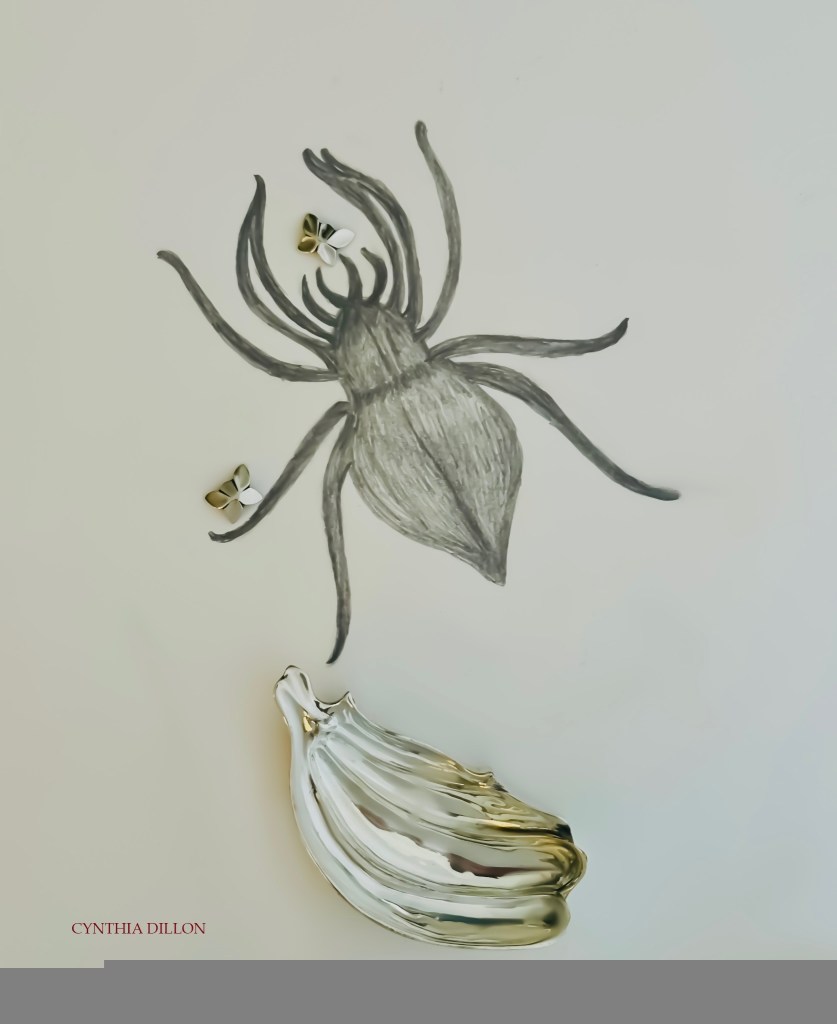
In every parody, there is a kernel of truth. I once encountered a colleague working for the competitor. He came across as a gentle gentleman. But, as time went on, every now and then, I would get a glimpse of fangs. I doubted myself, not thinking that he could be anything but a gentleman…a competitor, yes. But not ruthless.
And then one day…BANG! Not only did the fangs come out but the claws as well. After I recovered from the total shock, dishevelled and bruised, I discovered that he was known as the Honey Badger. Moral of the story? Better have the Honey Badger on your side!
He greets me and lets me swat away at the pesky flies and caress his head. He is thrilled if I give him a treat. Talking about caresses…if he were a human or a dog, he could lie next to me and I would caress his back to alleviate the anxiety or insomnia he might feel in his dreams.
He is a beauty, and a better friend than many whom I have known for half a century. I am lucky! Between my fox and my horse, how could I feel sad? He brings back memories of riding bare back, something I loved doing in my old neck of the woods in Argentina. Nah, I would never dream of doing it today. It would end in a funny tale of destruction. However, one can dream, right?
I have a bright orange silk hand-painted scarf. It is a pretty ornament, which can grace a woman’s sweater, dress, or coat.
We were far away then. My daughter found this pretty scarf during her school’s international fair and immediately thought of her Nonna. With her hard-earned dollars, she bought it from the lady who had painted it herself, because she thought the color combination was perfect for her own Grandmother to wear. I remember thinking how perceptive a 12-year old could already be. My Mother loved pinks, taupes and oranges.
I have this pretty kerchief because my Mother died. When we were clearing her things, that orange scarf brought back precious memories. Every time I look at this scarf I see myself wondering the halls of the school with my child.
Last night, as I was folding the scarf to put away, it struck me that its criss-cross pattern very much reflects the crossroads of life. My Mother is gone, but memories of her and her guiding principles remain. They are stronger today than when she was alive.
As I grow older, I understand my Mother’s view that -somehow- life and our experiences are interconnected by strong currents and delicate tendrils.
The orange color brought to mind an old song my Mother used to sing to us when we were kids, about an old blind man, a young Mother and her child, and an orange that quenched the child’s thirst. Little did I know that the song was an old Spanish romance from the 15th century. That was my Mother… a true teacher at heart, making the archaic sound modern to her children.
LA VIRGEN y EL CIEGO

Camina la Virgen pura
camina para Belén
y en el medio del camino
pidió el niño de beber.

No pidas agua mi niño
no pidas agua mi bien
que las aguas vienen turbias
y los arroyos también.

Allá arriba, más arriba
hay un viejo naranjel
que lo guarda un cieguecito
cieguecito que no ve.

Me da usted una naranja
para el niño entretener.
Coja las que usted quiera
coja la buena mujer.

Cogían de una en una
salían de cien en cien
según las iba cortando
el ciego empezó a ver.

Quién es aquella señora
quién es aquella mujer
es la Virgen María
que camina para Belén.

(Originally published June 16, 2014.  Updated.)
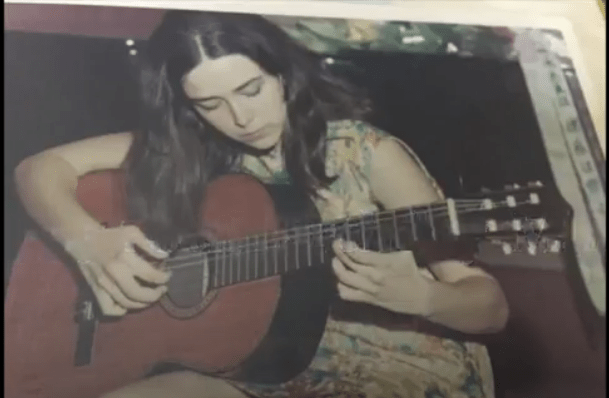
They stopped the air conditioning. The little hall went silent. Except for my parents, siblings, and my High School dear friend, the audience was Japanese. I was petrified. My Japanese guitar teacher had insisted that, part of his teaching me meant that I had to perform in his annual repertoire of students. I was his only “gaijin”, that is, the only foreigner.
Mind you, he seemed so old! He was probably in his 30’s, but I was a teenager, I was 16 years old. He did not speak English nor Spanish nor French. I knew enough Japanese to take a taxi or shop. But we communicated on a weekly basis through our mutual understanding of clefs, crotchets and quavers. Isn’t that a universal language?
He was so formal! He always bowed when he came to my house – 9-11 Minami 3-chome, Ebisu, Shibuya-ku, Tokyo- impeccably removing his shoes and putting on the slippers. I bowed back, but not quite well. Under the severe thick black-rimmed glasses, he had a twinkle in his eye, a beautiful smile, and the most amazing fingers that plucked the guitar and made it weep.
But I did not notice these things then. I was too immature. I was ambivalent about my lessons with him, and I knew I always disappointed him. I never practiced enough. Ie, ie ie. No, no no. Hai, hai, hai. Yes, yes, yes.
Somehow, we understood each other. He came dressed in a dark suit and a dark tie. He seemed severe, but when he took that guitar and strummed it, all his Japanese formality of those days melted away. He loved classical guitar and would get exasperated with me because he did not find in me the same enthusiasm. Little did he know that I did have it, though it was a bit dormant. I was too young then!
So the day arrived when I had to perform at the concert. Invitations had been sent, beautifully calligraphed on thick rice paper. バーバラ ディロン. Barbara Dillon, in Katakana.
If memory serves me, I played 3 musical compositions. Within the first couple of minutes of my taking the stage, the air conditioning was turned off because it made a purring sound. For some reason, someone in that hall decided to give me total silence for the performance. It then became quiet, like a tomb. I had stage fright, my fingers were trembling, but I wanted to make my professor proud. After all, I was, as the Argentines say, “sapo de otro pozo” (a toad from another well).
In that deep silence, I took the plunge. I still remember plucking those strings and how, soon enough, I fell into the right rhythm and cadence and mood. The silence of the hall was deafening. But, miracles of miracle, I never ever made a mistake! At the end, the applause was overwhelming. I looked up and saw my family and friend beaming. And, standing in the back of the room was that gentleman and gentle professor with the biggest smile I had ever seen.
I studied classical guitar through college and my Father got me the Argentine equivalent of a Stradivarius. He had high hopes. I did not deliver. Life interfered.
I have always returned to my guitar especially when I have needed succor and relief from sorrows. Today, my fingers are no longer spry. They are a little bit crooked and stiff with age.
Yet, I am soon getting back together again with my guitar and music scores of days gone by…and these crooked fingers will get the exercise that my soul has been longing for, finally!
As I have mentioned many a time, I have a soft spot in my heart for Afghanistan, and the work I was involved with for years opened a window into a fascinating world of beauty and history. I used to pester colleagues with my “Of Interest” emails, in which I would relate things that made me ponder. Now, I shall not just ponder, but actually read The Book of Kings:
Samangan is one of Afghanistan’s 34 provinces. What I did not know, is that it is also the setting of an epic love story, that comes from the Persian equivalent of the Odyssey and the Iliad: The Book of Kings, or Shahnameh.
The story, written in verse around 1,000 years ago by Persian poet Ferdowsi, tells how a mighty warrior, Rustam, makes it all the way to Samangan, seeking his lost horse. While the guest of the king, Rustam retires to his chambers, after enjoying a sumptuous meal with the king, only to be woken up by the king’s daughter, Tahmineh, who declares her love for the warrior. That one night of passion, that results in a marriage, yields a son, whom Rustam will only meet in battle many years hence.
The woeful story of Rustam and Tahmineh and their son Sohrab starts like this:
STORY OF SOHRÁB

O ye, who dwell in Youth’s inviting bowers,
Waste not, in useless joy, your fleeting hours,
But rather let the tears of sorrow roll,
And sad reflection fill the conscious soul.
For many a jocund spring has passed away,
And many a flower has blossomed, to decay;
And human life, still hastening to a close,
Finds in the worthless dust its last repose.
Still the vain world abounds in strife and hate,
And sire and son provoke each other’s fate;
And kindred blood by kindred hands is shed,
And vengeance sleeps not—dies not, with the dead.
All nature fades—the garden’s treasures fall,
Young bud, and citron ripe—all perish, all.

And now a tale of sorrow must be told,
A tale of tears, derived from Múbid old,
And thus remembered.—
What a beautiful translation! It is so true that “All nature fades–the garden’s treasures fall, young bud, and citron ripe–all perish, all.”
Initial thoughts I penned December 7, 2017. They still apply.
“Ideally, the genesis of an international Rule of Law “development” project should entail the meetings of the minds between the donor and the beneficiary. Some of us like to say that there has to be “buy-in” from the host government as well as the individual host organizations that might be involved in the project. This would show the cooperative efforts of all concerned towards what could be the key goals of the mission: strengthening of the rule of law and the fostering of accountability and transparency. For example, a specific justice sector program’s mission might be to build the capacity of the host country’s criminal justice sector institutions through improving the ability of their professional staff to deliver fair and effective justice services to citizens. Sometimes, the initial focus is to help a country build its police and prosecutorial capacity through formal training programs of academic instruction.
What I have discovered is that what the donor organization (which may include the program implementer as well) wants to see happen may not necessarily be best suited to the way the project should be carried out. One does not become an international development practitioner overnight. While an expatriate technical advisor may have stellar credentials from his or her prosecutorial days in their particular state or country, they may have never lived in a different environment other than their own. This can lead to disastrous results because there is a lack of understanding of, and maybe a lack of empathy for, the recipient of the technical advice.
A long time ago, I witnessed a foreign “expert” deliver a lecture on American jurisprudence and individual rights to an academic group in a socialist country. The audience was barely curious and did not seem to engage. What the “expert” did not realize was the group’s lack of understanding of what he believed were common concepts, until someone asked “what is the right to privacy?” Once it became obvious that there had been such a gulf between the lecturer and the trainees, the “expert” was able to correct the situation and begin to provide examples that the local nationals could finally relate to!
I was at the very beginning of my professional “Rule of Law” work, and it was a fine lesson for me too: borrowing from the Spaniards, there are many “Ruperto el Experto” types, but few that meet the “experto crede Ruperto” standard.”
I just came across a little blurb I had written 10 years ago, and had to laugh. First of all, how time flies! I probably was staring at a bunch of pot pourri, thinking “Like sands through the hourglass, so are the Days of Our Lives.” Also, I was probably contemplating hurling that pot pourri into the compost heap of oblivion, which I eventually did, when I moved to Maine!
—————————-
ON GETTING OLD
Between the ages of 20 and 48, we feel we can do anything, but the reality is that around 48 those under that age see us as “old”.
The Aging Rose (by me).

Aging is like a rose:
A calyx embraced by its sepals
A bud in a vase
An emerging corolla
A blossom
A bursting perianth…
Should it be nipped in the bloom,
A desiccated flower with all its beauty, color, and fragrance suspended in time.
Come to think of it, some would consider the desiccated blossoms dust collectors… (I have many of those!).







 Dum Spiro Spero