Apparently, 1 out of 200 college students has synesthesia. One can also learn languages seeing colors and numbers! An explanation for this may be that synesthetes played with those colorful magnetic numbers and letters that, at least in my home, graced the fridge door for quite a long time. I’ve never asked my children if they see words or hear sounds in colors. I sure wish I did, so that I could have mastered Russian, Czech and Polish after just a few weeks!
Tammet is a savant. As a child he had epileptic seizures. Doctors later diagnosed him with Asperger’s Syndrome, a mild form of autism. He mastered the world of emotions only through hard training.
Numbers and foreign words, on the other hand, come to him naturally. He sees colors and shapes where most people see only plain words and numbers. He’s memorized the number pi to 22,514 digits. He knows instantly that January 10, 2017, will be a Tuesday. And he’s a fleet-footed traveler in the rocky terrain of languages.
Tammet can speak Romanian, Gaelic, Welsh and seven other languages. He learned Icelandic in a week for a TV documentary, at the end of which he gave a live interview on television. He felt somewhat nervous, but was able to speak quite fluently with the show’s host. He even dared to make a joke in Icelandic, which is generally dreaded for its complexity. He still speaks the language today.
The history of the study of synesthesia stretches all the way back to Ancient Greece, when philosophers attempted to understand the chroia (what we now refer to as timbre), or color, of music and how to quantify it. Many eager investigations were conducted on the subject in the late-19th and early-20th centuries, until the ascension of behaviorism within psychology rendered the study of such subjective and internal experiences a ticket to academic oblivion. Since the cognitive revolution of the 1980s, however, there has been more and more study of synesthesia, bringing to light some exceptional insights into the functioning of the human mind.
Below is a video that provides a clue about this alternate perception.
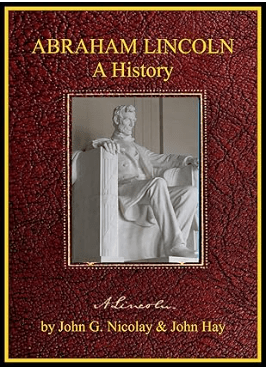
Authored by Lincoln’s two private secretaries, this massive work has been described by Lincoln historians as a “most complete biography”
A good man, my brother. I am his older sister. I carry “old” memories of days gone by, of family lore, of some of the old matriarchs and patriarchs who are no more.
He is a true intellectual. He knows more about Abraham Lincoln, history, philosophy, theology, the law, than anyone I have ever met.
The sophists I know, and have been associated with for years, have no clue of the depth of his knowledge and the extent of his work, because my brother doesn’t brag, is not a know-it-all, and is unassuming and humble beyond belief. The sophists always think they are too clever and know more. Experts on everything. Ruperts the Experts, as the Spaniards like to say. HAH. Not really. They are parochial fools.
My brother has taken care of me in my most dire moments. He was with me at the worst of times when we were used and duped by fools, and at the best of times, when we celebrated Chopin in Poland and my nephew’s coming of age.
Lo and behold, chatting with my brother this summer, I discovered he had edited the 10 volumes and had published the set through his Lex de Leon Publishing house! It was a labor of love, done in his spare time (he has a busy law practice) and it took him about 10 months to edit and re-introduce a historical record. Lex de Leon Publishing has already sold almost 1,000 copies of the 10-volume set. Not bad for a “hobby”!
He and I read a blog written by a former Constitutional Law professor, Ann Althouse, and coincidentally, she discussed the latest book she was reading and noted:
His “beach book” for the season was Nicolay and Hay’s Abraham Lincoln: A History, in ten volumes. Unfazed, he read it straight through, along with his usual supply of dime novels and periodicals.
My curiosity was piqued, because in the Spring I had been reading reviews about Morris’ Theodore Roosevelt biography and was considering getting it as a Christmas present for someone who loves history.
Originally published in 1890 by The Century Co. (New York) as a ten-volume account of the life and times of Abraham Lincoln, this kindle edition includes all ten volumes fully edited with a linked comprehensive table of contents and a linked table of contents for each of the ten volumes. There are over 4,600 linked endnotes, consisting of the original footnotes and side notes (marginalia) found in the 10-volume hard copy. It also includes over 365 original illustrations and maps, all uniformly sized and edited.
I am sharing this because I am proud of my younger brother!
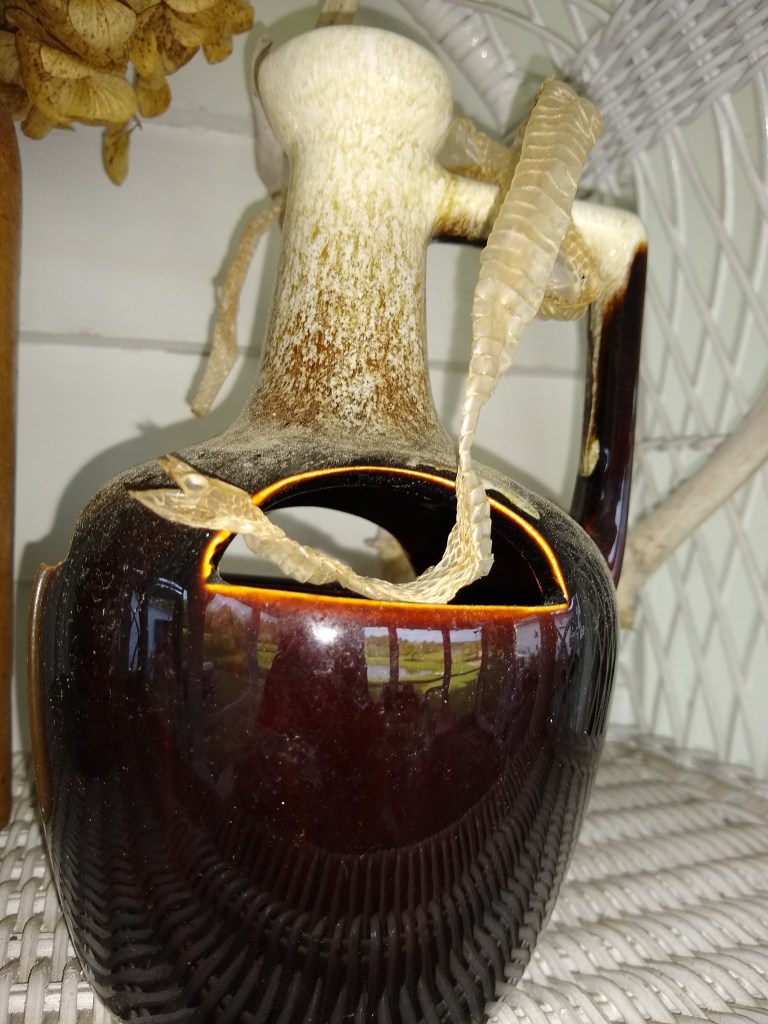
I have a transparent snake’s skin that someone found walking around the fields in Maine. He gave it to me and I saved it, thinking one day my baby grandchildren would find that exoskeleton fascinating. The other day I found a faded photo of the critter. And it made me wonder…
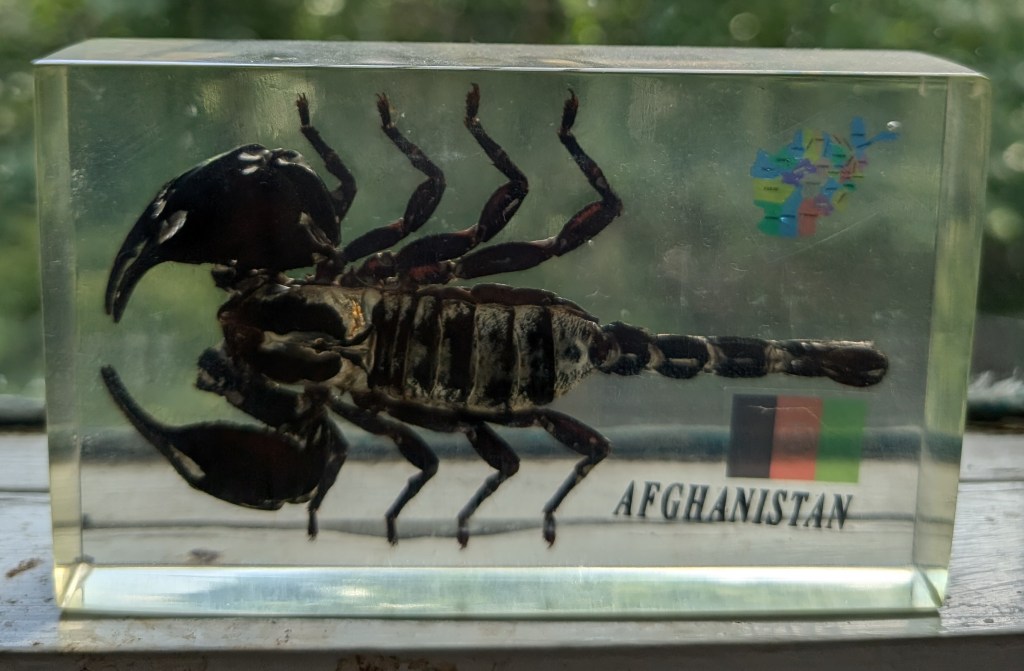
Fast forward to this summer: I discovered an old curiosity I had gifted one of my nephews. I should have kept it for myself, since I am a Scorpio! I remember how thrilled I was to find a creepy crawly immortally entombed in plastic at a tired old “store” at a US Government compound in Kabul. What are aunts for if not to do wacky things for their nephews and nieces?
I also just discovered that scorpions, like snakes, shed their mortal coils, as Hamlet would eloquently state. Sometimes, I wish I could do the same.
Sometimes, we tend to forget that actions have consequences and relegate our own to the dust bin of irrelevance or oblivion. A while back, I discovered this is not necessarily true, and that our actions can have surprising consequences.
About 20 years ago, a lady I knew adopted a Russian child. She brought the 6-year old to my home, to a party we were hosting. At the time, this new Mother was thrilled with her new status, but trepidatious, because there was an enormous chasm between her and her son: they just could not communicate. The boy was shy and withdrawn, and she ached to hold him and comfort him, but it was oh so very difficult to penetrate the boy’s world.
I happened to have a lot of children’s stories in Russian (including Tolstoy’s stories), because I once had had BIG dreams that my sons would learn the language, having lived in Moscow. It didn’t work out. None were interested. To my chagrin, they preferred the romance languages.
Listening to this lady’s plight, I remembered my precious little Russian children’s stories, and, without hesitating, I gathered all these books and gave them to her. Before doing so, I chatted with the little boy in my elementary Russian and his eyes lit up. Seeing that flicker of recognition in that boy’s eyes made me think that, maybe, these stories would help a little Russian boy lost in America.
Fast forward 7 years. I return to the US after many years abroad, and I meet a strapping young 15-16 year old young man accompanied by his Mother, who is selling Boy Scout Christmas wreaths. I don’t recognize the young man, and his Mother looks vaguely familiar, but I cannot quite place where we have met. (This is a phenomenon that has happened to me a lot during my life in the Foreign Service!).
The lady greets me warmly and tells me that I may not have realized it, but I had helped both her and her son many years before. I am baffled. She then proceeded to tell me that through the gift of a bunch of Russian stories I had made a long time ago, she and her adopted son had bonded. Although it would take a little while for them to overcome the language barrier, those books brought the two of them together. That little boy, many years back, could find solace in something so familiar, and could read in his language… and she, at least, could hold the books while he snuggled with her, delighting in their content.
I had totally forgotten what I had done. Yet the memories came pouring out of the recesses of my mind. I was humbled and touched as I have never been. Today, the little Russian boy is a young man. I wonder what he is doing nowadays.
Actions do have consequences. One sometimes is blind to the ripple effect of a tiny gift. So, my sons did not learn Russian – they closed that door. But, for a little boy out of a Russian orphanage, lost in his new home in the US, a window was opened.
And for me? The boy’s Mother gave me the biggest gift of all: discovering that I had, unknowingly, helped open that window!
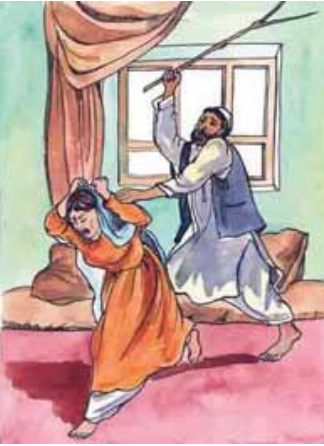
“We bought you with money and will kill you with a stone “Da zar kharidim da sang mekoshim”“
Violence against women and girls is a universal problem. The fear and sadness in a victim’s face is something I will never forget. I witnessed those faces in many countries, while working on “Rule of Law” projects, where we were trying to make the public aware that there were “legal” avenues to combat such an abuse. The recurring theme from the victims I met had an underlying commonality: the cold hatred in the eyes of the perpetrator, before and after the violent acts, was worse than the actual physical pain.
When I worked in a program involving the justice sector of Afghanistan, I learnt about “baad”. The New York Times had a story in 2012 that explained the baad custom that is prevalent in certain areas of Afghanistan.
It is a practice that most of us find repulsive: the giving of girls as reparation for the crimes or bad deeds of their male relatives. It is a traditional form of dispute resolution that had been made illegal in Afghanistan at the national level.
The Afghan Government in 2009 had enacted by decree, The Law on the Elimination of Violence against Women (EVAW), that specifically referred to the practice of baad, making it a criminal act to marry or “give away” girls and women to someone as blood price. The law prohibited the trading of women and girls to resolve disputes, including those related to murder, sexual violence, or other harmful acts. The UN’s Assistance Mission to Afghanistan (UNAMA) had to say about baadin 2010 added this explanation to the problem:
“UNAMA HR found that giving away girls to settle disputes, through baad, takes place in communities throughout the country. In spite of the prevalence of this practice, many Afghans expressed strong opposition to it. As an informal method of dispute resolution, UNAMA HR found that in the central region more baad is practiced in conflict zones where the Government exercises less authority and lacks legitimacy (for example, conflict-affected areas such as Tagab and Alasay district in Kapisa province, Uzbin in Sarobi district of Kabul province) and in remote areas where the formal rule of law institutions are weakest.“
One reality, though, was that the formal justice sector outside of major urban areas had limited resources and functionality. At the local level, jirgas or shuras headed by community elders or religious leaders settled community disputes. Another reality was the fact that many communities were totally unaware of what the national law stated.
A booklet produced by the International Development Law Organization (IDLO), that was used by the Afghan Attorney General’s office to explain the EVAW, provided a glimpse of the enormity of the educational campaign needed to reach the many rural and remote provinces, communities and Government officials who did not know about the laws affecting the rights of women. There were other publications, as well as a comic book, Masooma’s Sunrise (see below). IDLO is a “global intergovernmental organization exclusively devoted to promoting the rule of law to advance peace and sustainable development”.
The U.S. military intervention in Afghanistan did not contemplate advancing women’s status and rights. However, the U.S. reconstruction effort’s goals included improving the lives of Afghan women and girls.
Nowadays, I find so little information about the plight of the women and girls in Afghanistan. So much time has gone by, and the little progress that had been made went up in smoke, so to speak, when the U.S. withdrew from Afghanistan.
I look back at my involvement in the Rule of Law work we did in Afghanistan and can’t help thinking that we were neophytes in a social and legal experiment that we did not understand and were not fully committed to carry through.
One of my prized possessions is a lapis lazuli stone and a CD that the Afghan ladies working in the gender-based violence program I was involved with gave me. The CD contained pictures and recordings of the numerous billboards and TV programs that had been created to bring awareness to the population at large, and to let the victims of violence know that there were shelters available for them to seek protection and peace. A small amount of those millions of funds went into that campaign.
Nowadays, I can’t help but wonder, was all this for nought?
Meet Argentina’s famous tree: the ombú (Phytolacca dioica), that conjured in me images of a long-ago childhood, and poems that I did not appreciate -then- the beauty of their cadences. For example, a famous Argentine writer and statesman, wrote an ode to the tree:
Every region of the planet
Has a feature of importance:
Has Brazil its sun of ardor,
Mines of silver has Peru,
Montevideo its hillock,
Buenos Aires, land of beauty,
Has its grandiose spreading pampa,
And the pampa the ombu.

Or, in its original Spanish:

Cada comarca en la tierra
Tiene un rasgo prominente:
El Brasil, su sol ardiente;
Minas de plata el Pera,
Montevideo, su cerro;
Buenos Aires, patria hermosa,
Tiene su pampa grandiosa;
La pampa tiene el ombú…
The ombú’s magnificence is in its intricate roots and the thick foliage that protects cattle and man alike from the harsh elements. Yet the tree’s sap is poisonous.
Reconnecting with a friend of mine, whom I had not seen in decades, I discovered -to my amazement – that Afghanistan produces the one root that has medicinal powers and is widely used for flavoring: licorice (Glycyrriza glabra). In fact, licorice from Afghanistan used to be one of Afghanistan’s biggest exports to Europe and the United States. (Today, doing a cursory search, I could not find much data).
My last journal entry was a hopeful one: “Next time I visit Afghanistan I shall explore more about their abundant and unique root. In the meantime, I am enjoying reconnecting with the beautiful roots that, in my travels, I have only seen in Argentina: the ombu’s.”
Some of the things that have amazed me about Poland: A vignette.
I had been listening to the radio and the music score of the movie The Great Escape was playing. What a score! It always makes me feel good. Yet, this time, it triggered some memories.
Many years ago I did have my Great Escape encounter. I could understand the frustration of the then survivors of the horrific event to realize that most people would only recall what happened 65 years earlier through a fictionalized account of the real feat, starring Steve McQueen, who played a character that presumably was an amalgamation of many of the heroes who were murdered by the Nazis.
The movie, to this day, is still one of the most entertaining and chilling portrayals of World War II incarcerations and man’s longing to be free from brutal restraint. But it is Hollywood. Based on a real event, Hollywood took liberties. There was no Steve McQueen character in real life.
Yet, despite the tale woven out of real events, the basic story told was true.
All the real life characters who were involved in the daring escape, and subsequently executed by the Nazi Germans, are buried in a beautiful and serene cemetery in Poland: in Poznan, to be exact.
I walked through the cemetery with my young daughter and spent a long time finding the grave of the main character of that feat, Roger Bushell, and regaled her with some of the facts that I had learnt along the way. What a hero and what an ill-fated deed.
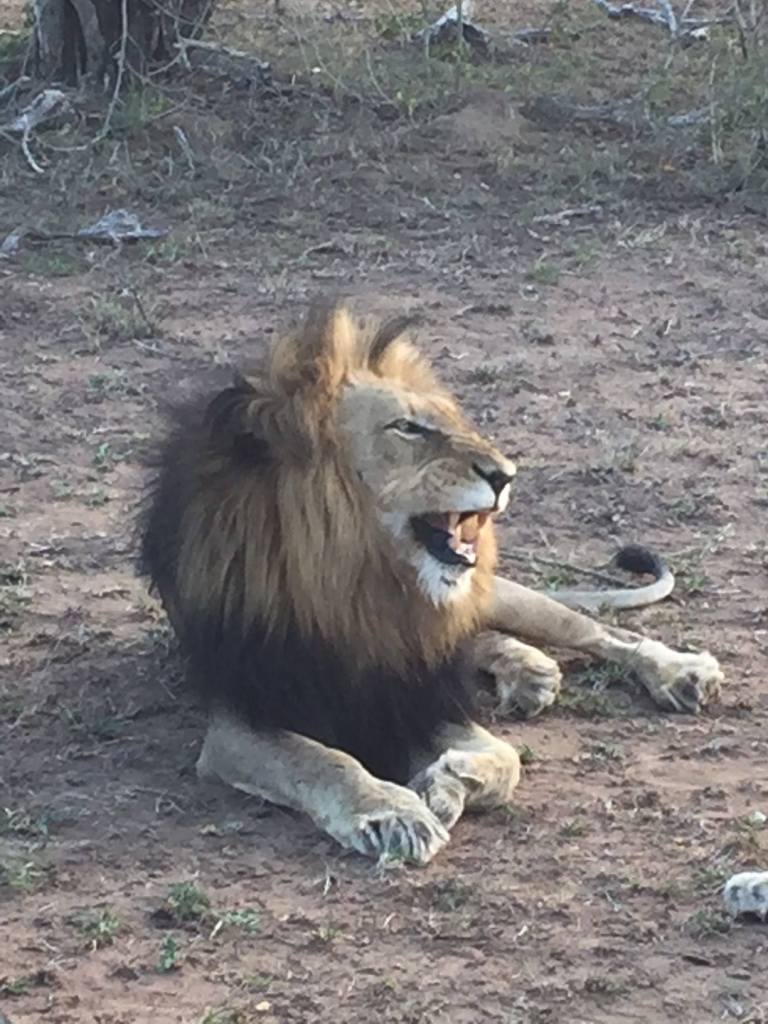
Seven years ago exactly yesterday I posted this beautiful lion noting: “HA HA HA HA! said the lion… He knows something I do not. There is a story to be told.Beauty of the beast.”
So now I am trying to write another little fable with a moral for my grandchildren, because hindsight is 20/20. I have discovered that, no matter how old you are and alert, you can be duped and tricked and be totally in la-la land.
Sometimes, the discovery of the lies or deception has been quite comical. Other times, it has been an earth-shattering disappointment. Most of the times, you feel like a fool, and that is quite a painful realization. Who wants to hear “You are a fool, not because I fooled you, but because you are personally a fool”? But it’s true. For a fleeting moment you believe you are a fool.
It is quite sad when you discover those you admired and thought had integrity turned out to have feet of clay, I believe the worst thing that can happen involving business colleagues, or friends, or family is the crumbling of trust.
Once broken, trust can never be regained. There is no going back. You can forgive, but you can never forget. And that is the saddest part of all.
A while back I watched a beautiful Iranian film that I had missed, and which has been around for 25 years! It is a lyrical story of a physically blind boy and his spiritually blind father.
The Color of Paradise gave me a wonderful glimpse into a different culture, strange and melodic language, spectacular topography, and a great performance by the 8-year old actor. The film also demonstrates that there are certain sentiments common to all people. The metaphors and allegories are gently presented. At one point the boy is told by his blind carpenter mentor that he will feel God with his hands… The last scene encapsulates what the mentor has said.
Here’s a review of this serene and poignant film. Time to watch it again!



 Dum Spiro Spero
