Of Tigers and Lions and the Rule of Law ~ Kabul-kind-of days, circa 2-24-2012
“Corans brûlés”… I read the title doing a Google search, and, for an instance, found it amusing. For a fleeting moment, the term conjured up pleasant, sweet images. Yet, thanks to the “Corans brûlés” we had been on “lockdown” for a couple of days.

Life in Afghanistan, which, according to all expats I had spoken with, could be tediously monotonous, had the capacity of changing course in a blink.  I was happily ensconced in our working compound, researching away, when word came out that the Security office of the US Embassy was enforcing a lockdown because it had been told the Korans had been burnt in one of our bases there.

It was odd, traipsing to our SUVs and starting the trek back to our living quarters.  All of a sudden, I kept looking at the people standing on the sides of the roads with trepidation.  The men one saw on those same roads, carrying weapons, who were they?  Presumably, they were policemen.  But who were they meant to protect?

We hit some traffic, but all went well.

The next day, the American and international advisors were all ready to leave to our work compound by 7:15AM, but by 9:30AM it became obvious we were not going anywhere (we followed what the US Embassy dictated).  So we all stayed in our gilded cages, working from our rooms. 

Yet, all the classes for Afghan judges, prosecutors, defense lawyers, and criminal investigators were still being held inside our compound, and all our Afghan staff (instructors, justice advisors, cooks, char force) was still there. The irony of our work environment and the monumental dangers these Afghans faced did not escape me and I marveled at their dedication and strength of spirit.

By the end of the day we knew that the compound called Green Village, where a large group of contractors and other foreigners lived (and where we had been the week before), had been accosted – so much so, that apparently the residents had to stay in the concrete bunkers for a while.

But our own Camp X had been calm, probably because it was right next door to the airport and the airbase out of which US military and State Department flights took off.  The areas in my Camp containing what I thought were excess concrete dividers turned out to be where the bunkers had been set up to protect us.   There had been no need to use these bunkers until that day.

The previous day, for some strange reason, they had lifted lockdown for a while, so that we ended up going to the office (even though all travel to all places – like ministries – had been cancelled).   In the entire time I had been in Kabul, this was the first and only time that I was uncomfortable with the idea, because our Afghan driver was uncomfortable himself.  Yet, the trip was uneventful, and we took a completely different route, far away from the madding crowd. 

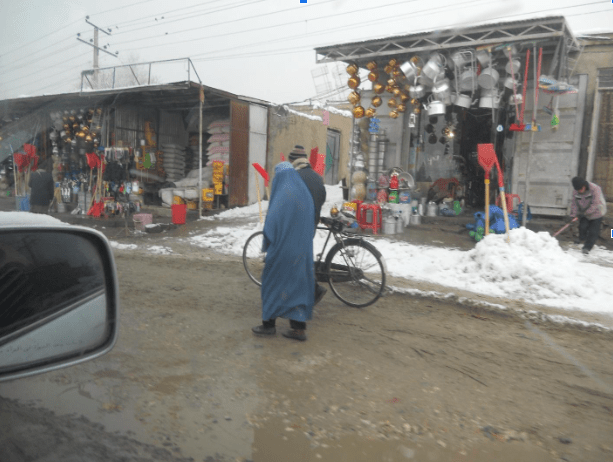
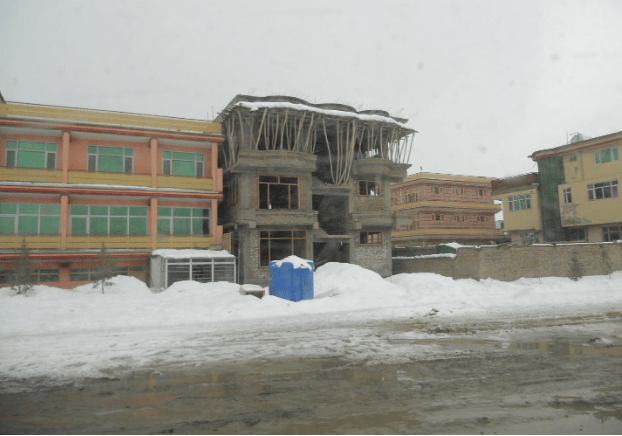
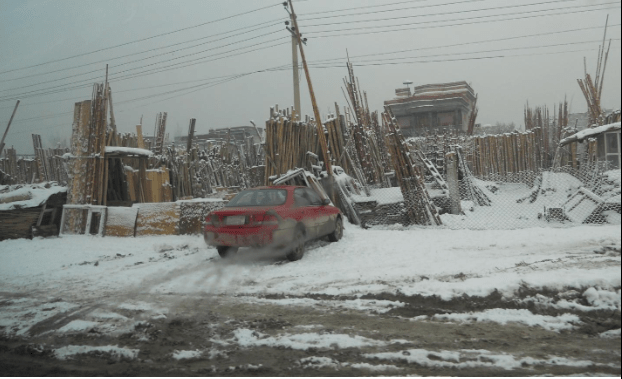
Because we left much later than usual (around 10AM), I noticed the squalid little stores all a-buzz with action:  the butcher shops with their mutton carcasses hanging outside; the cobblers sitting on their dilapidated wooden boxes; the men clearing snow off little shelves where wooden planks and poles were kept for construction purposes; the tin pot stores with their glittery gold and silver wares shining pretty in an otherwise bleak setting; and everywhere the women in their burqas, walking with little high heels or heavy boots over filthy slush, or squeezed inside a mini-bus or taxi.  I kept thinking I had never seen such pathetic penury with an eclectic whirring of sorts.  However, in all the places I had ever been, I had never looked at a city with such sadness. 

Despite it all, the morning commute turned into a veritable history lesson, and the 3 of us passengers, and the nervous Afghan driver, had a hilarious conversation that began when I tried to make light of a nerve-wracking trip. I asked my Pakistani Muslim colleague whether kids in Afghanistan had names signifying “barbarian”, like mine.  

Thus the driver and my colleague began the story of Babur, a former king of Afghanistan, descendant of Genghis Khan and Tamerlane, who settled in Delhi and began the Moghul Dynasty in India, and whose great-grandson built the Taj Mahal. 

They told me that Babur (or Babr in Persian) is very close to Barbara, and that Babur’s name really means “lion”. I pointed out that Babur and I had something in common -the lion- since my surname Dillon originally stems from “De Leon”.  There were some guffaws and by the time we entered Compound Y, there was no longer nervous tension in the car, and I was not a “barbarian”, but rather “Barbara the double lion!”. I didn’t quite get why “double”, but maybe it had something to do with my gray hair? It turned out that Babur can also mean “tiger” in Arabic, but the beauty of the laughter that helped alleviate tension was not lost on me. With a sense of relief, I genuinely felt close to my driver and fellow passengers. And so what; tigers and lions (and bears, oh my) at the end of the day conveyed the same image of strength and might.

By late afternoon, we were told the sobering news that 2 US soldiers and countless others had been killed, and we were once again put in our armored SUVs, but this time we had a third SUV with a couple of “shooters” inside, to escort us back.  Because it was Thursday afternoon, and the day before the Muslim “Sabbath”, there were few people in the streets, so our ride, thankfully, was uneventful as well, though we could see 3-4 helicopters flying in formation above the US compounds over my own Camp X.

Friday was the only day off at work, and we were also placed on lockdown, because it is the day when the Afghan males go to the mosque, and it was anticipated that the mullahs would be inciting the masses.  We were all surely safely ensconced in our little nests inside the gilded cage of our compound.  Other than the occasional helicopter flying over us, this was a totally calm and ordinary day in Kabul. 

I had no idea what would happen the next day.  The assumption was that we would all be getting ready to go to work.  But we would not find out until the early morning. It turned out the lockdown continued. Alas, our work in preparing class curricula, presentations, and reports to headquarters and the US Government, was never interrupted.

And so ended another day.  

Kabul commute 2 002.JPG

See the water pump to the left and Nan bread to the right.

A bunker by the dining facilities.

Poles used in construction.
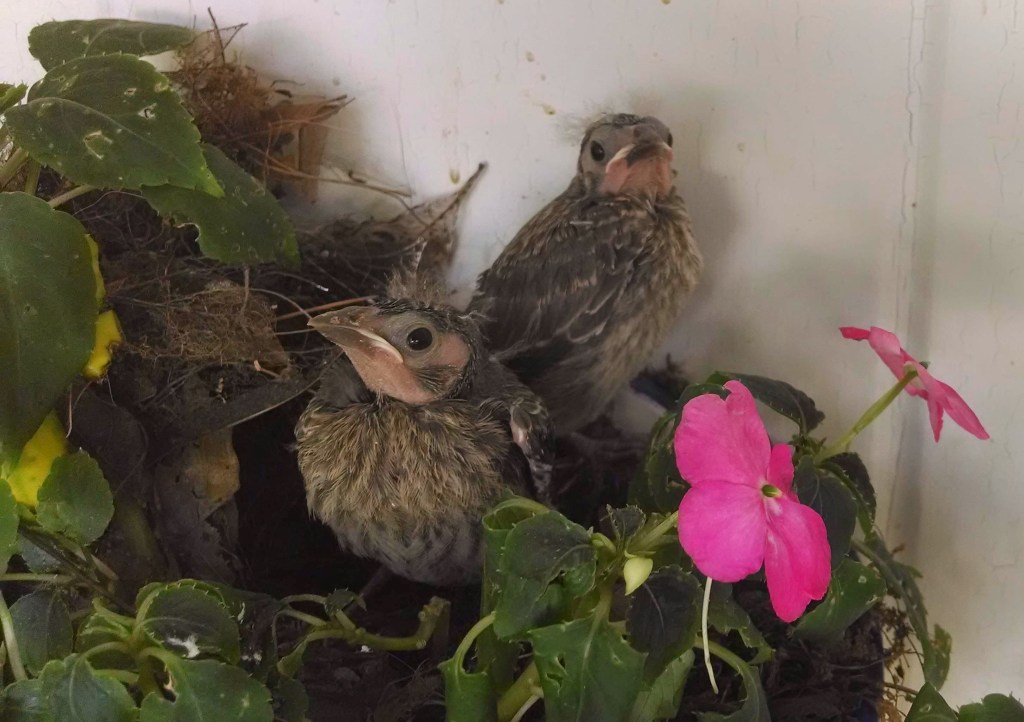
The Broken Nest

Silence everywhere
Like that of a birds’ nest bereft of birds
On the bough of a songless tree.
With the lifeless light of the waning moon was now blended
The pallor of dawn
Spreading itself over the greyness of my empty life.
I walked towards your bedroom
For no reason.
Outside the door
Burnt a smoky lantern covered with soot,
The porch smelt of the smouldering wick.
Over the abandoned bed the flaps of the rolled-up mosquito-net
Fluttered a little in the breeze.
Seen in the sky outside through the window
Was the morning star,
Witness of all sleepless people
Bereft of hope.

From “At the Last Watch“.

My image of what is a home has always been that of a nest. A carefully protected nest meant to hold fragile beings. I always balked at the idea of having to host individuals of dubious or unsavory character, because I felt the urge to guard my nest against prying eyes, and other ugly intrusions. I was not always successful, and people whom I trusted -or was willing to give them the benefit of the doubt- betrayed my trust, harmed my family, and essentially tried to dismantle my nest. Sometimes, life in the Foreign Service produces some negative personal results. There were some unfortunate incidents abroad. But then, a few nasty surprises also have occurred here at home as well. No one is immune to nefarious behavior.

My Mother kept “mothering” not just her children, but her grand-children as well. And, thanks to her efforts to expose them to what she thought was an important life message, I discovered a rare gem of an author and movie.

My Mother sought to use books and film as a way to expose her grand-children to philosophical, moral, cultural, and historical debate. Ever the perspicacious pedagogue, she realized that movies, accurately chosen, could expand a youngster’s horizon. She undertook this cinematographical pursuit with gusto, and my children were the recipients of her indefatigable research and search for the ultimate examples of the “morals of a story”.

Which brings me back to my strange remembrance of a forgotten author – poet, philosopher, Nobel laureate- of whom I had no deep knowledge. By happenstance, American TV had aired a beautiful Indian film and my Mother recorded it and shared it with us. We were living abroad at the time. The film was based on Rabindranath Tagore‘s novel, Nastanirh or The Broken Nest.

Until that time, I did not know much about Rabindranath Tagore, a friend of Ghandi’s, other than he had been a recipient of the 1913 Nobel Prize in Literature and had visited Argentina, in 1924 before my parents were born. A world famous Argentine poet and writer, Victoria Ocampo, hosted Tagore while he was recovering from influenza, and in their Autumn-Spring differences, they developed a love tenderness, a platonic relationship that resulted in a burst of literary exchanges. To understand this Indo-Argentine experience, the Edinburgh University Press has a fascinating article describing the ethos of the times.

My Mother had read Rabindranath Tagore. In researching about the man and his writings, I can now fully understand why my parents were culturally so immersed in his poetry and prose.

She made us watch the film “Charulata” (The Lonely Wife). I must confess, I was not too keen to watch the movie, since I had seen a few Indian movies in the USSR in the late 1980′s and I just could not relate to them. The USSR primarily showed Indian movies in those days, and I now realize I was too immature to want to spend the time to understand them.

The story of Charulata triggers some odd memories. Why? Because I remember my Mother’s intensity when she told us that it was this author that made her realize that, regardless of culture, when distilling the human essence, one discovers that human beings are all the same, feeling the same passions, suffering the same betrayals. This is not to say that we all behave, morally, the same.

Charulata, the film, transcends cultural barriers. It exquisitely and delicately captures the eternal themes of loneliness, contumacious neglect, good intentions that go awry, the yearning for understanding and compassion and companionship, a budding love affair that transcends consummation, the tenderness and harshness of youth, betrayal, and maybe, maybe, the possibility of redemption.

‘Sesh Basanta’ (The Last Spring)
by Rabindranath Tagore, 1924
You will experience many springs in your life,
Let me beg one of it…
Have no misgivings;
In your blossoming flower garden
I’ll not linger endlessly
Nor look back
When the day ends and it’s time for leave-taking.”

I would like to know that one day my children and grandchildren might remember me for my sprinkling some lyrics, or melody, or story because I sometimes go off on what some believe are tangents going nowhere, though I just see my perambulations as always returning to where I left off, albeit taking a bit of a long and windy way. It’s because I lack my Mother’s wonderful way with quotes of proverbs, poems, and sayings that had a concise application to whatever topic we were discussing.

Of all the memories I have of my Mother, I always return to her dear Charulata movie. Her protection of our nest was paramount. Her fledglings are old birds now. More or less, we have weathered the storms of life. If only I could give my children a legacy such as my Mother’s…

Sir Nicholas Winton, a Hero for the Ages

winton

Once upon a time, circa 2008, I was lucky to be invited by a friend to visit her in Paris.  My stay there coincided with the visit of one of those rare individuals who –in his unassuming way- was a giant of his era. He made an incredible contribution to mankind and is known as the British Schindler.

Sir Nicholas Winton, “Nicky” to his friends, was in France for a special program on anti-Semitism.  He hailed from Maidenhead (UK), was a lover of gardens, a gentle, kind, no-nonsense man who stressed that he was not a diplomat.

His story is one for the ages. In 1939, as an English stockbroker, Sir Nicholas Winton  spent some time in Prague and he became a “living angel” by rescuing 669 Czech children from their doomed fate in the Nazi death camps. Most of the saved children never saw their parents again. These unfortunate souls perished in the German Nazi concentration camps.

Nicholas Winton’s feat was unrecognized for more than 50 years, and most of the children he saved were totally unaware who their savior had been.  His story came to light when his wife Greta, rummaging through their attic, found an old leather briefcase that contained lists of the children and letters from their parents.  

Sir Nicholas’ perspicacity made him aware that something was terribly wrong. Unlike so many others, he was courageous enough to do something to right what was so terribly wrong at the time.  Because he was born of Jewish parents who later converted to Christianity, he was not recognized as one of the Righteous Gentiles at Yad Vashem.

The impact of Sir Nicholas’ remarkable achievement was so striking that there has even been a movie made of him, One Life, with Anthony Hopkins playing him. There also is a children’s book written and illustrated by Peter Sís called Nicky & Vera: A Quiet Hero of the Holocaust and the Children He Rescued. Below are 3 videos that tell his poignant story better than me.

I had the privilege, honor, and great fortune to meet a living legend, who lived to be 106 years and died in 2015.  I spent a few times with Sir Nicholas and heard the harrowing experiences from the man himself. He had a sparkle in his eye and a most beautiful smile. I think of him often, and how it is so true that one person can make an enormous difference.

Sir Nicholas Winton never thought what he did was outstanding. It was just the right thing to do.


Afghanistan: Reflections of a Not-so-Long Ago Era

Someone asked me about my legal work involving Afghanistan.  Her question triggered old memories of an enthralling time that appears to have been lost, at least for a while.  However, my propensity for keeping diaries and writing e-mails and letters, developed during elementary school in Buenos Aires, preserved memories of my impressions visiting and working in Kabul a decade ago. 

I was new to the country, but an old hand in what we used to call “development work in the Rule of Law”.  What follow are my personal impressions, as written then, updated with a couple of edits. All the work mentioned here can be found in the myriad of inspection reports, evaluation reports and other documents that the US Government makes available to the public.   

February 17, 2012:

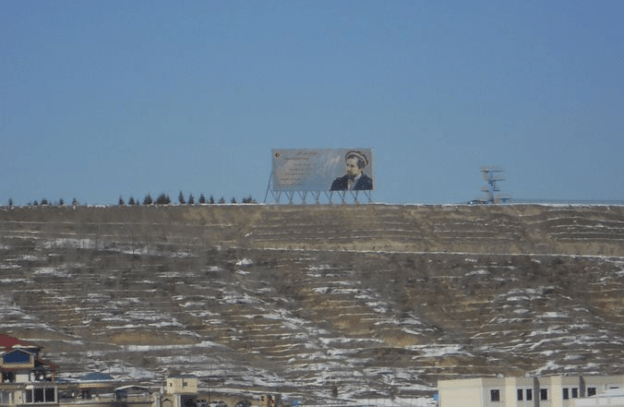
It was a gloriously sunny day, clear blue skies, with not a hint of cloud or haze.  So much so that I could see, for the first time, the little houses built on the denuded slopes of the Hindu Kush.  

I had no idea that Hindu Kush actually means Hindu Slaughter.  I need to do more research about this.

So, two days ago I was up by 6:30am and by 7:45am we were all in 3 vehicles going from Camp X, where I live, to Compound Y, where we work (some of us live and work in the same sites, which can become quite onerous.  Can you imagine having breakfast, lunch and dinner with the same people you work with day in and day out?  For a year or two or more?).

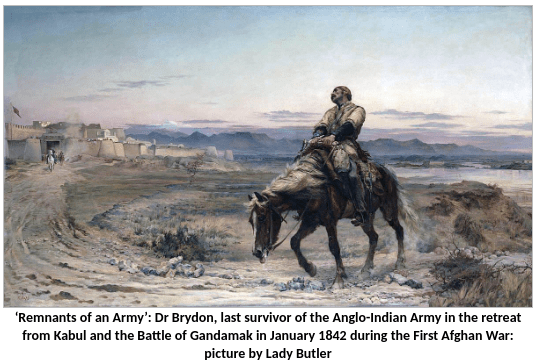
Compound  Y is situated in the most exclusive neighborhood of Kabul.  It consists of villas walled in.  It is no different than all the other villas around (some held by Embassies, others by international organizations, and others by the ministers and sundry government officials).   The movie The Kite Runner apparently was filmed in this neighborhood called Wazir Akbar Khan.  Wazir Akbar Khan was the leader who fought during the famous First Anglo-Afghan War that ended in a monumental defeat of the British army in Gandamak. At one point the highest governmental award that the Afghan Government could bestow was an eponymous medal.

What is noticeable, though, is that -apparently- all the streets are unpaved, (I cannot tell right now because of the snow), have barriers across them that are always up, and can compete with the rest of the roads in terms of the deep craters that destroy cars.  Rumor has it that the residents don’t want these holes repaired because it protects them from nefarious sorts:  these craters don’t allow for a quick getaway.

I took the opportunity to go to the roof of my building to take photos of the city and the surrounding mountains, because I was told that it is very, very rare to get such a clear glimpse of the mountains that encircle the city.

I met a young lady, from abroad, with a Masters in Business Administration, who is a “procurement advisor” at a major Ministry and is helping them set up a system for tracking, budgeting for and storing, inventory.  She has been in Kabul for 3 years and loves the Afghans and her job.   

One of the aims of my program is to train Afghan judges, prosecutors, lawyers and criminal investigators to clinically apply the law.  Among the several courses we offer, one lasts 8 weeks, and another 4 weeks.  Since 2007 there have been more than 14 thousand individuals trained by us! 

Another aspect of the project is to have the Attorney General’s and the Ministry of Justice’s Offices identify promising Afghan lawyers who are then trained for 1 year before sending them to University of Washington’s Law School for a 1 year LLM program.  Why University of Washington?  Because they have, apparently, the best legal clinic that provides pro bono work for Native American tribes.  And this is the closest one can get to understanding the tension between the formal justice sector (courts and the power of the state) and the informal justice sector that handles tribal issues and customary law.

There are so many things that are happening here that one never hears about!  I shared a cup of tea with an engineer with the US Corps of Engineers, who has been managing construction projects all around Afghanistan.  Example:  building generators in remote villages (that have no roads) and that, through the use of little streams, generate the first electricity these people have ever had!  They have also built small schools in these small villages, so that, again, for the first time, children have a place to go and sit down to attend classes taught by Afghans who have been trained by the international community.

I share the pics of the mountains that form the Kabul bowl, and you can get a sense for the architecture of the place.  We cannot drink the water, so bottles are stored, en masse, everywhere.  

And we have a little kitty that sits by the front door of the building. 

We are, of course, in a state of alert, and, for good reason, the security task force here takes it very seriously. 

I leave you with a comment a wise advisor made to me:  

In Afghanistan, 2012 is the Persian year 1390, which, if one compares it to our Western world’s 1390, not much has changed:  there are still feudal lords or barons (the Afghan warlords) fighting each other with the vast majority of the people being illiterate serfs.

My Daughter is her Mother’s daughter!

Well, all I can say is that my daughter Adriana is her Mother’s daughter!. A romantic at heart, a lover of melodic songs, Italian at that!

I laugh because one of the biggest cultural divides I ever faced (and still do) is that I was incessantly mocked for liking French, Italian, Spanish, American, Argentine, Croatian, English and Welsh balladeers of yester year.

I should have been into hard rock. But I never was. Because, although a Boomer by age, I was not culturally a real Baby Boomer, having been raised outside of the USA. I have changed in my old age, and appreciate the old iconoclasts (although I still find Dylan’s voice a bit jarring).

Sadly, the reverse has never been true: those who mocked me, could never really understand why I might have liked a Charles Aznavour or a Carlos Gardel (here’s the tango he composed, updated to Hollywood standards, and here’s the original song he sang) or a Bobby Solo. (Hey, I did move onto the 1980s in terms of music taste. I am not that much of a dinosaur.) In their ignorance, I see a loss!

I had never heard of this singer. She is a young modern composer. The lyrics are lovely and carry a punch.

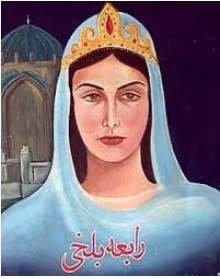
Rabia Balkhi, the First and Only Afghan Queen and Persian Poetess

I found this “letter to Rabia” quite a statement, from a Western perspective. 

The Princess and the Slave

A story of how love still kills in Afghanistan (Author: Nushin Arbabzadah)

Dear Rabia,

I am writing to you across centuries – from the land of the living to the realm of the dead. The year is 2012 and you were murdered exactly a thousand and sixty-nine years ago. You have the dubious privilege of being our first recorded case of honor killing.

I am caught in Love’s web so deceitful
None of my endeavors turn fruitful.
I knew not when I rode the high-blooded stead
The harder I pulled its reins the less it would heed.
Love is an ocean with such a vast space
No wise man can swim it in any place.
A true lover should be faithful till the end
And face life’s reprobated trend.
When you see things hideous, fancy them neat,
Eat poison, but taste sugar sweet.

Rabia Balkhi lived in the 10th century.  She fell in love with her brother’s slave.  She was imprisoned by her brother and committed suicide after writing the last stanza of her last poem, Love, on her prison wall with her own blood. 

Rabia Balkhi was the first and only Afghan queen.  Her tomb, presumably, is in the now familiar city of Mazar-e-Sharif.  A movie of her life survived destruction by the Taliban.

There used to be a busy woman’s hospital in Kabul named after the queen. It was supported by the International Committee of the Red Cross (ICRC). The last entry I read about the hospital by the ICRC is from 2022. I can find nothing else. I wonder, what has happened to it? Maybe the Taliban just changed the hospital’s name…

Lost in the Cradle of the Deep…

…was one my Father’s recurring refrains, and whenever I stare at the horizon or any body of water deep in thought, it comes back to me bathed in nostalgia, and sometimes with a flash of joy.

In the last year of his life, I remember how he sat on his favorite red leather wing chair, staring deeply into the flames in the fireplace, his big blue eyes lost in thought. When asked “Daddy, what are you thinking?” he would blurt “I am lost in the cradle of the deep”. And that was it. No explanation. Just that.

So yesterday, while I was ruminating about Dante’s circles, I thought of him. And down my rabbit hole I went.

My Father, John Dillon, lost his Father when he was a young 14 year old. The absence of his Father weighed heavily all his life. His Mother, my Grandmother, had worked for RCA Victor in Buenos Aires, and had a collection of old 78s. I believe I found the source of my Father’s saying, although it was not “lost”, but rather, it was “rocked”. The source was an old hymn, the lyrics of which were written by an amazing woman, Emma Willard (1787-1870), of Connecticut.

Willard moved to Middlebury, Vermont and had requested to attend classes at Middlebury College, but had been denied the opportunity. A persistent visionary, she was a pioneer in women’s education, and in 1814 started the Middlebury Female Seminary. Irony of ironies, today, her home is the Middlebury College Admissions Office. 

Emma Willard’s indefatigable pursuit of women’s education brings to mind my Mother in Law’s own common refrain, of British origin, so in order to rhyme you have to use English pronounciation:

“Patience and perseverance made a Bishop of his Reverence!”

So now, with patience and perseverance, my next project is to edit and publish my Father’s prolific writings which he only did for his children: a history of the Dillons, an autobiography “Don Juan Nadie” (Don Juan Nobody), and a novel “Murder on the Bullet Train”. They are too good to be kept all in the family!

Rocked in the Cradle of the Deep
Author: Emma Willard

Rocked in the cradle of the deep,
I lay me down in peace to sleep;
Secure I rest upon the wave,
For Thou, O Lord, hast power to save.
I know Thou wilt not slight my call,
For Thou dost mark the sparrow’s fall;
And calm and peaceful is my sleep,
Rocked in the cradle of the deep;
And calm and peaceful is my sleep,
Rocked in the cradle of the deep.

And such the trust that still were mine,
Tho’ stormy winds swept o’er the brine;
O, tho’ the temptest’s fiery breath
Rous’d me from sleep to wreck and death,
In ocean’s cave still safe with Thee,
The germ of immortality;
And calm and peaceful is my sleep,
Rocked in the cradle of the deep;
And calm and peaceful is my sleep,
Rocked in the cradle of the deep.

The Treasure Flower Leads Me to Dante

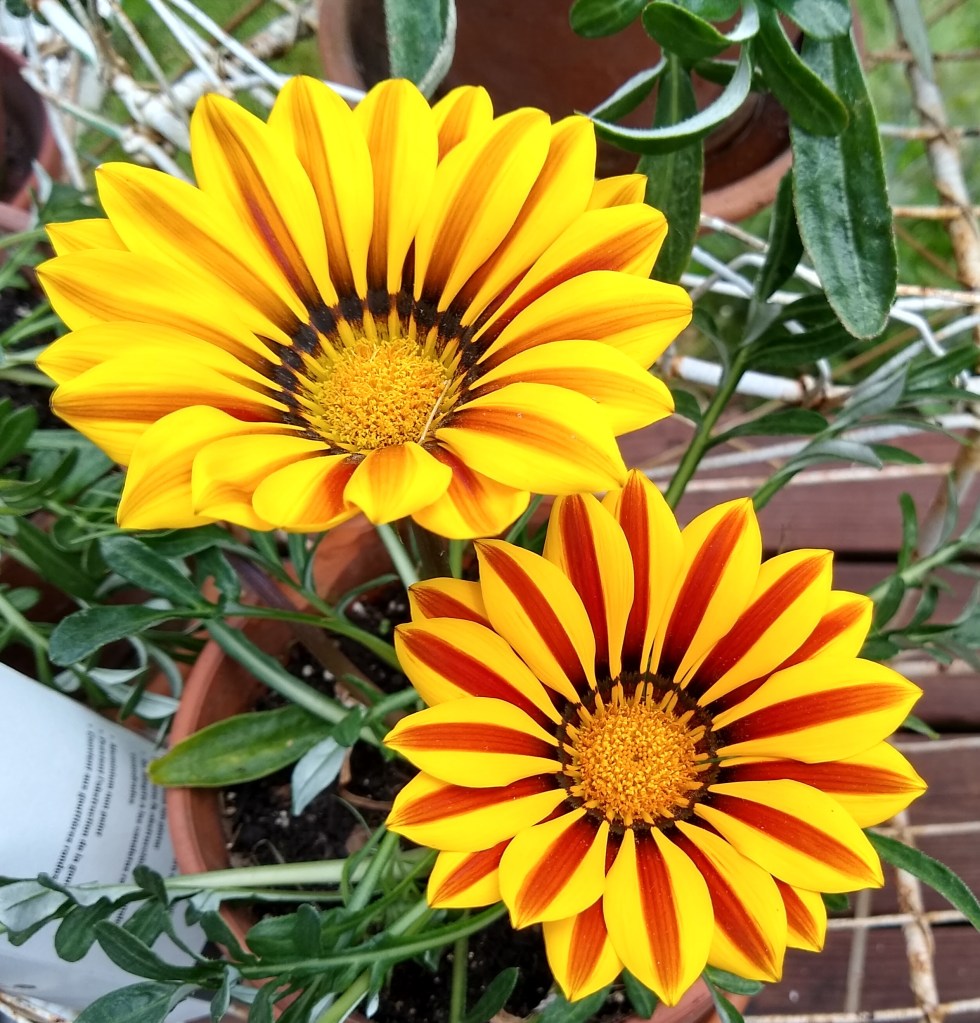
I remember so well the day I discovered these flowers. The promise of eternal summer blossoms (although they closed up after the sun went down or on cloudy days). They never disappointed.

They are called Gazania Rigens, but I like that they are referred to as the treasure flowers. They are native to South Africa, and named after a Greek philosopher, Theodorus of Gaza, who translated Aristotle and others into Latin during the Renaissance.

Summer has ended here in Maine, and with it all the expectations that I was anticipating in spring and which did not materialize for me, like the annual visits of family and friends. Like this flower, that closes up at sundown and in cloudy days, summer closed and then wilted away. The first frost has appeared, and more than ever, I am focused on what lies ahead.

Midway on our life’s journey, I found myself
In dark woods, the right road lost. To tell
About those woods is hard—so tangled and rough

And savage that thinking of it now, I feel
The old fear stirring: death is hardly more bitter.

I am at the sunset of my life, not midway. However, at different stages in my peripatetic life I have been lost and have gone through quite a few dark woods to find the road, so to speak.

Many summers, while the gazinias were at their peak, my life’s journey brought me down to what I perceived to be rock bottom. Crises of family, health, friends, work. In retrospect, these crises were existential in nature and I flowed with the river of life, and eventually always reached a shore. Despite my insecurities and doubts, I retained a buoy of sorts, and never quite felt I was totally adrift.

Nowadays, I am on a quest to seek “clarity of vision, clarity of understanding, clarity of purpose”. So I am trying to read and understand Dante Alighieri, no small feat. I am approaching this adventure by doing research about the man and the epoch before immersing myself into the walk down to hell and back.

For example, why is Dante’s Inferno’s last circle the place reserved for the worst of sinners, who are tortured because of the worst of sins: treachery? Why do the nine circles spiral down, constricting themselves to a narrower and icier place? Isn’t our image of hell a raging fire?

There is a reason why, despite meting out punishment for heinous crimes, even the law recognizes that some of those such crimes and ensuing punishments can be mitigated when the crimes are committed in the heat of passion. There is no premeditation.

Yet, fraudulence and treachery are done deliberately, in cold blood. They are sought out in an icy calculating way: they are a choice usually justified by chewing on past resentments, anger, hatred. At the end of the day, it seems to me, that the evil transgressions we humans engage in, all involve pure and unadeltarted selfishness, thinking only of our own personal pleasures, and not of caring for others. It is the essence of what St. Augustine referred to as homo incurvatus in se, a Latin phrase that means “”humanity curved in on itself”, curving ourselves into our own little and insignificant mini-kingdoms.  

I always felt uprooted, and that it was hard to belong somewhere, because of my itinerant life. But, my initial first excursions into researching the Inferno led to my AHA moment: finally understanding the true meaning of deracination. The Cambridge Dictionary’s definition states that to deracinate is “to make someone or something lose their connection to any particular place, background, way of life, etc.”

There is a difference between the meanderings of life as they take one on different voyages, and the calculating, callous and cruel dissevering of one’s tethered anchor or the tearing asunder of one’s soul, of all that was, is, and will be. The mind and heart cannot quite understand what is happening as it is happening. The closest description I can think of is the horror of becoming a prey to hyenas that do not kill their prey but, rather, tear them apart and eat them while they are alive. It is a most gruesome fate. Fittingly, the betrayers in Dante’s Ninth Circle are eternally chewed by Satan!

In the end, the only way up is down and an antidote to our transgressions is a good dose of humility. Humility has many synonyms; its etymology brings us to humus – the earth. The word human derives from humus as well. In Hebrew Adam is “man” and Adamah is “from the earth”. So much to learn, so little time left! I better start reading Dante sooner than later…

The Tiffany Coup de Grâce

A long, long time ago I worked at Tiffany & Co., when the archetypal store was the epitome of elegance and grace in everything, from design to service. 

I have fond memories of the old Tiffany’s, and was initially shocked and heartbroken to find out that the French had bought the American store.

An iconic centenarian old ad placement on Page 3 of the New York Times had been given the coup de grâce. As late as 2016, the American jewelry store insisted that,

“In an ever-changing world, perhaps Tiffany & Co.’s most consistent relationship with the public over the last century is its daily advertisement on page A3 of The New York Times, which began running in 1896.”

Alas, Tiffany’s new French owners had a nouveau vision, now that the American quintessential jewel was no more: her own Belle Époque had come to an end.

There may be some who still read the print edition of newspapers, who will feel a pang of nostalgie, and wonder if la mort d’une campagne publicitaire had to be done with such sang-froid.

However, according to Christie’s, the American Tiffany’s was the “world’s oldest jewellery brand”. And in 1887 it managed to purchase “about one third of the French crown jewels when they were sold off after the collapse of the Second French Empire.” 

Some have considered this event une catastrophe nationale.

So the American brand, emblematic of a time of excellence, is no more. C’est la vie!

And while the New York Times lost the daily ads, the French came back to reclaim some of their patrimony. Fait accompli!

Wojtek, the Polish Bear Soldier

“Wojtek had the look of a bear but indeed had the heart of a Pole.”

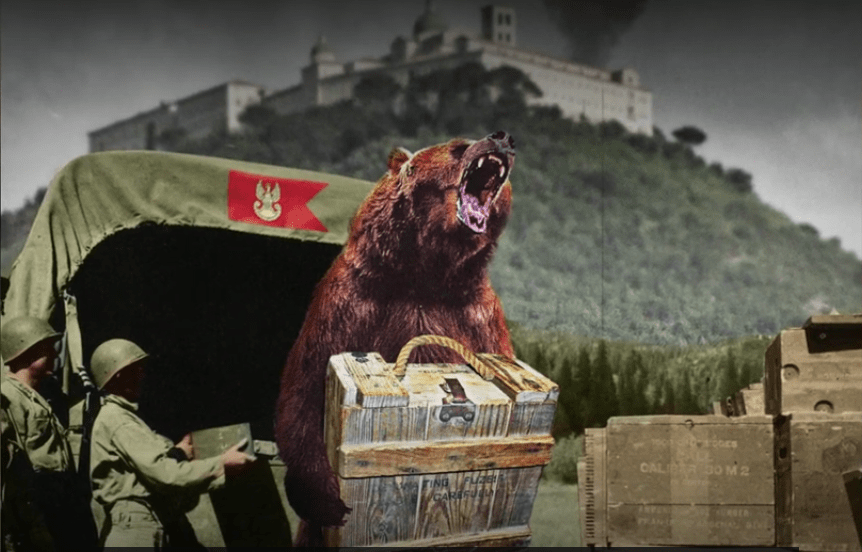
I love learning something new every day, and discovering the story of Wojtek, the Polish bear soldier, was one of the most remarkable surprises I ever had. He was born in Iran, was adopted by the Polish army, lived in Iraq and Egypt among other places, went to Italy and died in Scotland.

A magnificent 500lb military bear, he liked beer and cigarettes! Wojtek’s greatest moment may have been at the Battle of Monte Cassino in 1944.

In order to stay with the Polish Army when they joined the Allied military campaign in Italy, Wojtek was officially enlisted as a private, given a serial number, and was able to remain with his comrades in arms, the Polish soldiers. He not only carried artillery shells and ammunition crates between trucks and troops engaged in combat, but wounded soldiers as well. He received a promotion, to corporal. There was a documentary done about him in 2011.

A while ago, I remarked on Monte Cassino here:

How many people today remember that the Poles played a crucial role in the battle of Monte Cassino (1943), and that so many of them died there? It was on the fourth assault of the monastery, led by the Poles, that the Germans were defeated. The graveyard in Monte Cassino is numbing, and, in the context of history, it is overwhelming, because it was thanks to this assault that the road to Rome was opened and Rome was liberated 3 weeks later. 

One of my favorite French words is “coquelicots“. Nowadays, I think of the jolie coquelicots, The Red Poppies of Monte Cassino, with a sadness and enduring admiration for all who fought there.

Wojtek, the Polish soldier, the bear that had the “heart of the Pole”, became emblematic of the determination and devotion to carry through against all odds, including the ultimate sacrifice.

The coquelicots of Monte Cassino: