A “Baad” Story from Afghanistan
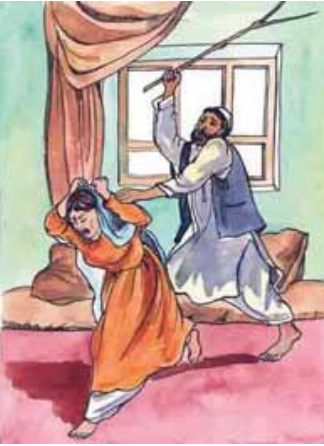
We bought you with money and will kill you with a stone “Da zar kharidim da sang mekoshim”

Violence against women and girls is a universal problem. The fear and sadness in a victim’s face is something I will never forget. I witnessed those faces in many countries, while working on “Rule of Law” projects, where we were trying to make the public aware that there were “legal” avenues to combat such an abuse. The recurring theme from the victims I met had an underlying commonality: the cold hatred in the eyes of the perpetrator, before and after the violent acts, was worse than the actual physical pain.

When I worked in a program involving the justice sector of Afghanistan, I learnt about “baad”. The New York Times had a story in 2012 that explained the baad custom that is prevalent in certain areas of Afghanistan.

It is a practice that most of us find repulsive:  the giving of girls as reparation for the crimes or bad deeds of their male relatives.  It is a traditional form of dispute resolution that had been made illegal in Afghanistan at the national level. 

The Afghan Government in 2009 had enacted by decree, The Law on the Elimination of Violence against Women (EVAW), that specifically referred to the practice of baad, making it a criminal act to marry or “give away” girls and women to someone as blood price. The law prohibited the trading of women and girls to resolve disputes, including those related to murder, sexual violence, or other harmful acts. The UN’s Assistance Mission to Afghanistan (UNAMA) had to say about baad in 2010 added this explanation to the problem:

UNAMA HR found that giving away girls to settle disputes, through baad, takes place in communities throughout the country. In spite of the prevalence of this practice, many Afghans expressed strong opposition to it. As an informal method of dispute resolution, UNAMA HR found that in the central region more baad is practiced in conflict zones where the Government exercises less authority and lacks legitimacy (for example, conflict-affected areas such as Tagab and Alasay district in Kapisa province, Uzbin in Sarobi district of Kabul province) and in remote areas where the formal rule of law institutions are weakest.

One reality, though, was that the formal justice sector outside of major urban areas had limited resources and functionality.  At the local level, jirgas or shuras headed by community elders or religious leaders settled community disputes.  Another reality was the fact that many communities were totally unaware of what the national law stated.  

A booklet produced by the International Development Law Organization (IDLO), that was used by the Afghan Attorney General’s office to explain the EVAW, provided a glimpse of the enormity of the educational campaign needed to reach the many rural and remote provinces, communities and Government officials who did not know about the laws affecting the rights of women. There were other publications, as well as a comic book, Masooma’s Sunrise (see below). IDLO is a “global intergovernmental organization exclusively devoted to promoting the rule of law to advance peace and sustainable development”.  

The U.S. military intervention in Afghanistan did not contemplate advancing women’s status and rights. However, the U.S. reconstruction effort’s goals included improving the lives of Afghan women and girls.

The Special Inspector General for Afghanistan Reconstruction (SIGAR) found that from 2002 to 2020, the Department of State, the U.S. Agency for International Development (USAID), and the Department of Defense (DOD) disbursed at least $787.4 million for programs that specifically and primarily supported Afghan women and girls in the areas of health, education, political participation, access to justice, and economic participation. SIGAR also stated that “[t]his understates the total U.S. investment in women and girls, however, since hundreds of additional U.S. programs and projects included an unquantifiable gender component. State and USAID have not consistently tracked or quantified the amount of money disbursed for projects which directly or indirectly support Afghan women, girls, or gender equality goals. Therefore, the full extent of U.S. programming to support Afghan women and girls is not quantifiable.”

Nowadays, I find so little information about the plight of the women and girls in Afghanistan. So much time has gone by, and the little progress that had been made went up in smoke, so to speak, when the U.S. withdrew from Afghanistan.

I look back at my involvement in the Rule of Law work we did in Afghanistan and can’t help thinking that we were neophytes in a social and legal experiment that we did not understand and were not fully committed to carry through.

One of my prized possessions is a lapis lazuli stone and a CD that the Afghan ladies working in the gender-based violence program I was involved with gave me. The CD contained pictures and recordings of the numerous billboards and TV programs that had been created to bring awareness to the population at large, and to let the victims of violence know that there were shelters available for them to seek protection and peace. A small amount of those millions of funds went into that campaign.

Nowadays, I can’t help but wonder, was all this for nought?

Argentina and Afghanistan: a root discovery.

Meet Argentina’s famous tree:  the ombú (Phytolacca dioica), that conjured in me images of a long-ago childhood, and poems that I did not appreciate -then- the beauty of their cadences. For example, a famous Argentine writer and statesman, wrote an ode to the tree:

Every region of the planet
Has a feature of importance:
Has Brazil its sun of ardor,
Mines of silver has Peru,
Montevideo its hillock,
Buenos Aires, land of beauty,
Has its grandiose spreading pampa,
And the pampa the ombu.

Or, in its original Spanish: 

Cada comarca en la tierra
Tiene un rasgo prominente:
El Brasil, su sol ardiente;
Minas de plata el Pera,
Montevideo, su cerro;
Buenos Aires, patria hermosa,
Tiene su pampa grandiosa;
La pampa tiene el ombú…

The ombú’s magnificence is in its intricate roots and the thick foliage that protects cattle and man alike from the harsh elements.  Yet the tree’s sap is poisonous.

Reconnecting with a friend of mine, whom I had not seen in decades, I discovered -to my amazement – that Afghanistan produces the one root that has medicinal powers and is widely used for flavoring: licorice (Glycyrriza glabra).  In fact, licorice from Afghanistan used to be one of Afghanistan’s biggest exports to Europe and the United States. (Today, doing a cursory search, I could not find much data).

My last journal entry was a hopeful one: “Next time I visit Afghanistan I shall explore more about their abundant and unique root.  In the meantime, I am enjoying reconnecting with the beautiful roots that, in my travels, I have only seen in Argentina:  the ombu’s.”

The Great Escape: Fact vs. Fiction.

Some of the things that have amazed me about Poland: A vignette.

I had been listening to the radio and the music score of the movie The Great Escape was playing. What a score! It always makes me feel good. Yet, this time, it triggered some memories.

The 2009 Times heading ‘Great Escape’ POWs remember comrades…and boo ’silly’ Steve McQueen‘ summarized it all.

Many years ago I did have my Great Escape encounter. I could understand the frustration of the then survivors of the horrific event to realize that most people would only recall what happened 65 years earlier through a fictionalized account of the real feat, starring Steve McQueen, who played a character that presumably was an amalgamation of many of the heroes who were murdered by the Nazis.

The movie, to this day, is still one of the most entertaining and chilling portrayals of World War II incarcerations and man’s longing to be free from brutal restraint. But it is Hollywood. Based on a real event, Hollywood took liberties. There was no Steve McQueen character in real life.

Yet, despite the tale woven out of real events, the basic story told was true.

All the real life characters who were involved in the daring escape, and subsequently executed by the Nazi Germans, are buried in a beautiful and serene cemetery in Poland: in Poznan, to be exact.

It was a little tidbit I discovered while visiting the air force base where US pilots were training Polish pilots to fly their F-16s.

I walked through the cemetery with my young daughter and spent a long time finding the grave of the main character of that feat, Roger Bushell, and regaled her with some of the facts that I had learnt along the way. What a hero and what an ill-fated deed.

The BBC has more information on Bushell’s daring caper that occurred in Poland. There are so many such stories waiting to be told.

Poznan Cemetery, Poland.  Photo by Pawel Macuga.

Poznan Cemetery, Poland. Photo by Pawel Macuga.

You Are a Fool, not because I Fooled You, but because You are Personally a Fool

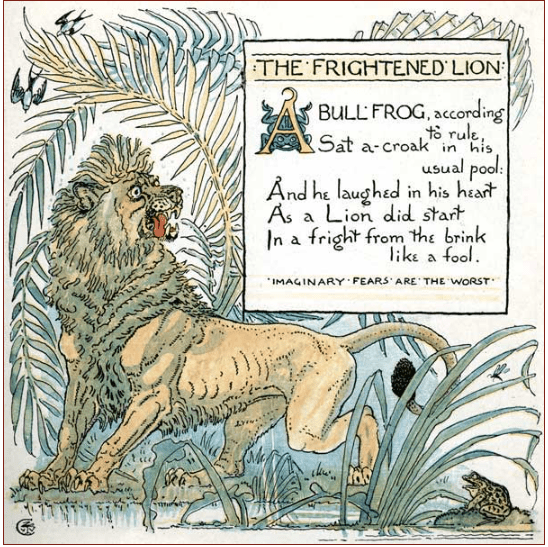
Seven years ago exactly yesterday I posted this beautiful lion noting: “HA HA HA HA! said the lion… He knows something I do not. There is a story to be told. Beauty of the beast.”

So now I am trying to write another little fable with a moral for my grandchildren, because hindsight is 20/20. I have discovered that, no matter how old you are and alert, you can be duped and tricked and be totally in la-la land.

Sometimes, the discovery of the lies or deception has been quite comical. Other times, it has been an earth-shattering disappointment. Most of the times, you feel like a fool, and that is quite a painful realization. Who wants to hear “You are a fool, not because I fooled you, but because you are personally a fool”? But it’s true. For a fleeting moment you believe you are a fool.

It is quite sad when you discover those you admired and thought had integrity turned out to have feet of clay, I believe the worst thing that can happen involving business colleagues, or friends, or family is the crumbling of trust.

Once broken, trust can never be regained. There is no going back. You can forgive, but you can never forget. And that is the saddest part of all.

The Story of a Blind Boy

From sonypictures.com.

A while back I watched a beautiful Iranian film that I had missed, and which has been around for 25 years! It is a lyrical story of a physically blind boy and his spiritually blind father.

The Color of Paradise gave me a wonderful glimpse into a different culture, strange and melodic language, spectacular topography, and a great performance by the 8-year old actor.   The film also demonstrates that there are certain sentiments common to all people.  The metaphors and allegories are gently presented.  At one point the boy is told by his blind carpenter mentor that he will feel God with his hands…  The last scene encapsulates what the mentor has said.

Here’s a review of this serene and poignant film. Time to watch it again!

Imaginary Fears and the “Chantapufi”.

This year alone will end for me, yet again, with many, many experiences with worthless but dangerous “chantapufis”.   I periodically revisit an old journal entry, because I keep encountering these unsavory human beings all the time! So, here it goes:

Chantapufis are totally worthless because their only contribution to society is bullying.  But they are dangerous because, when cloaked under the mantle of authority, they can turn regular decent individuals into cowards and servile vassals.  

The latest example of a chantapufi that I have experienced is an obnoxious type, someone who wields power because of his/her position, who issues “orders” like a master to his dog:  “Come”… And who resents what he/she perceives to be an underling who ought not to have better access to information and/or powerful individuals than he/she.  Yet, as always, when the chantapufi is revealed, he/she crawls back into the shell of isolation, like one of those crabs that move into another crab’s shell.  

I ought to feel benign at this juncture, because I like to think I am a better person.  But, right now, I want to squish the chantapufi like the cockroach that he/she is.  Not very noble nor charitable. Shame on me.

Sometimes we are our own worst enemies, especially when doubt in one’s principles and abilities creeps in. Everyone is prone to tsk-tsk clichés and proverbs and fables alike (though not many seem to have heard of Aesop or La Fontaine nowadays), because they sometimes invoke stereotypes.  But, stereotypes are not necessarily all evil and sometimes they do help identify a certain character or characteristic, based on the cumulative knowledge that we amass through the centuries of experience.

One particular such stereotype is what the Argentines refer to as a “chantapufi”, a slang term that means someone who has no qualms lying or deceiving in order to gain something.  More specifically, it is a person whose word has no value because he or she has no honor.

There are many “chantapufis” in this world, and I have come across them quite often, though -in some cases- it took me a long time to figure some of them as such.  The problem is that these “chantapufis” are hard to decipher initially, because they are master liars and obfuscators. They are very dangerous when they come cloaked in the veneer of reputable professions and organizations.

But “chantapufis” will forever be “chantapufis” so, when we are afraid of our imaginary fears, it makes sense to figure out who or what is originating that fear.  If it comes from a “chantapufi”, chances are we are hearing from a charlatan, like the fox in the Aesop’s fable….

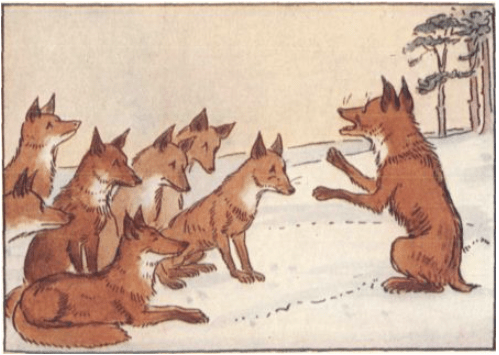
The Fox without a Tail, by Aesop

A fox lost his tail in escaping from a steel trap. When he began to go about again, he found that every one looked down upon or laughed at him. Not liking this, he thought to himself that if he could persuade the other foxes to cut off their tails, his own loss would not be so noticeable.

Accordingly he called together the foxes and said: “How is it that you still wear your tails? Of what use are they? They are in the way, they often get caught in traps, they are heavy to carry and not pretty to look upon. Believe me, we are far better without them. Cut off your tails, my friends, and you will see how much more comfortable it is. I for my part have never enjoyed myself so much nor found life so pleasant as I have since I lost mine.”

Upon this, a sly old fox, seeing through the trick, cried, “It seems to me, my friend, that you would not be so anxious for us to cut off our tails, if you had not already lost yours.”

(Journal entry May 5, 2013)

To Everything there is a Reason

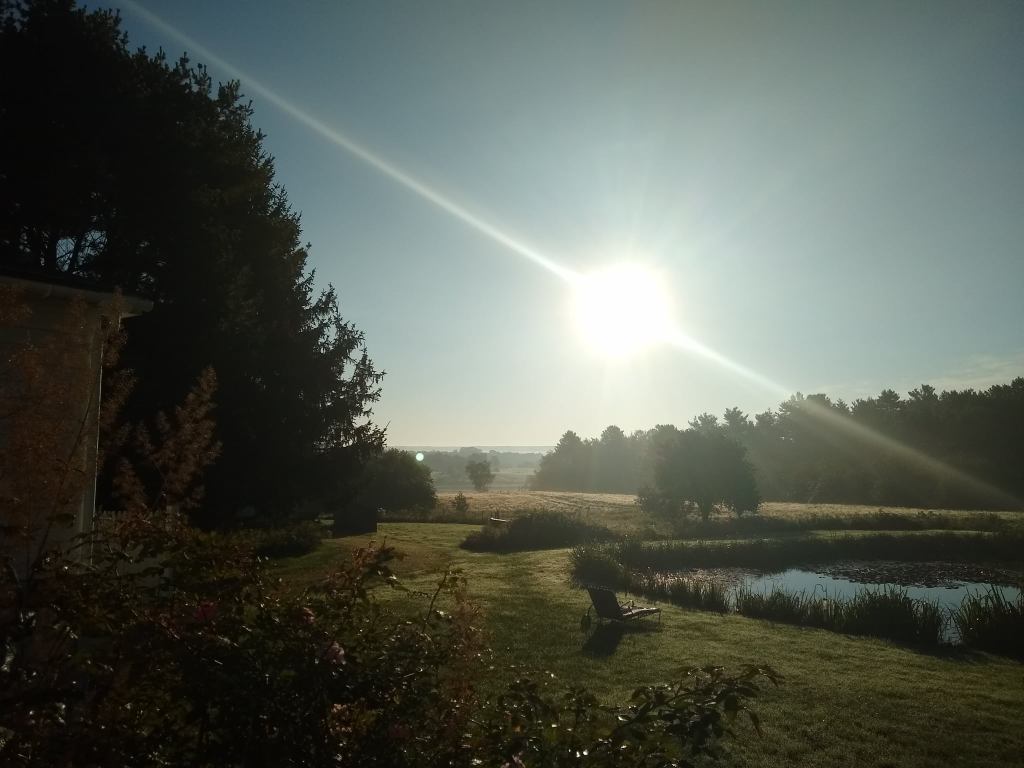
“Today, August 31, 2021, I found this sunrise. I call it “Death and Dying by the Sword”, because I feel that I have been singled out. The message is quite clear, right?”

This summer, 3 years later, I came across my old entry above. It jolted me! And then, it made me reflect, because, in hindsight, I realize my mood hinted to a foreboding of sorts. Nowadays, it is clear the perspicacity of what was my intuition but I could not name nor label the imponderable then.

And that is life, right? We are so impatient and impetuous to try to get answers right then and there. Sometimes we do. But other times, it takes months or years to reach an understanding of sorts.

Today, I would rename it “Hope’s Crepuscular Radiance”. Time to go read Sir Walter Scott again!

Of Foofaraws

May be an image of boat and body of water

“Partirà, la nave partirà…”

Oh what memories of youthful expectations of travel to unknown destinies, pondering where we would all end up, these few words of a chorus of a famous 1970 San Remo Festival song conjured in the Dillon siblings’ minds…

To this day, the mere singing of these few Italian words makes my siblings’ and mine eyes sparkle with mirth and we break out in peals of laughter. Go figure.

This summer, we ended up singing the song more than a few times, laughing at the thought that the boat had finally hit more than a few rocks, but what a trip it had endured.

There is something cathartic about indulging in foofaraws. And I still find Sergio Endrigo, the Italian crooner, transports me to happy times.

The Sailboats, The Bagaduce and The Cross

I have always found solace in the peaceful beauty of a wonderful landmark in my neck of the woods, the little Catholic Chapel called Our Lady of Holy Hope in Castine. It is unpretentious but commands a most spectacular view. Someone once made a disparaging comment that it was an afterthought built for the “help” of the more affluent citizens of the town. Maybe. But I have my doubts.

The little Church sits where Fort Pentagoet was, and an old plaque inscribed in Latin showed that the French had built it. “A University of Maine archaeological team recently established that a Catholic chapel was originally built by the French in 1635 on the site of the present Our Lady of Holy Hope chapel in Castine. From all indications this mission was one of the first in Maine and in the United States.”

I have gone to this place many a time to think, meditate, ponder about the joys and vicissitudes of life, feel closer to my parents and other dead relatives, and reflect on the role that the French Catholic priests of the day played in establishing relationships with the indigenous population.

In fact, it was a Jesuit priest, Father Sebastien Râle, who spent most of his life among the Abenaki, who produced an Abenaki-French dictionary that is recognized as an opus because it helped preserve the language.

I perused that dictionary and it is why I came up with the name “K’chi Casco” for our little farm (meaning Great Heron).

Earlier on a breezy summer day, wondering when or if children and grandchildren might visit, fishing and hiking trips might end, thinking about the University of Maine end-of-summer picnic we were hosting, anticipating an upcoming trip to Europe to reunite with friends (and how I hate to fly, which is a real curse for me), I came across the two sailing ships. Lo and behold, thank God for the phone. I caught them competing with each other and then the Cross providing a magnificent frame…(I think so!).

And now, uploading these photos, I remembered an ancient song based on Charles Kingsley‘s poem, that I had learnt as a kid, thanks to my formidable Great-Aunts, who were steeped in old English literature and lore. I used to sing it with them, and it was the saddest of tunes and lyrics.

However, one day, when I was 10 or so, I heard a young Joan Baez singing it mournfully like a loon, the way I thought ought to be sung. I still do.

I sometimes wonder if I am the only one who takes these labyrinthine journeys through the memories in my heart and mind.

The Three Fishers
by Charles Kingsley

Three fishers went sailing away to the West,
Away to the West as the sun went down;
Each thought on the woman who loved him the best,
And the children stood watching them out of the town;
For men must work, and women must weep,
And there's little to earn and many to keep,
Though the harbor bar be moaning.

Three wives sat up in the lighthouse tower,
And they trimmed the lamps as the sun went down;
They looked at the squall, and they looked at the shower,
And the night-rack came rolling up ragged and brown.
But men must work, and women must weep,
Though storms be sudden, and waters deep,
And the harbor bar be moaning.

Three corpses lay out on the shining sands
In the morning gleam as the tide went down,
And the women are weeping and wringing their hands
For those who will never come home to the town;
For men must work and women must weep,
And the sooner it's over, the sooner to sleep;
And goodbye to the bar and its moaning.

(Journaled about it on September 8, 2024)