A Daughter’s Tribute to Her Mother

Today would have been Adriana Dillon’s 97th birthday. It has been 14 years since my Mother left us. 

Amazingly, though I spent many years remembering the dénouement, I am not sad thinking about her loss.  In fact, I don’t think of her as being absent from my life the way I did when it happened.  In many ways, she is ever more present than she ever was.

As my Mother was leaving this world, I emailed my children, who were not at her side, what their Grandfather, Aunt and Uncles and I were going through:

We have spent a lot of time laughing and crying together with her.  We have rosaries blessed by John Paul II and pray our Our Fathers and Holy Mary’s and St. Francis’ prayers… and then we will make jokes and laugh …

We are at peace, and know that Grannie is better off going to meet her parents, the Pope, Jane Austen, Charles Dickens, Thackeray, Balzac, Victor Hugo, and all her beloved authors.

Grannie always said she knew God would keep her in this world until we no longer needed her.  She needs to know now that we are strong enough to let go of her.

Reflecting on those last moments, I realize how lucky we were to be able to mix laughter with the tears, and to share until the very end the strong family bond that was at the heart of my Mother’s life.

I also realized then, after a full year of her death, the meaning behind the tradition of wearing black for mourning.  It was a way to let the world know that the mourner was going through a stage in his/her life that required others to understand, at the very least, his/her constant void and woeful sorrow.

I once wrote that “not all women who give birth are good Mothers, and many women who do not have children themselves make formidable Mothers. For the essence of Motherhood is in giving of oneself in a selfless manner.”  My Mother was the most unselfish person I have known.

Two years after her death I embarked on a new venture, one that would take me to Afghanistan, something that I found exhilarating and approached with trepidatious anticipation.  How I wish I could have shared with her my discoveries of Afghanistan’s history and poetry and art. There was enduring beauty I came across, despite the incessant danger and sadness of a war-ravaged place.

Her constant reflections and wisdom are my ever-guiding principles.  God’s mills grind slowly, but they grind exceedingly small was one of her favorite quotes. In my own experience, it is absolutely true.

She also made the best scones and empanadas one could ever dream of, and her High Teas were a feast to behold, like Babette’s.

I am grateful that she was spared the biggest viscissitudes that some in her family have encountered since her death. I miss her physical presence, her big eyes and warm smile.  She left an indelible mark that withstands the ebb and flow of time. 

Since death is inescapable, one of these days we will all be with my Mother again.   She was an incurable romantic.  What I would give to watch Pride & Prejudice with her one more time.

If only I could leave a minuscule fraction of good will for my children to reflect on, I shall leave this world like my Mother said, when God no longer thinks I am needed around.


Solzhenitsyn’s Gulag

The daffodil represents rebirth and hope.

I have just discovered this Russian television miniseries “In the First Circle”, which is based on Solzhenitsyn’s Gulag Archipelago, and Solzhenitsyn himself was the playwright and narrator. I just finished watching it, and it is fascinating. 

Many years ago, I had discovered a Russian film adaptation of Alexander Solzhenitsyn’s autobiographical novel “In the First Circle”.  And, before I could watch it, life hurried by me, and I forgot all about it.  

While perusing old musings of mine, I found my reference to this gold nugget of a Russian TV miniseries in my defunct blog.  I finally started watching it a couple of nights ago and went through the ten 45-minute episodes in two sittings.  

It is profoundly beautiful, poignant, sad and, despite the anguish presented, it is deeply hopeful and redemptive.  No wonder!  Solzhenitsyn himself worked on the adaption of his novel for the series, and wrote its screenplay.  

It is a 2006 beautiful series directed by Gleb Panfilov, who had been thinking of adapting Solzhenitsyn for over 30 years.  The music score is perfection. The composer, Vadim Bibergan’s romance at the end evoked memories of Ashokan Farewell of Ken Burns’ Civil War series.

The actors are amazing in their portrayals of the characters, and how I wish I knew Russian well enough to understand the intricacies of the dialogue.  Their eyes, their faces capture the turmoil of a disastrous time in Russia and the moral dilemma they all face, whether victim or foe, while attempting to survive under a draconian and unjust episode of history. 

The portrayal of the eternal conflict between good and evil and the moral choice between escaping horror and inhumanity and not compromising one’s own principles and conscience is deeply moving. 

While some people hate all things Russian nowadays, it is interesting to note that Solzhenitsyn himself was half Russian and half Ukrainian.  

The English subtitles are not optimal.  For those who have never heard of Solzhenitsyn or have not read the book, it might be frustrating initially.  Give it more than 15 minutes.  

This is not your typical boom-boom/ka-boom series.  It is not a documentary, although Stalin seems so real in the film!  It is a lyrical series, with intertwining historical and philosophical dialogue that invites retrospection.

Am sharing because I found it to be a gem of a film.  I am still searching for my own “ataraxia”.  Come to think of it, I did not realize that it was “ataraxia” I was chasing, until I delved into In The First Circle!

“They could look forward to nothing but the worst. Yet in their hearts they were at peace with themselves. They were gripped by the fearlessness of people who have lost absolutely everything-such fearlessness is difficult to attain, but once attained it endures.” In the First Circle.

Rule of Law and Lessons Learnt

The Special Inspector General for Afghanistan Reconstruction (SIGAR) had released at the end of May 2018 its latest “lessons learnt” report covering the period 2002-2017.  It was chock full of information for anyone who is interested in “development” work. For those who follow “rule of law” issues, the report still strikes, at least to me, a very familiar chord.

In my many years of working in international settings doing “development” work, I have found that one of the biggest problems is overcoming individual egos and the posturing that comes with those egos.  “Development” work is not just altruistic:  there is a lot of money to be made and prestige to be gained.  There is a door that is always “revolving” between the implementer, the donor, the supervising entity, the inspecting authority, the academicians, and other intellectuals.  It is human nature.

Once in a while, it is good to read that some of the lonely and knowledgeable individuals who point out some of the flaws in design are vindicated.   Note that I don’t use the term “expert”, because, in my work, most experts are really “Rupertos the “expertos””.  (My own label for the a few years was “subject matter expert”!).

Ideally, the genesis of an international Rule of Law “development” project should entail the meetings of the minds between the donor and the beneficiary.  Some of us like to say that there has to be “buy-in” from the host government as well as the individual host organizations that might be involved in the project.  This would show the cooperative efforts of all concerned towards what could be the key goals of the mission:  strengthening of the rule of law and the fostering of  accountability and transparency. 

For example, a specific justice sector program’s mission might be to build the capacity of the host country’s criminal justice sector institutions through improving the ability of their professional staff to deliver fair and effective justice services to citizens.  Sometimes, the initial focus is to help a country build its police and prosecutorial capacity through formal training programs of academic instruction.

What I have discovered is that what the donor organization (which may include the program implementer as well) wants to see happen may not necessarily be best suited to the way the project should be carried out. 

One does not become an international development practitioner overnight.  While an expatriate technical advisor may have stellar credentials from his or her prosecutorial days in their particular state or country, they may have never lived in a different environment other than their own.  This can lead to disastrous results because there is a lack of understanding of, and maybe a lack of empathy for, the recipient of the technical advice.

A long time ago, I witnessed a foreign “expert” deliver a lecture on American jurisprudence and individual rights to an academic group in what was then the U.S.S.R. , a communist/socialist country.  The audience was barely curious and did not seem to engage.  What the “expert” did not realize was the group’s lack of understanding of what he believed were common concepts, until someone asked “what is the right to privacy?”  Once it became obvious that there had been such a gulf between the lecturer and the trainees, the “expert” was able to correct the situation and begin to provide examples that the local nationals could finally relate to!

I was at the very beginning of my professional “Rule of Law” work when this happened, and it was a fine lesson for me too:  borrowing from the Spaniards, there are many “Ruperto el Experto” types, but few that meet the “experto crede Ruperto”  standard.

Life in the Foreign Service – Saying Good-bye

In my peripatetic life, I have found that, no matter how many times I move, it never gets any easier.  In fact, the annoyances that come with sorting the relevant with the irrelevant don’t seem to decrease in size. They actually metamorphosize into Kafkaesque gigantic insects, which cannot be swatted down.

However, the hardest part of having to get up and go, is the realization that I am leaving behind a portion of my heart.  Partir c’est mourir un peu. To leave is to die a little. It hurts.  There is a hole, and nothing will ever fill the void.  Yes, there will be new experiences, and new friends, which will allow the hole to shrink, but a hole it will always remain.

One of the nicest memories I took away from every Foreign Service post was sharing times with most Embassy members, trying, in a small way, to serve the U.S. Government while I was there.

I was not the “employee”, but rather what was then labeled the “dependent spouse”, a moniker that I never liked because it made the spouse an appendage of sorts! And it did not reflect reality either. Also, there were lots of partners accompanying the Foreign Service Officers. But that is a subject for a future musing.

An era always ends, when so many good Embassy people leave, and a new era begins, with so many new people coming to post. 

I always imagined, based on myriad of conversations, it had to be hard for all the local employees who remained to adjust to yet another change, no matter what.  Although, in a few occasions, they were delighted that the tour was relatively short, to see insufferable characters move on! At the end of the day, though, we, the expats, come and go… but the Foreign Service Nationals are always there, a wonderful steadfast presence.

If I have two big regrets that have been common whenever I left every country I lived in it is that I failed to avail myself of all the incredible opportunities that the Embassy network and expat and local communities provided the transient dependent, and that, because of my own busy life, I did not dedicate as much time to get to know many of the Embassy member employees better. Sometimes, our paths did cross again, here or there, but not as often as I had hoped.

Those are the regrets that come with the realization that life is a river, never stopping, ever flowing, until the end.

I learnt about this poem and the song from my Mother, when we lived in Tokyo, She was a young mother then, and now I realize how she ached for what she had left behind. But at the time, she never showed her melancholy. On the contrary, we were embarking on a new and exciting adventure.

I leave you with the great Pavarotti and a translation of the French poet Edmond Haraucourt’s best known poems.

Rondel de l'adieu
by Edmond Haraucourt

To part, is to die a little,
Dying to the things we love:
We leave a little of ourselves
In each hour and each place.

Always the grieving of a wish
The closing verse of a poem;
To part, is to die a little,
Dying to the things we love.

And in parting, just a game,
Yet until the final goodbye
With our souls, we leave
Our marks at each farewell:
To part, is to die a little.

A Painter’s Ramblings on War

On May 8, 2009 I discovered Ramblings from a Painter, a painter’s ramblings of his Iraq military tour of duty. At the time I had noted in my defunct old blog that artist Skip Rhode had a wonderful gift, and made some ugly landscapes look delightful! For example, his painting of a Containerized Housing Unit or CHU (a shipping container used for living quarters by the US military in Iraq and Afghanistan) makes it seem inviting and cozy.

But what caught my eye initially was Mr. Rohde’s blog entry on Iraqi children’s drawings. He said,

What got my attention was just how normal these drawings are. They could have been done by any kid in the United States. Here are happy families with little houses in the countryside with flowers and trees and puffy clouds.  I’m not quite sure what that thing is in the sky in the bottom picture – a bird? a bug? – but for sure it isn’t threatening.  All the figures have big happy smiles on their faces.  These are happy drawings from happy kids.

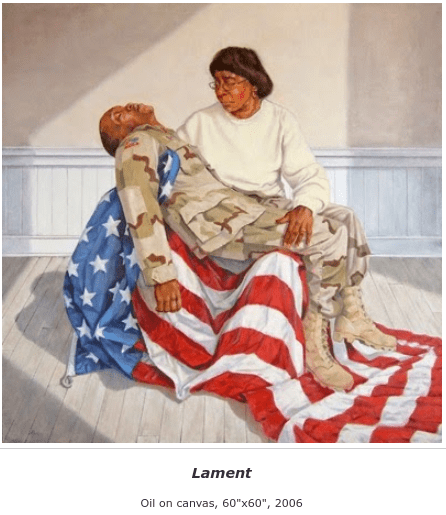
Lament, the Pietà-like painting above, evokes a sorrow, an anguish that is hard to fathom. It is the inescapable grief of a Mother who has lost her son, seemingly forever. The Mother’s pained look displays some determination, in my humble opinion. This Lament makes me think that she is a woman of faith, so that beyond the sadness there is a glimmer of hope.

What a poignant painting that encapsulates the senseless horrors of feckless times.

Aurora Borealis or The Northern Lights

Last night I thought the earth and the heavens were smiling at me, auguring good days ahead. There was a shooting star to boot! I thanked God for all my blessings and for having given me the chance to see such beauty on a chilly night.

I ventured outside to capture the magic, and was jolted 3 times by hissing and jumping creatures (the foxes? last night’s coyotes? do they hiss and make clicking sounds?), but I overcame my fright and stayed out for a bit, relishing in the changing view.

I have yet to explore the state of Maine. I have never been to Mt. Katahdin, nor the Appalachian trail, nor any of the myriad fishing lakes and other scenic places members of my family and others have explored. I will get there, God willing. However, last night, I was thrilled to be in the Blue Hill Peninsula, a slice of heaven on earth.

I thought of my long-gone parents and was reminded of one of my Mother’s favorite little poems, a beautiful rhyme (XVII) written by a famous Spanish Romantic poet, Gustavo Adolfo Bécquer:

Today the earth and the heavens smile at me;
today the sun reaches the depths of my soul;
today I have seen her… I have seen her and she has looked on me…
Today I believe in God!
***
Hoy la tierra y los cielos me sonríen,
hoy llega al fondo de mi alma el sol,
hoy la he visto… La he visto y me ha mirado…
¡Hoy creo en Dios!

The poem has a subliminal message. I finally understand its significance. 

Synesthesia – an Alternate Way of Perceiving the World

Apparently, 1 out of 200 college students has synesthesia.  One can also learn languages seeing colors and numbers! An explanation for this may be that synesthetes played with those colorful magnetic numbers and letters that, at least in my home, graced the fridge door for quite a long time.  I’ve never asked my children if they see words or hear sounds in colors.  I sure wish I did, so that I could have mastered Russian, Czech and Polish after just a few weeks!

Meet a polyglot savant, with a mild form of autism:

Tammet is a savant. As a child he had epileptic seizures. Doctors later diagnosed him with Asperger’s Syndrome, a mild form of autism. He mastered the world of emotions only through hard training.

Numbers and foreign words, on the other hand, come to him naturally. He sees colors and shapes where most people see only plain words and numbers. He’s memorized the number pi to 22,514 digits. He knows instantly that January 10, 2017, will be a Tuesday. And he’s a fleet-footed traveler in the rocky terrain of languages.

Tammet can speak Romanian, Gaelic, Welsh and seven other languages. He learned Icelandic in a week for a TV documentary, at the end of which he gave a live interview on television. He felt somewhat nervous, but was able to speak quite fluently with the show’s host. He even dared to make a joke in Icelandic, which is generally dreaded for its complexity. He still speaks the language today.

My own son, Bryant Hillas, provided a fascinating bit of information on synesthesia:

The history of the study of synesthesia stretches all the way back to Ancient Greece, when philosophers attempted to understand the chroia (what we now refer to as timbre), or color, of music and how to quantify it.  Many eager investigations were conducted on the subject in the late-19th and early-20th centuries, until the ascension of behaviorism within psychology rendered the study of such subjective and internal experiences a ticket to academic oblivion.  Since the cognitive revolution of the 1980s, however, there has been more and more study of synesthesia, bringing to light some exceptional insights into the functioning of the human mind.

Below is a video that provides a clue about this alternate perception.

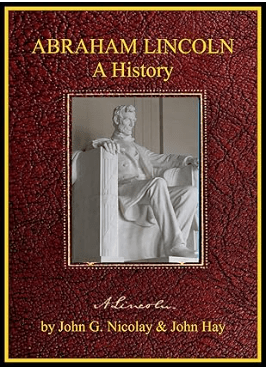
Abraham Lincoln and a Labor of Love

Authored by Lincoln’s two private secretaries, this massive work has been described by Lincoln historians as a “most complete biography”

A good man, my brother. I am his older sister.  I carry “old” memories of days gone by, of family lore, of some of the old matriarchs and patriarchs who are no more.

He is a true intellectual.  He knows more about Abraham Lincoln, history, philosophy, theology, the law, than anyone I have ever met.  

The sophists I know, and have been associated with for years, have no clue of the depth of his knowledge and the extent of his work, because my brother doesn’t brag, is not a know-it-all, and is unassuming and humble beyond belief.  The sophists always think they are too clever and know more.  Experts on everything.  Ruperts the Experts, as the Spaniards like to say.  HAH.  Not really.  They are parochial fools.

My brother has taken care of me in my most dire moments.  He was with me at the worst of times when we were used and duped by fools, and at the best of times, when we celebrated Chopin in Poland and my nephew’s coming of age.   

Unbeknownst to me, my brother had edited and published a biography (10-volume!!!!!) of Abraham Lincoln.  It is a monumental opus.  Only serious historians pay attention to these things. 

How did I find out?  Serendipity!

Lo and behold, chatting with my brother this summer, I discovered he had edited the 10 volumes and had published the set through his Lex de Leon Publishing house!  It was a labor of love, done in his spare time (he has a busy law practice) and it took him about 10 months to edit and re-introduce a historical record.  Lex de Leon Publishing has already sold almost 1,000 copies of the 10-volume set.  Not bad for a “hobby”!

He and I read a blog written by a former Constitutional Law professor, Ann Althouse, and coincidentally, she discussed the latest book she was reading and noted:

I’m reading page 108 of “Theodore Rex (Theodore Roosevelt Series Book 2),” by Edmund Morris (Amazon link, commission earned).

Also, on page 126:

His “beach book” for the season was Nicolay and Hay’s Abraham Lincoln: A History, in ten volumes. Unfazed, he read it straight through, along with his usual supply of dime novels and periodicals.

You can put those 10 volumes in your Kindle for $2.99. Over 4,000 pages.

My curiosity was piqued, because in the Spring I had been reading reviews about Morris’ Theodore Roosevelt biography and was considering getting it as a Christmas present for someone who loves history.   

For the historians and those who have insatiable curiosity, Amazon’s description states:

Originally published in 1890 by The Century Co. (New York) as a ten-volume account of the life and times of Abraham Lincoln, this kindle edition includes all ten volumes fully edited with a linked comprehensive table of contents and a linked table of contents for each of the ten volumes. There are over 4,600 linked endnotes, consisting of the original footnotes and side notes (marginalia) found in the 10-volume hard copy. It also includes over 365 original illustrations and maps, all uniformly sized and edited.  

I am sharing this because I am proud of my younger brother!

Shedding Mortal Coils

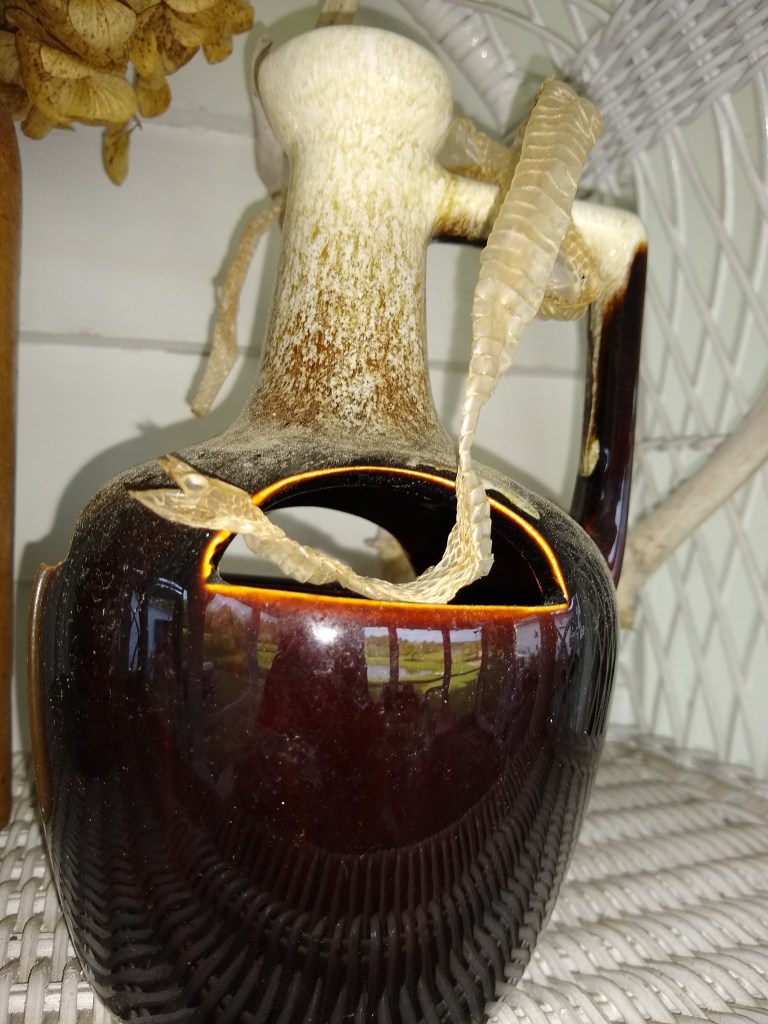
I have a transparent snake’s skin that someone found walking around the fields in Maine. He gave it to me and I saved it, thinking one day my baby grandchildren would find that exoskeleton fascinating. The other day I found a faded photo of the critter. And it made me wonder…

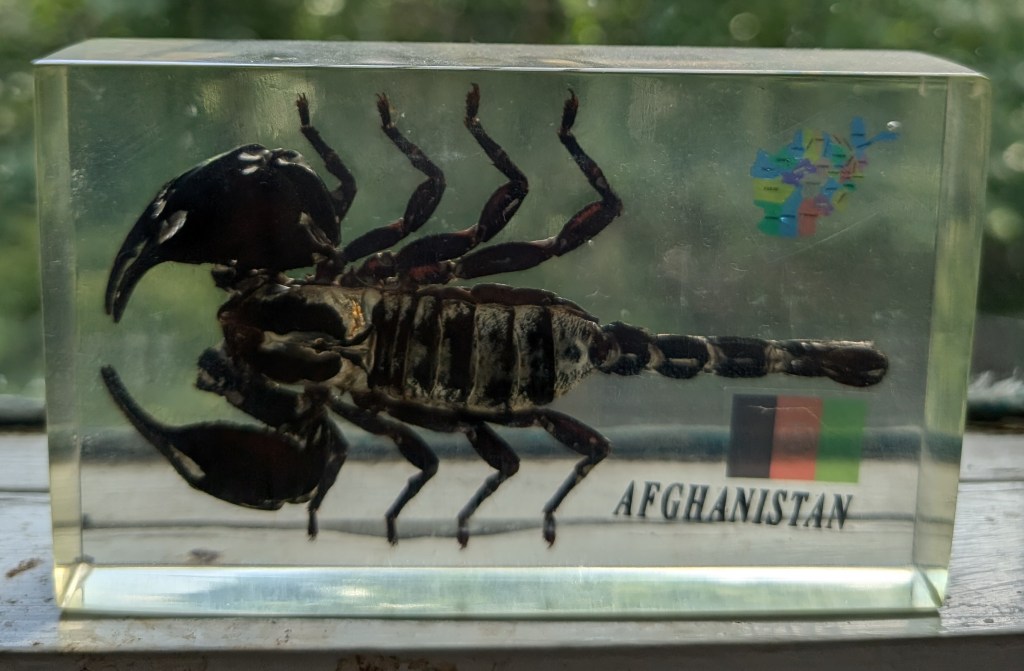
Fast forward to this summer: I discovered an old curiosity I had gifted one of my nephews. I should have kept it for myself, since I am a Scorpio! I remember how thrilled I was to find a creepy crawly immortally entombed in plastic at a tired old “store” at a US Government compound in Kabul. What are aunts for if not to do wacky things for their nephews and nieces?

I also just discovered that scorpions, like snakes, shed their mortal coils, as Hamlet would eloquently state. Sometimes, I wish I could do the same.

The Ripple Effect of a Tiny Gift

Sometimes, we tend to forget that actions have consequences and relegate our own to the dust bin of irrelevance or oblivion. A while back, I discovered this is not necessarily true, and that our actions can have surprising consequences.

About 20 years ago, a lady I knew adopted a Russian child. She brought the 6-year old to my home, to a party we were hosting. At the time, this new Mother was thrilled with her new status, but trepidatious, because there was an enormous chasm between her and her son: they just could not communicate. The boy was shy and withdrawn, and she ached to hold him and comfort him, but it was oh so very difficult to penetrate the boy’s world.

I happened to have a lot of children’s stories in Russian (including Tolstoy’s stories), because I once had had BIG dreams that my sons would learn the language, having lived in Moscow. It didn’t work out. None were interested. To my chagrin, they preferred the romance languages.

Listening to this lady’s plight, I remembered my precious little Russian children’s stories, and, without hesitating, I gathered all these books and gave them to her. Before doing so, I chatted with the little boy in my elementary Russian and his eyes lit up. Seeing that flicker of recognition in that boy’s eyes made me think that, maybe, these stories would help a little Russian boy lost in America.

Fast forward 7 years. I return to the US after many years abroad, and I meet a strapping young 15-16 year old young man accompanied by his Mother, who is selling Boy Scout Christmas wreaths. I don’t recognize the young man, and his Mother looks vaguely familiar, but I cannot quite place where we have met. (This is a phenomenon that has happened to me a lot during my life in the Foreign Service!).

The lady greets me warmly and tells me that I may not have realized it, but I had helped both her and her son many years before. I am baffled. She then proceeded to tell me that through the gift of a bunch of Russian stories I had made a long time ago, she and her adopted son had bonded. Although it would take a little while for them to overcome the language barrier, those books brought the two of them together. That little boy, many years back, could find solace in something so familiar, and could read in his language… and she, at least, could hold the books while he snuggled with her, delighting in their content.

I had totally forgotten what I had done. Yet the memories came pouring out of the recesses of my mind. I was humbled and touched as I have never been. Today, the little Russian boy is a young man. I wonder what he is doing nowadays.

Actions do have consequences. One sometimes is blind to the ripple effect of a tiny gift. So, my sons did not learn Russian – they closed that door. But, for a little boy out of a Russian orphanage, lost in his new home in the US, a window was opened.

And for me? The boy’s Mother gave me the biggest gift of all: discovering that I had, unknowingly, helped open that window!