This week I was mesmerized by the turbulent waters caused by humans on an otherwise smooth and peaceful sheltered bay. It brought a fleeting memory of a song that someone I once knew long ago kept playing over and over and over again, “Bridge Over Troubled Waters”. There was no bridge though, and the troubled waters were manmade!
Feeling guilty that I did not attend Mass, I perused some of the readings for today’s services, and came across the sin of “detraction”. Of course, I went down another one of my rabbit holes, because I did not remember this particular sin…gluttony, envy, pride, greed, bearing false witness, etc., etc., yes. But detraction?
In this day and age of living in a society that insists in having the “right to know” everything, the concept of detraction is alien.
The sin of detraction is when we disclose or exaggerate another person’s faults to those who didn’t need to know, and the detraction has been spread deep and wide and you cannot repair it. In other words, contrary to calumny or slander -which involve lies-, detraction is the unjust violation of the good reputation of another by revealing something true about him/her. It uses the truth as a weapon to hurt another person. And one of the worst possible things we can do, is to use detraction to hurt that person in order to justify our own reckless or bad behavior, or shift blame, or seek pity.
Hence the significance of the famous meditation of St. James about the taming of the tongue:
“For every kind of beasts, and of birds, and of serpents, and of things in the sea, is tamed, and hath been tamed of mankind: But the tongue can no man tame; it is an unruly evil, full of deadly poison.”
Haven’t we all been there at some point? It is correct that the truth shall set you free. And yet, and yet… Food for thought.
A lifetime ago – actually, only 6 years ago -, when I left my legal career and the Washington DC area to move to Maine full time, I embarked on a little project. By June 2018 I had finished the very first chapter of what I had hoped would become a series of vignettes about our experiences in Maine. It was dedicated to my Grandchildren.
I wrote two little books about “Pop of Penobscot”. Although not the protagonist, I had included myself, Nonna of Penobscot, in those stories.
I have so many little stories that I wrote for the third volume, one of them about the “Legend of the K’chi Casco Birch Tree”. I hope to finish it before the end of 2024. I thought I was done, but life happens, and some things need to be edited out. (Isn’t that the prerogative of the writer? Yes, but then it delays the process!).
Today I made a new friend, and of course, I immediately thought of my Grandchildren and another story. But this time, it will be about this handsome fox with perspicacious eyes that looked at me as if knowing something about me, or so I thought. He stopped when I said hello.
I interrupted his visit to the chicken coop, which is well protected. He looked at me and I loved those cotton-ball cheeks. He then decided to make himself at home, waiting for me to tell my side of the story. I need a name for this handsome character.
I have lost count of the many times I have been mocked for anthropomorphizing animals. I always felt that I was in good company, though, beginning with Aesop, La Fontaine, Rabier, and others, and ending with Walt Disney. In fact, historian Paul Johnson wrote a wonderful chapter in his book “Creators” contrasting Disney with Picasso. Worth a read.
The whole encounter brought back memories of the old Disney movie, The Fox and the Hound. We used to watch it when my kids were young. How they loved it!
Except for a brief moment when I was a 1st grader and wanted to be either a teacher, a grocery store sales person, a fantastically wonderful Scottish sword dancer, a singer, or -more importantly- an amazing classical guitarist, I realized after I turned 7 years old that I wanted to be a lawyer. Family history and lore are partly to blame. However, I recall I always argued both sides of the coin… I loved sophistry then, the what ifs, and the what thens…without understanding the ugliness behind that word, for I had yet to meet the nasty sophists of legend.
Once upon a time and long ago, there was a wonderful movie that made an impact on me because of the philosophical argument that you give the devil the same rights that you give righteous people. An argument that helped me understand why it is necessary to provide legal counsel to the vilest and most despicable of defendants.
I am always asked this question: why would any lawyer defend the despicable? And, in all honesty, I always struggled with the answer: but no more!
I eventually began to understand the famous dialogue between Thomas More and his son-in-law Roper and the pragmatic side of the law. It may not seem fair nor kind, but we need to have structures that protect the devil so as to defend the rest of us, meek and strong alike.
Every Easter, which for some of us is a time of deep reflection, I have always remembered a special moment.
One day, in 2013, my sister Cynthia and I ended up staring at a golden cross. A crucifix that transcended history. Here was a cross, with a relic in it, that St. Thomas More had in his chapel, on his desk, and which he may have taken to the Tower of London: the patron saint of adopted children, lawyers, statesmen, politicians, and widowers would soon be beheaded. That was almost 5 centuries ago, and I was amazed to be looking at the cross that meant so much to the Englishman.
Today, I marvel at the fact that he is still studied and revered by many, even if they don’t share the same faith, because he was known to be a man of principles, honesty, and who considered it his duty to protect the integrity of his reputation.
Earlier this year, I considered May the “Nightmare of The Scream” for I witnessed an old woman’s look of horror with her mouth agape. Go figure. Probably because I have always loved art and I have had a fondness for Edvard Munch’s The Scream, that open mouth reminded me of the painting. I especially have Munch’s caricature of horror seared in my memory because I was so impressionably young when I first studied it in High School and have been trying to write a story based on that lightbulb-shaped head.
Fast forward to this past July, and I am walking the pristine beaches of the Hamptons in New York. So many shells. So many frolicking dolphins. So many dancing terns and sandpipers. So many memories of youth and beautiful summer days with young children, fun siblings, new potential “in-laws”, old parents.
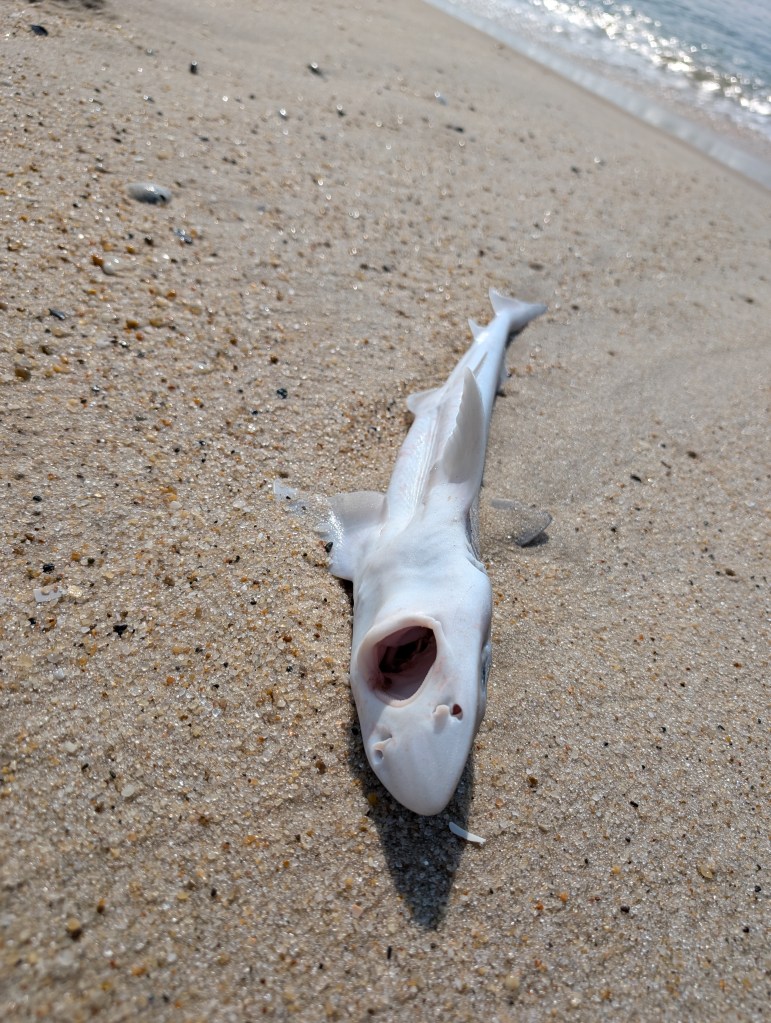
And then? I am spooked beyond belief: a young dead shark, staring like a dessicated and dumbfounded ancient creature frozen in shock…
There is beauty in that petrified “rigor mortis”, but the little shark reminded me of that stupefied old woman, who belonged in the annals of history or an old and yellowed yearbook.
And yet, I couldn’t stop laughing. Hey, I was expecting to see some perfect teeth in the making! It was a baby shark, after all!
The dead toothless shark also reminded me of a little old man who once upon a long time ago grabbed my wrist on a subway in Tokyo with his toothless gums and planted a soft gumless kiss. At the time I stared at my High School friend horrified. And then we laughed! How weirdly odd and sweet was that!
The little old man was tiny and bald and looked up at me and smiled a toothless grin. I hadn’t thought of that memory until I saw The Nightmare of The Scream.
A long time ago I had a blog. It gave me great pleasure, because I recorded my impressions of places I visited, people I admired, events that impacted me. But then, one day, POOF. I updated something and it was not the right thing to do. It now is a soul lost in the ethereal world of the interwebs. Every now and then I find an old essay, which triggers back memories of yester years. I want to return to Dubrovnik and I want to reread the beautiful book I read then.
———————————————–
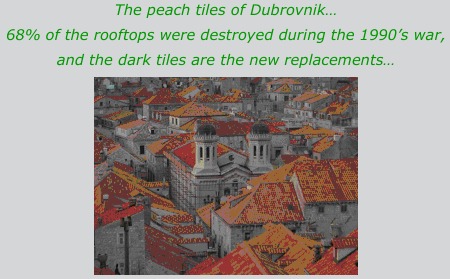
THE BELLS OF DUBROVNIK ring every hour and half hour, although they are silent throughout the night, when the local cats begin their hellish meows. From where I sat in the evening many summers ago, overlooking the city’s mosaic of pale-peach and red tiled roofs, I could admire a large sliver of Adriatic blue, sometimes speckled by imposing cruisers or elegant yachts that came and went.
Croatia is a special place… Its coast is magnificent. I kept comparing: gorgeous Italy vis-à-vis this incredibly beautiful, but more pristine version of a Mediterranean coast…
One of the saddest things to see were the gaping holes, some large, some small, sometimes many, sometimes few, on the façades of regular-looking buildings along the way… These are the scars of war left by the many bullets and shells on apartment complexes, houses overlooking the Adriatic, clusters of village dwellings… These wounds, unfortunately, are so recent, it’s almost embarrassing to remember! I mentioned to my sons that all of their contemporaries in Croatia were exposed to the horrors of war in the heart of Europe, while they were playing soccer with their classmates in Rome, having a wonderful and peaceful childhood, so very near by. Hard to believe – except for the physical scars on buildings – that Croatia experienced such savagery just a few years ago!
We visited the island of Lokrum, where the Benedictine monks settled many centuries ago, and where a few mortar shells landed a few years ago… Does the world remember?
A beautiful island 15 minutes away from Dubrovnik, Lokrum’s water at the time was very refreshing, crystalline as can be, and snorkeling in it was unbelievable. Something out of National Geographic: the waters were magnificent in what they delivered: underground gorges, multi-colored fish, and schools of gray and black fish…
On a cursory trip to Cartvat, an old city about 16 kms from Dubrovnik, we didn’t find the right beach (it was too crowded for my taste) and we went back to the little one we discovered a few days earlier, which once held a big hotel and apartment complexes, and which are now boarded up because of the gunfire they withstood…modern monuments to modern disasters… I liked the guy who had the concession stand and sold us ice cream (50% cheaper than in Dubrovnik)…
The days we spent in Dubrovnik and its surroundings were beautiful and I know, for certain, that I shall remember this place forever: it is a gem. The white marble of the city’s buildings, staircases, and streets absorbed the heat, so that in the evening one could feel the warmth irradiating from the marble streets and the building walls.
To anyone who ever wants to begin to understand how we could have had such a savage war in the heart of Europe, I recommend reading The Bridge over the Drina. It is a beautiful story written by a Nobel Laureate, a former Yugoslav diplomat, Ivo Andric. With poignant melancholy, it recounts the traumas and tragedies, joys and woes, loves and hatreds of a multi-ethnic, multi-cultural, multi-religious multitude in a town in Bosnia, from the Middle Ages until the outbreak of World War I. It is a formidable epic, and the perfect book to read in Croatia!
I discovered Vinko Coce, in one of our trips to the island of Lokrum… He is a crooner, a balladeer. Croatian melodies are sad, gypsy-like and harmonious. We listened to Vinko as we drove out of the walled-city, a fitting way to end our stay. It was hard to depart… Maybe soon I will see that beautiful and melancholic Dubrovnik again.


 Dum Spiro Spero