Thoughts on the Evolution of a Rule of Law Development Program

Initial thoughts I penned December 7, 2017. They still apply.

“Ideally, the genesis of an international Rule of Law “development” project should entail the meetings of the minds between the donor and the beneficiary.  Some of us like to say that there has to be “buy-in” from the host government as well as the individual host organizations that might be involved in the project.  This would show the cooperative efforts of all concerned towards what could be the key goals of the mission:  strengthening of the rule of law and the fostering of  accountability and transparency.  For example, a specific justice sector program’s mission might be to build the capacity of the host country’s criminal justice sector institutions through improving the ability of their professional staff to deliver fair and effective justice services to citizens.  Sometimes, the initial focus is to help a country build its police and prosecutorial capacity through formal training programs of academic instruction.

What I have discovered is that what the donor organization (which may include the program implementer as well) wants to see happen may not necessarily be best suited to the way the project should be carried out.  One does not become an international development practitioner overnight.  While an expatriate technical advisor may have stellar credentials from his or her prosecutorial days in their particular state or country, they may have never lived in a different environment other than their own.  This can lead to disastrous results because there is a lack of understanding of, and maybe a lack of empathy for, the recipient of the technical advice.

A long time ago, I witnessed a foreign “expert” deliver a lecture on American jurisprudence and individual rights to an academic group in a socialist country.  The audience was barely curious and did not seem to engage.  What the “expert” did not realize was the group’s lack of understanding of what he believed were common concepts, until someone asked “what is the right to privacy?”  Once it became obvious that there had been such a gulf between the lecturer and the trainees, the “expert” was able to correct the situation and begin to provide examples that the local nationals could finally relate to!

I was at the very beginning of my professional “Rule of Law” work, and it was a fine lesson for me too:  borrowing from the Spaniards, there are many “Ruperto el Experto” types, but few that meet the “experto crede Ruperto”  standard.”
On Getting Old

I just came across a little blurb I had written 10 years ago, and had to laugh. First of all, how time flies! I probably was staring at a bunch of pot pourri, thinking “Like sands through the hourglass, so are the Days of Our Lives.” Also, I was probably contemplating hurling that pot pourri into the compost heap of oblivion, which I eventually did, when I moved to Maine!

—————————-

ON GETTING OLD

Between the ages of 20 and 48, we feel we can do anything, but the reality is that around 48 those under that age see us as “old”.

The Aging Rose (by me).

Aging is like a rose:
A calyx embraced by its sepals
A bud in a vase
An emerging corolla
A blossom
A bursting perianth…
Should it be nipped in the bloom,
A desiccated flower with all its beauty, color, and fragrance suspended in time.

Come to think of it, some would consider the desiccated blossoms dust collectors… (I have many of those!).

THE ONE WHO LAUGHS LAST LAUGHS BEST!

I love learning something new every day… and I do. Some of my best teachers are my children and the young people I work with.

When I was a kid growing up, my Mother always had a saying : “He who laughs last laughs best”. As time has passed me by, I realize how true it is. Though, it does take some time for this proverb to kick in. Or, as my Mother also said… “The mills of God grind slowly, but they grind …”.

Little did I know that “He who laughs last laughs best” came from the French author, Florian, and his fables (“Rira bien qui rira le dernier”). One of my anthropomorphising heros. He almost lost his head to the guillotine in 1793.

I just came across Florian’s fable about a lawsuit between 2 foxes. Although I think the bad reputation lawyers have nowadays is unfair, I recognize that there are some who give us all a bad name…not because they defend their clients’ claims zealously (as they should), but because they sometimes twist the truth worse than a pretzel.

So, for all those who care about lawyers and lawsuits, here is Florian in all his wisdom:

THE LAWSUIT BETWEEN TWO FOXES

Oh how I hate that pedant art, So captious and so very smart, Which of a thing as clear as light, Makes all obscure and dark as night; Makes error right, and proves to you That truth itself must be untrue!

Th’ invention of this art belongs To folks once skill’d in all such wrongs, The subtle Greeks, who may they get All the reward for’t due them yet!

This art an old fox once profess’d Its perfect master stood confess’d. He kept a school to teach the way, And took fat pullets for his pay. One of his pupils aim’d to be A lawyer of the first degree, And for tuition did agree Of case first gain’d to give the fee. In legal form the two compact; Sign’d, seal’d, deliver’d is the act. But when the course of study’s done, The pupil for injunction sues; Declares he owes his master none Of all the pullets claim’d for dues. The leopard, learned in the laws, Presides as judge to hear the cause. “May’t please the court,” the pupil cried, “If my case’s gain’d, I need not pay; For so your honor will decide; And we the sentence must obey. And if I lose, why, nothing’s due, For the conditions plainly say, ‘Tis only if I win I pay. Such is the law I apprehend; I would not, truly, wrong my friend.”

“Nay, nay, not so,” the master said, “The law is clear upon that head; For should the case against you go, Then you should pay the debt you owe. And if you win, why, then indeed You must pay up, as you agreed.”

Here rested counsel its defense. The leopard sat in mute suspense; And by the workings of his face He seem’d confounded with the case. But finally he silence broke, And thus his sentence briefly spoke: “In this sharp case the court must rule The master no more keeps his school; And to the pupil this award, From future practice he’s debar’d.”

Afghanistan’s Treasures

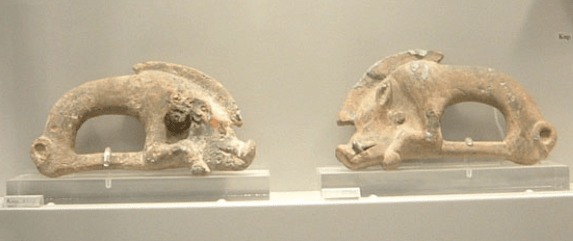
A long time ago, when I started working on a project with Afghanistan, I was constantly amazed -and perplexed- at discovering its “hidden” treasures… The dolphin clasp above brought to mind the pair of ancient boars I saw in Greece.

There is a dolphin statue at the airport in Kabul, which makes me wonder…what is the significance of the dolphin in Afghan culture? Alexander the Great invaded Afghanistan in 330 BC and Pakistan’s Indus River has dolphins. It is also the national mammal of Pakistan! I wish I could find some information about this.

The Metaphor of The Snow

Lately, I seem to run into serendipity every time I turn a corner, or so it seems.  Pure chance?  I don’t know.  I have my suspicions.  Sometimes, I do think I am being gently guided to discover and understand and be in awe of what was, what is, and what may be.  

Such is the case with a beautiful song I have been practicing, in a new venture of mine, singing with an amazing group of professional choristers.

The song is called The Snow, based on a poem written by Lady Caroline Alice Elgar.  Her husband, Sir Edward Elgar (he of Pomp and Circumstance fame) wrote the music.  

What struck me was the melody and the poignancy of the lyrics.  

In essence, it is a meditation:  why the soul in its purest form ought to be as white as snow.  But life happens, and one’s heart should strive to be strong in the face of adversity, bleakness and dejection.

For under a blanket of snow, lies the sadness of the wilting flora.  Eventually, though, the snow melts and is no longer pure and white.  It fades away.  It is fleeting.  Here today and gone tomorrow.  But the cadence of nature continues, and the soul should propagate clarity, integrity and faith in sombre and stinging times.  

And when inevitably we lose our luster and fade away, like the melting snow, we should “endure through all the years full sure “:  that is, cling as best we can to our core values, nurturing our principles, staying true to ourselves, and never giving up regardless of fate.

Below is a beautiful rendition by the University of Manchester Chorus.

THE SNOW
by Caroline Alice Elgar

O snow, which sinks so light,
Brown earth is hid from sight
O soul, be thou as white as snow,
O snow, which falls so slow,
Dear earth quite warm below;
O heart, so keep thy glow
Beneath the snow.

O snow, in thy soft grave
Sad flow'rs the winter brave;
O heart, so sooth and save, as does the snow.
The snow must melt, must go,
Fast, fast as water flow.
Not thus, my soul, O sow
Thy gifts to fade like snow.

O snow, thou'rt white no more,
Thy sparkling too, is o'er;
O soul, be as before,
Was bright the snow.
Then as the snow all pure,
O heart be, but endure;
Through all the years full sure,
Not as the snow.

The Day of the Dead Moon.

PIP

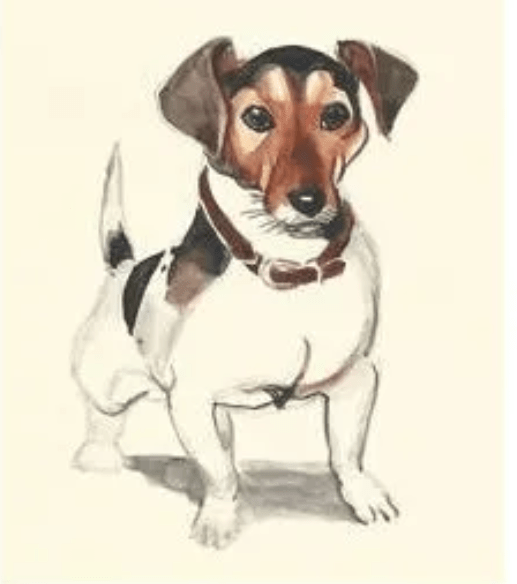
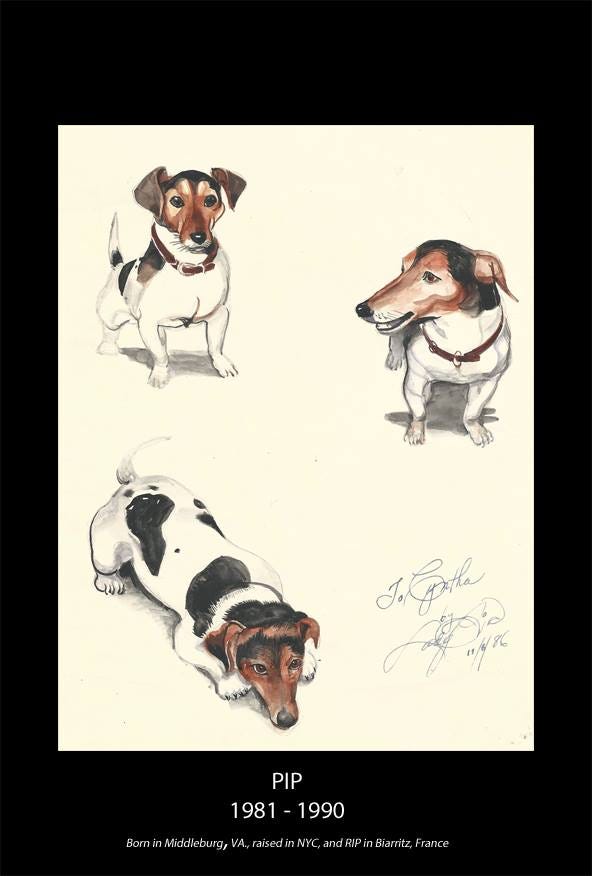
My sister Cynthia Dillon just discovered this beautiful painting of her ubiquitous dog, Pip, made by Lady Bird Strickland!

Pip was a great dog… He made it into the New York Times, the East Hampton Star, Channel 5, the Tiffany catalog, the Long Island Railroad, etc. I once almost gave the poor thing mouth-to-mouth CPR because he choked on a lamb’s rib (that he had stolen…). My second son, at 9 months, bit his ear. Pip, as gentlemanly as he could be, hit back…the forehead…, but it was a tender bite, just reminding the toddler that he had gone too far. Pip died a romantic poet’s death in what I thought were the north of Spain’s ocean cliffs, but, in truth, was Biarritz, France.

What I soon would discover is that there was a previous Pip, who shared my sister’s Pip’s indomitable courage and incredible personality:

January 22nd, 1879 was the “day of the dead moon”, an eclipse of the sun, on which Zulus were not meant to fight; that was why they had crouched in the ravine and waited. And when the young warriors disemboweled every British body, this was not gratuitous mutilation: they were helping the spirit to escape.

The Battle of Isandlwana at South Africa’s Rorke’s Drift celebrated its 145 years. David Rattray, storyteller par excellence, used to narrate the poignant events of the famous battle mesmerizing foreign tourists and South Africans alike.

I was one of those foreign tourists who was captivated by David’s enthralling description of a far-away-long-ago tale of war.

David made us all walk the trail of impending sorrow and harrowing horror on a sunny and hot and beautiful day. It was at his lodge, Fugitive’s Drift, that I learnt to add a shot of sherry to all sorts of soups that transformed them from tasty to exquisite. It was at his lodge that we found out our eldest son had been accepted by 2 of his colleges of choice, and David took out a silver goblet that British royalty (including Prince Charles) had used to drink lovely South African wine, and made my son drink from it in celebration of such good news.

It was listening to David’s description of the battle that I learnt about a little Jack Russell Terrier, Pip, that walked back and forth on the wall alerting the few trapped British soldiers of the Zulus hiding in the night.

We were so taken by the experience, that we listened to The Day of the Dead Moon narration on cassettes all the way back to Pretoria.

A few years later, after we had left South Africa, we found out David Rattray had battled a throat condition that threatened his story telling. But nothing could silence him…except the shot from a member of his most beloved people, the Zulus. I will forever be grateful to my South African friend for having introduced me to an incredible legend.

(Updated. Originally published in 2014.)

A Little Lie is Like a Little Pregnancy…

One of the things I used to try to inculcate in my children was the importance of never lying, because once one is categorized as a liar, the link of trust is broken, and it really can’t be repaired. The worst thing that can happen to a person is to be seen as a liar, because their word will be forever doubted, even when they speak the truth (Peter and the Wolf comes to mind).

Lately, I keep returning to a conundrum of my making, and this is how my mind works: why would I lie, not to protect myself or hide my shame, but rather, to protect someone else’s misdeed, when I know full well that there is misconduct involved? There’s the rub that led me to a vortex of etymological discovery and legal peregrination.

The Greek word “diaballein” means “to slander, attack, cast apart”. “Dia” meaning “across, through” and “ballein” meaning “to throw”. It literally means “to throw across, to scatter” (e.g., families get scattered, communities get divided). It is the source of another Greek word “diavolos” , which is the provenance of the term we all know, “the devil”.

Now this led me to discover the origin of that other name for devil, “ho sataunus”, which is also Greek and based on the Hebrew word that means “The Accuser”, and is the origin of the name Satan.

A philosopher I read somewhere even stated that in today’s world, The Accuser’s role could be seen as that of a Prosecuting Attorney, whose job is to blame and blame the accused: he/she did it! (Poor lawyers, they never get a break!).

We mere mortals engage in accusations all the time when we gossip, point the finger, play the shame and blame game, and/or destroy someone’s character. How many times are we oblivious to carelessly wounding others by saying or implying an untruth that may wreck their family life, their reputation and character, all done through a lie?

At the end of the day, the Bible calls the devil the father of lies… and for good reason.

I leave it to better writers than me to share my conclusions through their thoughts on lies and lying:

A liar will not be believed, even when he speaks the truth. (Aesop)

No man has a good enough memory to be a successful liar. (Abraham Lincoln)

You can always lie to others and hide your actions from them… but you can not fool yourself.    (Also A. Lincoln).

A little lie is like a little pregnancy; it doesn’t take long before everyone knows. (C.S. Lewis)

A truth can walk naked…but a lie always needs to be dressed. (Khalil Gibran)

Lastly, Fyodor Dostoevsky has a brutal passage in the Brothers Karamazov on lying.

By the way, daffodils symbolize honesty and truth. I like daffodils!

Beauty among the Ruins

No photo description available.

I have a broken ruby red crystal little pitcher that used to belong to my parents. It was the smallest one of a set of three. When I was a little girl, I used to love staring at the three that represented Father, Mother and me (my younger sister Cynthia was missing, since they were just a trio!). One day, I must have been 5 years old, I climbed on a chair and tried to grab one, and it fell and broke into smithereens. So then there were two.

Fast forward to when I was in my early 20s. I moved to Philadelphia, and my Mother gave me the littlest pitcher to take to my new home, because she knew of my sentimental attachment to that little jug.

Life happened, and I carried that little pitcher wherever I went, until one day someone dropped it and it shattered in 4 pieces or so. I was heartbroken. I identified with that little broken crystal flask. It carried so many memories of where I had been and where I was. For some reason, I saved the crystal shards in a box. I couldn’t bear to throw them out.

One day, about three years ago, I came across the Japanese art of “kintsugi”, a technique using gold and lacquer that enhances the flaws of the damaged object and, as the Smithsonian Institute says, “not only accepts but highlights the life of the object.”

It dawned on me that I could learn to restore the broken little pitcher. Somewhere at home I have the gold and the lacquer that I bought to do it. I hope to spend some time mending this memento that represents so many significant stages in my life. It will be one of my most cherished possessions and emblematic of what it was and what it will become: a most beautifully rebuilt little pitcher and stronger than it ever was.

Come to think of it, isn’t “kintsugi” a metaphor for life?

Of Trees and Destruction

May be an image of tree

Well, this poor birch bark dropped down and lies asunder, despite having been joined together to the tree, Robert Frost. I think the weight of life was just a bit too much to bear.

....Earth’s the right place for love:
I don’t know where it's likely to go better.
I'd like to go by climbing a birch tree,
And climb black branches up a snow-white trunk
Toward heaven, till the tree could bear no more,
But dipped its top and set me down again.
That would be good both going and coming back.
One could do worse than be a swinger of birches.

Or, maybe, it suffered from the suppressed anger that not only leads to the destruction of one, but to the moral corruption of the other.

A POISON TREE
By William Blake

I was angry with my friend;
I told my wrath, my wrath did end.
I was angry with my foe:
I told it not, my wrath did grow.
And I waterd it in fears,
Night & morning with my tears:
And I sunned it with smiles,
And with soft deceitful wiles.
And it grew both day and night.
Till it bore an apple bright.
And my foe beheld it shine,
And he knew that it was mine.
And into my garden stole,
When the night had veild the pole;
In the morning glad I see;
My foe outstretched beneath the tree.

The Quarreling Squirrel

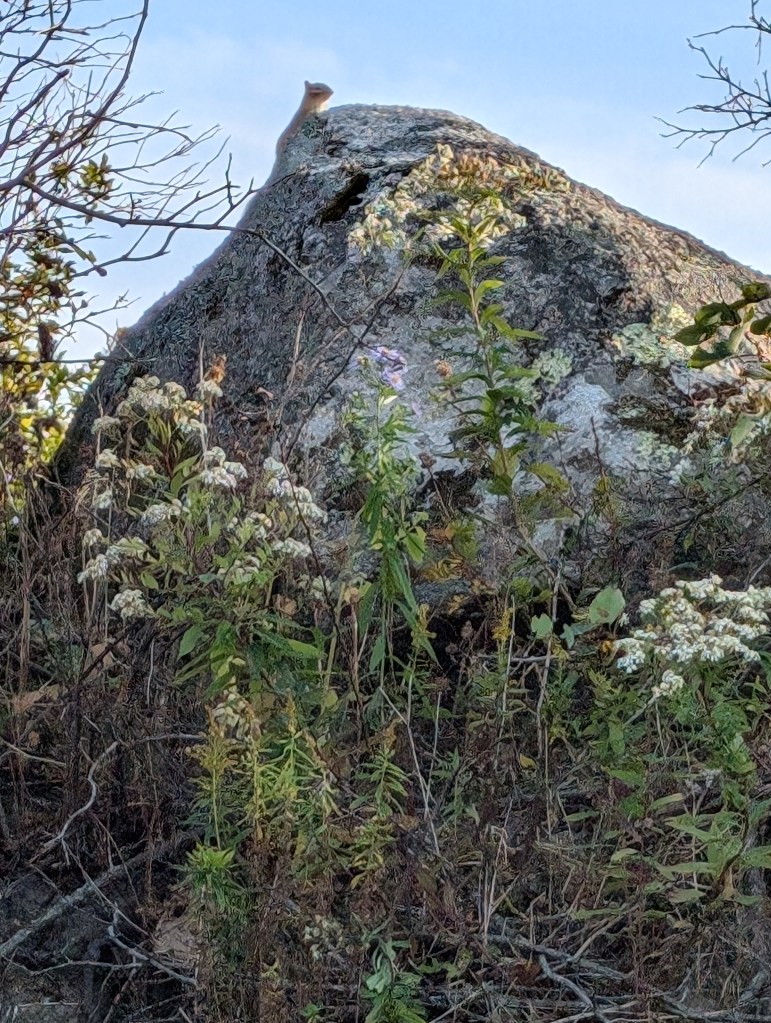
She stood almost at the peak of the glacial erratic. She never budged, despite my getting near. The foxes abound, the seagulls hovered around, and yet she was not scared.

There are acorns everywhere, and the chipmunks and the squirrels are busily burying them in a hurry. Diligent and peculiar little things! She gave me food for thought. I also had stepped up on a rock, looking at the horizon, deep in introspection until I heard the squeaky chirp. It turns out that the sounds squirrels make are identified as kuks, quaas, moans, twitches and flags. What a collection of names! Hunters can buy squirrel callers to lure them. Apparently, the squirrels are considered a nuisance everywhere since they chew on aluminum siding.

FABLE
By Ralph Waldo Emerson

The mountain and the squirrel
Had a quarrel;
And the former called the latter ‘Little Prig.’
Bun replied,
‘You are doubtless very big;
But all sorts of things and weather
Must be taken in together,
To make up a year
And a sphere.
And I think it no disgrace
To occupy my place.
If I'm not so large as you,
You are not so small as I,
And not half so spry.
I'll not deny you make
A very pretty squirrel track;
Talents differ; all is well and wisely put;
If I cannot carry forests on my back,
Neither can you crack a nut.’

I don’t know. She is too cute, even though she may be the very squirrel that dragged about 3 meters of toilet paper from my bathroom, and shredded it in places, I guess to start making its nest for the winter. I’d rather think of her as the one that quarrelled with the mountain.